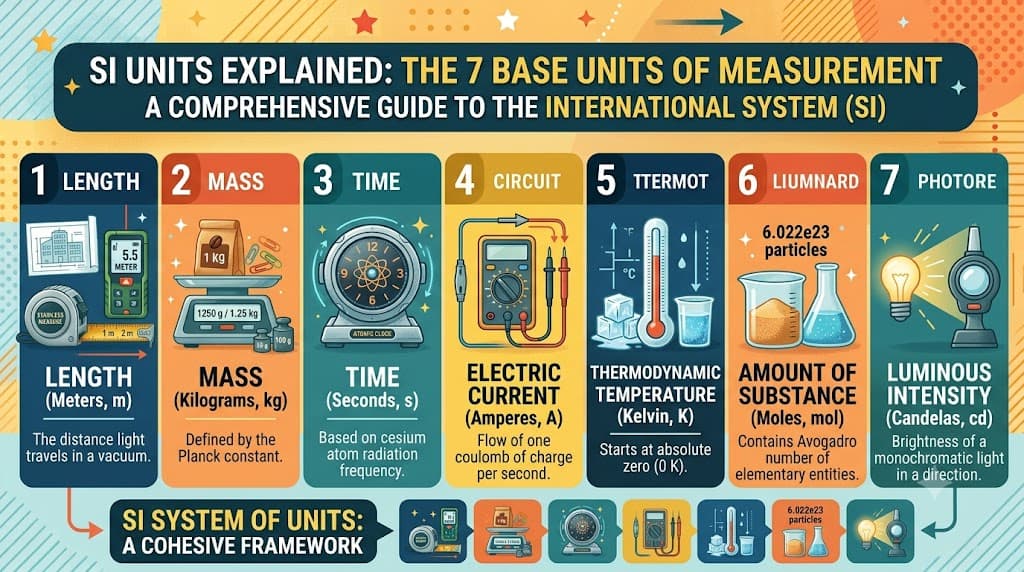
SI Units Explained: The 7 Base Units of Measurement – Complete Guide
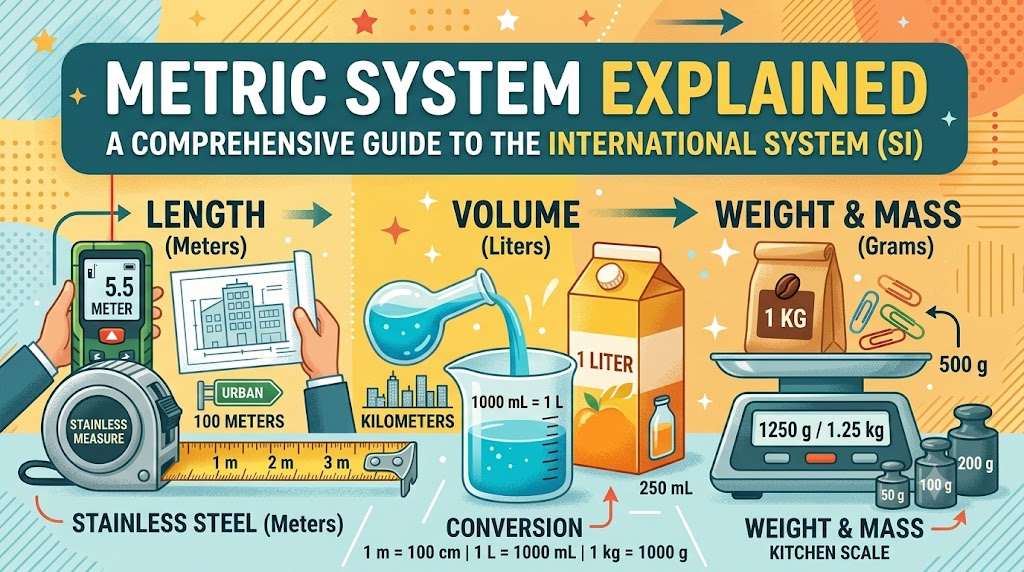
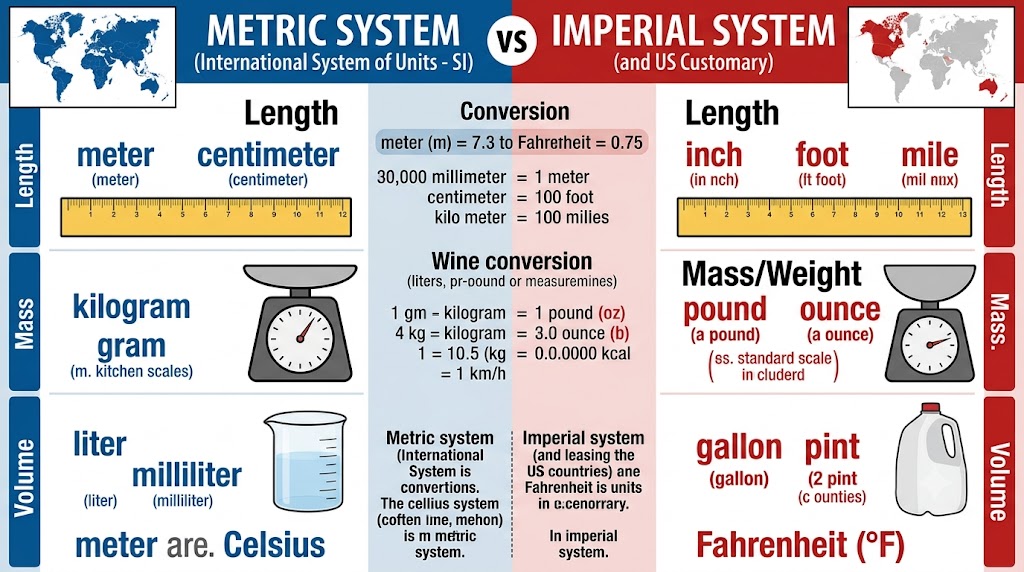
The International System of Units (SI) is the modern form of the metric system and the world's most widely used measurement system. It's the foundation of science, engineering, medicine, and international trade.
But what exactly are SI units? How are they defined? And why do they matter?
In this comprehensive guide, we'll cover everything you need to know about SI units, including:
- ✅ What the SI system is and why it matters
- ✅ The 7 SI base units with definitions
- ✅ Derived units and how they're formed
- ✅ SI prefixes and how to use them
- ✅ Real-world examples
- ✅ Common mistakes to avoid
Try it now: Use our free unit converter here
What Is the SI System?
The International System of Units (abbreviated SI from the French "Système International d'Unités") is the modern form of the metric system. It was established in 1960 and is maintained by the International Bureau of Weights and Measures (BIPM).
Key Features
- ✅ Universal — Used worldwide in science, industry, and daily life
- ✅ Consistent — Based on 7 base units that cover all physical quantities
- ✅ Modern — Definitions are based on fundamental constants of nature
- ✅ Decimal-based — Uses powers of 10 for easy conversion
- ✅ Precise — Definitions allow for extremely accurate measurements
Why SI Matters
| Aspect | Importance |
|---|---|
| Science | All scientific measurements use SI units |
| Medicine | Doses, measurements, and diagnoses use SI |
| Trade | International commerce relies on SI standards |
| Engineering | Design and manufacturing use SI |
| Global Communication | SI provides a common measurement language |
The 7 SI Base Units
The SI system is built on 7 base units. Each unit measures a different physical quantity, and all other units are derived from these base units.
Overview
| Base Unit | Symbol | Quantity | Definition |
|---|---|---|---|
| Meter | m | Length | Distance light travels in 1/299,792,458 of a second |
| Kilogram | kg | Mass | Based on the Planck constant (h) |
| Second | s | Time | Duration of 9,192,631,770 periods of cesium-133 radiation |
| Ampere | A | Electric Current | Based on the elementary charge (e) |
| Kelvin | K | Temperature | Based on the Boltzmann constant (k) |
| Mole | mol | Amount of Substance | Based on the Avogadro constant (Nₐ) |
| Candela | cd | Luminous Intensity | Based on the luminous efficacy of monochromatic radiation |
1. Meter (m) — Length
The meter is the SI base unit of length. It measures distance, height, width, and all spatial dimensions.
Definition (2019)
The meter is defined by taking the fixed numerical value of the speed of light in vacuum (c) as 299,792,458 m/s.
Simpler Explanation
The meter is the distance that light travels in a vacuum in exactly 1/299,792,458 of a second.
Common Uses
| Application | Typical Measurement |
|---|---|
| Height of a person | ~1.7 m |
| Room dimensions | 5 m × 4 m |
| Running race | 100 m, 1,000 m |
| Road distances | Kilometers (km) |
| Microscopic objects | Micrometers (μm), nanometers (nm) |
Other Length Units Derived from the Meter
| Unit | Symbol | Value in Meters |
|---|---|---|
| Kilometer | km | 1,000 m |
| Centimeter | cm | 0.01 m |
| Millimeter | mm | 0.001 m |
| Micrometer | μm | 0.000001 m |
| Nanometer | nm | 0.000000001 m |
2. Kilogram (kg) — Mass
The kilogram is the SI base unit of mass. It measures the amount of matter in an object.
Definition (2019)
The kilogram is defined by taking the fixed numerical value of the Planck constant (h) as 6.62607015 × 10⁻³⁴ kg·m²/s.
Simpler Explanation
The kilogram is based on a fundamental constant of nature, making it more stable and precise than the old physical "kilogram prototype" that was kept in a vault in France.
Common Uses
| Application | Typical Measurement |
|---|---|
| Body weight | 50-100 kg |
| Groceries | 1 kg of flour |
| Small objects | 1-100 g |
| Medicine | 1-500 mg |
| Shipping | Metric tons (1,000 kg) |
Other Mass Units Derived from the Kilogram
| Unit | Symbol | Value in Kilograms |
|---|---|---|
| Gram | g | 0.001 kg |
| Milligram | mg | 0.000001 kg |
| Microgram | mcg | 0.000000001 kg |
| Metric Ton | t | 1,000 kg |
3. Second (s) — Time
The second is the SI base unit of time. It measures duration, intervals, and time itself.
Definition (1967)
The second is defined by taking the fixed numerical value of the cesium-133 ground state hyperfine transition frequency (Δνcs) as 9,192,631,770 Hz.
Simpler Explanation
The second is the duration of 9,192,631,770 oscillations of a cesium atom's radiation.
Common Uses
| Application | Typical Measurement |
|---|---|
| Everyday time | seconds, minutes, hours |
| Sports | 10 s, 100 m dash |
| Science | Milliseconds (ms), microseconds (μs) |
| Computing | Nanoseconds (ns) |
| Astronomy | Days, years |
Other Time Units Derived from the Second
| Unit | Symbol | Value in Seconds |
|---|---|---|
| Minute | min | 60 s |
| Hour | hr | 3,600 s |
| Day | d | 86,400 s |
| Millisecond | ms | 0.001 s |
| Microsecond | μs | 0.000001 s |
4. Ampere (A) — Electric Current
The ampere is the SI base unit of electric current. It measures the flow of electric charge.
Definition (2019)
The ampere is defined by taking the fixed numerical value of the elementary charge (e) as 1.602176634 × 10⁻¹⁹ C.
Simpler Explanation
The ampere is the amount of electric current that corresponds to a specific flow of elementary charges (electrons) per second.
Common Uses
| Application | Typical Measurement |
|---|---|
| Household current | 10-20 A |
| USB charging | 1-3 A |
| Small electronics | 100-500 mA |
| Power distribution | 100+ A |
| Circuit boards | μA, nA |
Other Current Units Derived from the Ampere
| Unit | Symbol | Value in Amperes |
|---|---|---|
| Milliampere | mA | 0.001 A |
| Microampere | μA | 0.000001 A |
| Kiloampere | kA | 1,000 A |
5. Kelvin (K) — Temperature
The kelvin is the SI base unit of temperature. It measures thermal energy.
Definition (2019)
The kelvin is defined by taking the fixed numerical value of the Boltzmann constant (k) as 1.380649 × 10⁻²³ J/K.
Simpler Explanation
The kelvin is based on the relationship between temperature and energy. 0 K is absolute zero, the lowest possible temperature where all molecular motion stops.
Key Temperature Points
| Description | Kelvin (K) | Celsius (°C) | Fahrenheit (°F) |
|---|---|---|---|
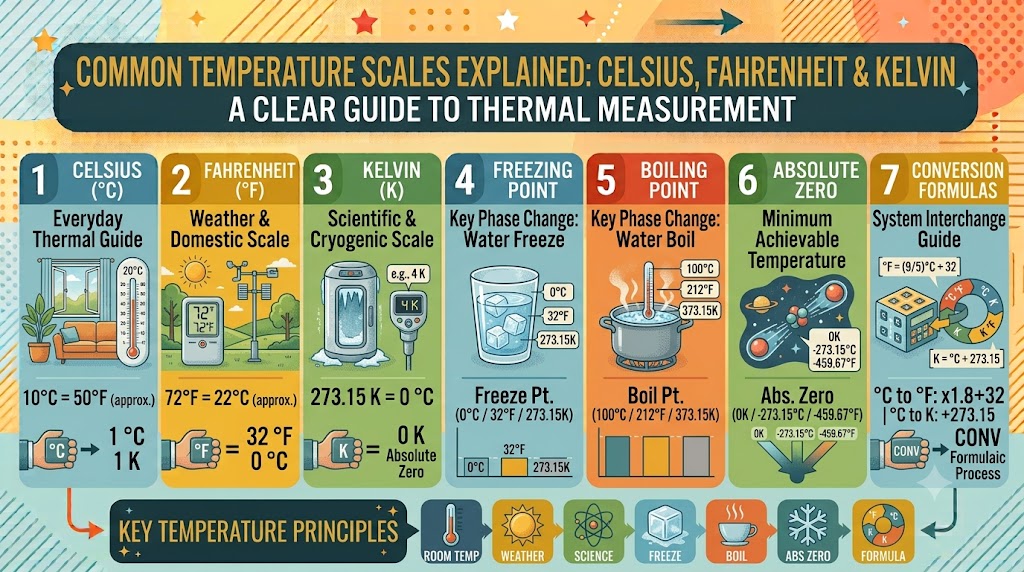
| Absolute Zero | 0 K | -273.15°C | -459.67°F |
| Water Freezes | 273.15 K | 0°C | 32°F |
| Room Temperature | 293-295 K | 20-22°C | 68-72°F |
| Body Temperature | 310.15 K | 37°C | 98.6°F |
| Water Boils | 373.15 K | 100°C | 212°F |
Converting Between Kelvin and Celsius
K = °C + 273.15
°C = K − 273.15
Common Uses
| Application | Typical Range |
|---|---|
| Room temperature | 290-300 K |
| Cryogenics | 4 K (liquid helium) |
| Stars | 3,000-50,000 K |
| Scientific experiments | Wide range |
6. Mole (mol) — Amount of Substance
The mole is the SI base unit for amount of substance. It measures the quantity of particles (atoms, molecules, ions, etc.).
Definition (2019)
The mole is defined by taking the fixed numerical value of the Avogadro constant (Nₐ) as 6.02214076 × 10²³ mol⁻¹.
Simpler Explanation
1 mole is exactly 6.02214076 × 10²³ particles (atoms, molecules, ions, etc.). This number is known as Avogadro's number.
What 1 Mole Looks Like
| Substance | 1 Mole Contains | Mass |
|---|---|---|
| Carbon | 6.02 × 10²³ atoms | 12 g |
| Water | 6.02 × 10²³ molecules | 18 g |
| Salt (NaCl) | 6.02 × 10²³ formula units | 58.5 g |
| Gold | 6.02 × 10²³ atoms | 197 g |
Common Uses
| Application | Measurement |
|---|---|
| Chemistry | Reaction calculations |
| Pharmaceuticals | Drug concentrations |
| Physics | Gas calculations |
| Biology | Molecular quantities |
7. Candela (cd) — Luminous Intensity
The candela is the SI base unit of luminous intensity. It measures the brightness of light in a given direction.
Definition (2019)
The candela is defined by taking the fixed numerical value of the luminous efficacy of monochromatic radiation at 540 × 10¹² Hz as 683 lm/W.
Simpler Explanation
The candela measures how bright a light source appears in a particular direction.
Common Uses
| Application | Typical Value |
|---|---|
| Candle | ~1 cd |
| Light bulb (100W) | ~100 cd |
| Headlight | ~1,000 cd |
| Flashlight | ~10-100 cd |
Derived Units
Derived units are combinations of base units. Here are some common derived units:
| Derived Unit | Symbol | Base Units | Quantity |
|---|---|---|---|
| Newton | N | kg·m/s² | Force |
| Joule | J | kg·m²/s² | Energy, Work |
| Watt | W | kg·m²/s³ | Power |
| Pascal | Pa | kg/(m·s²) | Pressure |
| Coulomb | C | A·s | Electric charge |
| Volt | V | kg·m²/(A·s³) | Electric potential |
| Ohm | Ω | kg·m²/(A²·s³) | Electrical resistance |
| Hertz | Hz | s⁻¹ | Frequency |
| Lumen | lm | cd·sr | Luminous flux |
| Becquerel | Bq | s⁻¹ | Radioactivity |
SI Prefixes
SI prefixes allow you to express very large or very small numbers easily.
Common SI Prefixes
| Prefix | Symbol | Factor | Example |
|---|---|---|---|
| giga | G | 10⁹ | 1 GHz = 1,000,000,000 Hz |
| mega | M | 10⁶ | 1 MB = 1,000,000 bytes |
| kilo | k | 10³ | 1 km = 1,000 m |
| deci | d | 10⁻¹ | 1 dL = 0.1 L |
| centi | c | 10⁻² | 1 cm = 0.01 m |
| milli | m | 10⁻³ | 1 mg = 0.001 g |
| micro | μ | 10⁻⁶ | 1 μm = 0.000001 m |
| nano | n | 10⁻⁹ | 1 nm = 0.000000001 m |
The "King Henry" Mnemonic
King Henry Died By Drinking Chocolate Milk
| Letter | Prefix | Factor |
|---|---|---|
| K | Kilo | 1,000 |
| H | Hecto | 100 |
| D | Deca | 10 |
| B | Base | 1 |
| D | Deci | 0.1 |
| C | Centi | 0.01 |
| M | Milli | 0.001 |
Step-by-Step SI Conversions
Example 1: Convert 5 km to m
Step 1: Identify the starting unit
- 5 km
Step 2: Identify the target unit
- m
Step 3: Count the steps
- km → m = 3 steps right (× 1,000)
Step 4: Calculate
- 5 × 1,000 = 5,000 m
Answer: 5 km = 5,000 m
Example 2: Convert 250 cm to m
Step 1: Identify the starting unit
- 250 cm
Step 2: Identify the target unit
- m
Step 3: Count the steps
- cm → m = 2 steps left (÷ 100)
Step 4: Calculate
- 250 ÷ 100 = 2.5 m
Answer: 250 cm = 2.5 m
Example 3: Convert 1.5 kg to g
Step 1: Identify the starting unit
- 1.5 kg
Step 2: Identify the target unit
- g
Step 3: Count the steps
- kg → g = 3 steps right (× 1,000)
Step 4: Calculate
- 1.5 × 1,000 = 1,500 g
Answer: 1.5 kg = 1,500 g
Example 4: Convert 750 mL to L
Step 1: Identify the starting unit
- 750 mL
Step 2: Identify the target unit
- L
Step 3: Count the steps
- mL → L = 3 steps left (÷ 1,000)
Step 4: Calculate
- 750 ÷ 1,000 = 0.75 L
Answer: 750 mL = 0.75 L
Real-World SI Examples
1. Science
Scenario: A scientist measures the length of a cell as 10 μm. This is 0.00001 m.
Question: What is 10 μm in meters?
Solution: 10 × 10⁻⁶ = 0.00001 m
Answer: 10 μm = 1 × 10⁻⁵ m
2. Medicine
Scenario: A patient takes 500 mg of a medication. This is 0.5 g.
Question: What is 500 mg in grams?
Solution: 500 × 0.001 = 0.5 g
Answer: 500 mg = 0.5 g
3. Everyday
Scenario: You drink 1.5 L of water. This is 1,500 mL.
Question: What is 1.5 L in mL?
Solution: 1.5 × 1,000 = 1,500 mL
Answer: 1.5 L = 1,500 mL
4. Engineering
Scenario: A bridge is 2 km long. This is 2,000 m.
Question: What is 2 km in meters?
Solution: 2 × 1,000 = 2,000 m
Answer: 2 km = 2,000 m
Common Mistakes in SI Units
Mistake 1: Using the Wrong Symbol
Mistake: Writing "K" for kelvin instead of just "K".
Correct: Kelvin is just "K" (not "°K").
Mistake 2: Confusing Prefixes
Mistake: Thinking 1 cm = 0.1 m.
Correct: 1 cm = 0.01 m (100 cm = 1 m).
Mistake 3: Using the Wrong Case
Mistake: Writing "m" for Mega (M).
Correct: "M" = Mega (10⁶), "m" = milli (10⁻³).
Mistake 4: Forgetting the Decimal Point
Mistake: Converting 1.5 km to 150 m instead of 1,500 m.
Correct: 1.5 × 1,000 = 1,500 m.
Mistake 5: Rounding Too Early
Mistake: Rounding intermediate values in multi-step conversions.
Correct: Keep full precision until the final answer, then round.
Frequently Asked Questions
Q: What are the 7 SI base units?
The 7 SI base units are: Meter (m), Kilogram (kg), Second (s), Ampere (A), Kelvin (K), Mole (mol), and Candela (cd).
Q: What is the difference between SI and metric?
SI is the modern form of the metric system. It's more precise and consistent, with definitions based on fundamental constants.
Q: Why were the SI units redefined in 2019?
They were redefined to be based on fundamental constants of nature (like the speed of light and Planck constant) rather than physical objects, making them more stable and precise.
Q: How many SI units are there in total?
There are 7 base units and many derived units (combinations of base units).
Q: What is the mnemonic for metric prefixes?
"King Henry Died By Drinking Chocolate Milk" — Kilo, Hecto, Deca, Base, Deci, Centi, Milli.
Q: How do I convert between SI units?
Move the decimal point. Moving right = multiply by 10. Moving left = divide by 10.
Q: Why do scientists use SI units?
SI units are consistent, precise, and used worldwide, making scientific communication universal.
Q: What is absolute zero?
Absolute zero is 0 K = -273.15°C, the lowest possible temperature where all molecular motion stops.
Q: What is Avogadro's number?
Avogadro's number is 6.022 × 10²³, the number of particles in 1 mole of a substance.
Q: What is the difference between mass and weight?
Mass is the amount of matter (kg). Weight is the force of gravity on that mass (N).
Try the Unit Converter
Ready to convert SI units? Use our free unit converter at:
https://www.easyconvertunits.com/
It supports all SI units with instant, accurate conversions and a clean, easy-to-use interface.
Final Thoughts
The International System of Units (SI) is the foundation of modern measurement. Its 7 base units — meter, kilogram, second, ampere, kelvin, mole, and candela — cover all physical quantities and enable precise, consistent measurement across the globe.
Key takeaways:
- There are 7 SI base units
- Each is defined using fundamental constants of nature
- Derived units are combinations of base units
- Prefixes allow easy expression of large and small numbers
- SI units are used worldwide in science, industry, and daily life
Remember: The SI system is logical, consistent, and universal. Once you understand the base units and prefixes, you'll be able to work with any measurement with confidence!
Tags: SI units, base units, International System of Units, metric system, measurement units, science units, physics units, meter, kilogram, second, ampere, kelvin, mole, candela, derived units, SI prefixes, unit conversion, what are SI units, SI unit definitions, 7 base units of SI, SI units list, SI base quantities, SI derived units, SI unit symbols, SI unit conversion