Temperature Conversion Guide: Celsius, Fahrenheit, Kelvin – Complete Reference
Temperature is one of the most commonly measured physical quantities. Whether you're checking the weather, cooking a meal, monitoring your health, or working on a science experiment, understanding temperature and how to convert between different scales is essential.
This comprehensive guide covers everything you need to know about temperature conversions, featuring all 3 temperature units available in the EasyConvertUnits tool: Celsius (°C), Fahrenheit (°F), and Kelvin (K).
Try it now: Use our free temperature converter here
What Is Temperature?
Temperature is a measure of the average kinetic energy of particles in a substance. In simpler terms, it indicates how hot or cold something is.
Temperature is one of the seven base quantities in the International System of Units (SI). The standard unit of temperature in SI is the Kelvin (K).
Temperature measurements are used in:
- Weather forecasting and climate science
- Cooking and food safety
- Medicine and healthcare
- Science and engineering
- Industrial processes
- Everyday life
The Three Temperature Scales
Based on the EasyConvertUnits data structure, here are all 3 supported temperature units:
| Unit | Symbol | Scale Type | Common Use |
|---|---|---|---|
| Celsius | °C | Metric | Everyday use worldwide, science |
| Fahrenheit | °F | Imperial | Weather, cooking (USA) |
| Kelvin | K | SI Base | Science, physics, engineering |
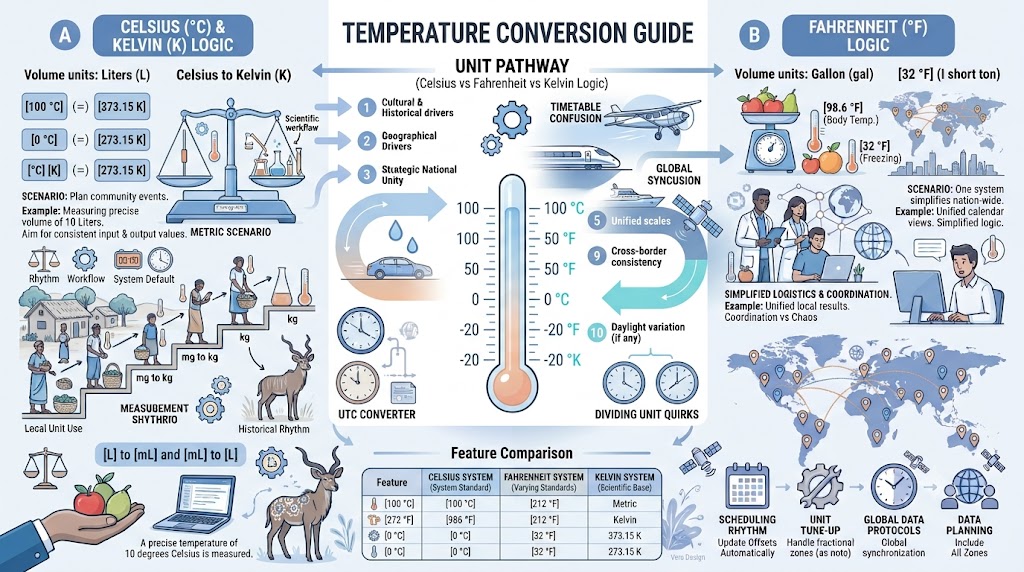
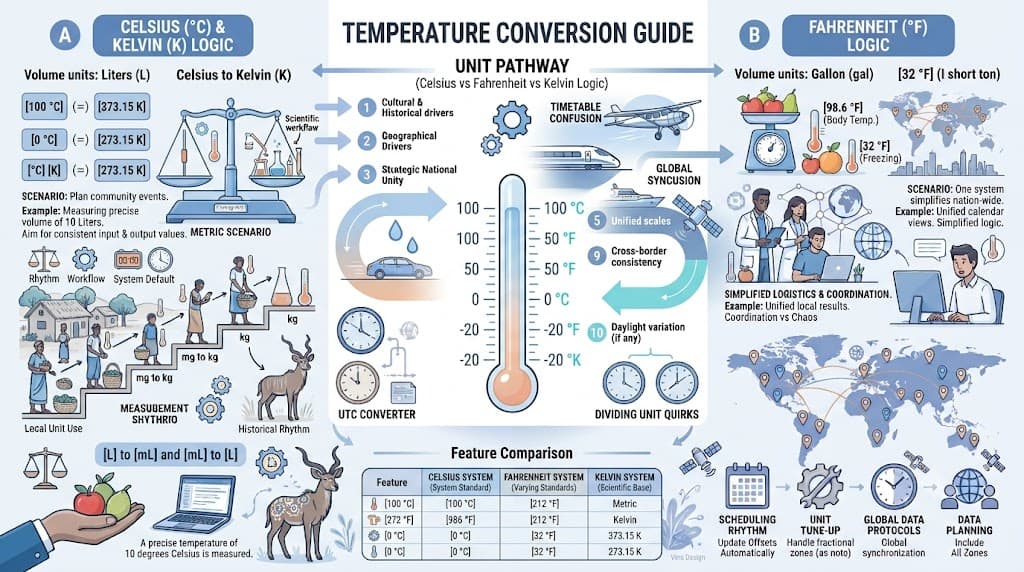
Temperature Scale Comparison
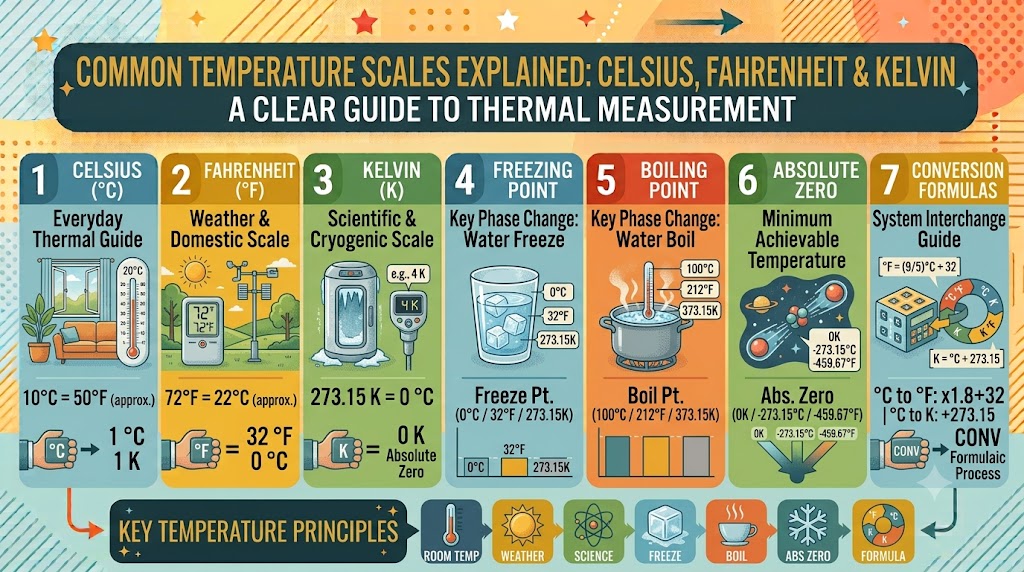
Key Reference Points
| Reference Point | Celsius (°C) | Fahrenheit (°F) | Kelvin (K) |
|---|---|---|---|
| Absolute Zero | -273.15°C | -459.67°F | 0 K |
| Water Freezes | 0°C | 32°F | 273.15 K |
| Room Temperature | 20-22°C | 68-72°F | 293-295 K |
| Body Temperature | 37°C | 98.6°F | 310.15 K |
| Water Boils | 100°C | 212°F | 373.15 K |
Visual Scale Comparison
┌─────────────────────────────────────────────────────────────────────────┐
│                         TEMPERATURE SCALE COMPARISON                   │
├─────────────────────────────────────────────────────────────────────────┤
│                                                                         │
│   °C    -273   -200   -100    0     50    100    200    300    400    │
│          │      │      │      │      │      │      │      │      │     │
│   °F    -459   -328   -148   32    122    212    392    572    752    │
│          │      │      │      │      │      │      │      │      │     │
│    K      0     73    173   273   323    373    473    573    673     │
│          │      │      │      │      │      │      │      │      │     │
│          ▲      ▲      ▲      ▲      ▲      ▲      ▲      ▲      ▲     │
│       Absolute  │      │   Water   Body   Water   │      │      │     │
│         Zero    │      │   Freeze  Temp   Boil    │      │      │     │
│                 │      │           (37°C)         │      │      │     │
│                 │      │                           │      │      │     │
└─────────────────────────────────────────────────────────────────────────┘
Temperature Conversion Formulas
Celsius ↔ Fahrenheit
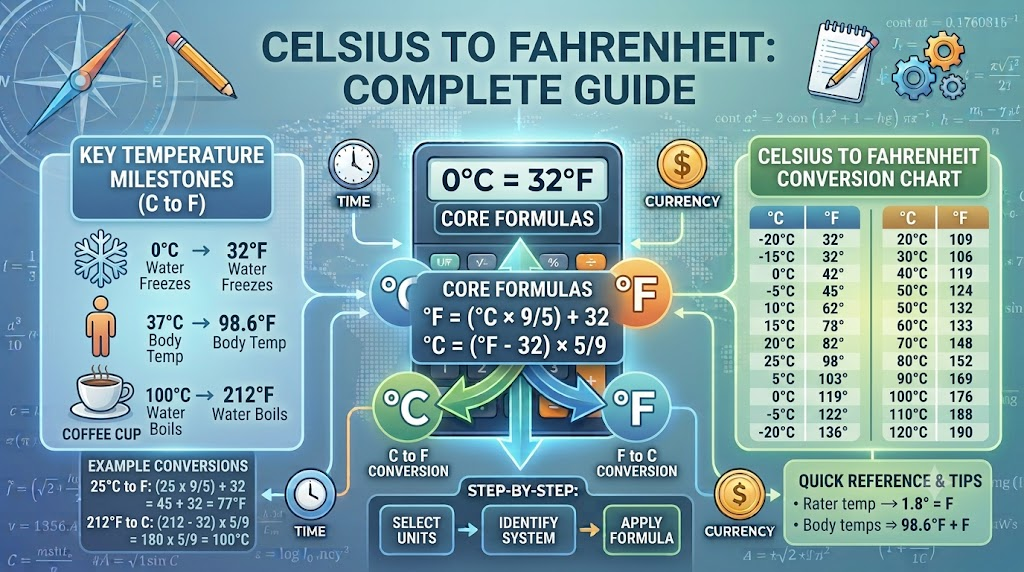
Celsius to Fahrenheit:
°F = (°C × 9/5) + 32
Fahrenheit to Celsius:
°C = (°F − 32) × 5/9
Celsius ↔ Kelvin
Celsius to Kelvin:
K = °C + 273.15
Kelvin to Celsius:
°C = K − 273.15
Fahrenheit ↔ Kelvin
Fahrenheit to Kelvin:
K = (°F − 32) × 5/9 + 273.15
Kelvin to Fahrenheit:
°F = (K − 273.15) × 9/5 + 32
Comprehensive Conversion Table
| From | To | Formula | Example |
|---|---|---|---|
| Celsius to Fahrenheit | °F = (°C × 9/5) + 32 | 25°C = 77°F | |
| Fahrenheit to Celsius | °C = (°F − 32) × 5/9 | 77°F = 25°C | |
| Celsius to Kelvin | K = °C + 273.15 | 25°C = 298.15 K | |
| Kelvin to Celsius | °C = K − 273.15 | 298.15 K = 25°C | |
| Fahrenheit to Kelvin | K = (°F − 32) × 5/9 + 273.15 | 77°F = 298.15 K | |
| Kelvin to Fahrenheit | °F = (K − 273.15) × 9/5 + 32 | 298.15 K = 77°F |
Understanding Each Temperature Scale
Celsius (°C)
The Celsius scale is used by most countries worldwide for everyday temperature measurements.
Key Characteristics:
- Water freezes at 0°C
- Water boils at 100°C
- Based on the properties of water
- Used in science, medicine, and daily life
Also Called: Centigrade (historical)
Common Uses:
- Weather forecasts (outside USA)
- Cooking (outside USA)
- Science and medicine
- Body temperature measurement
Fahrenheit (°F)
The Fahrenheit scale is primarily used in the United States for everyday temperature measurements.
Key Characteristics:
- Water freezes at 32°F
- Water boils at 212°F
- Based on human body temperature (96°F originally)
- More granular than Celsius (180°F between freezing and boiling vs. 100°C)
Common Uses:
- Weather forecasts (USA)
- Cooking (USA)
- Body temperature (USA)
- Everyday temperature discussions
Kelvin (K)
The Kelvin scale is the SI base unit for temperature, used primarily in science and engineering.
Key Characteristics:
- Water freezes at 273.15 K
- Water boils at 373.15 K
- Absolute zero at 0 K (lowest possible temperature)
- No degree symbol used (just "K")
- Same interval as Celsius (1 K = 1°C)
Common Uses:
- Physics and chemistry
- Engineering
- Astronomy and space science
- Cryogenics
- Thermodynamics
Step-by-Step Conversion Examples
Example 1: Celsius to Fahrenheit
Problem: Convert 25°C to Fahrenheit.
Step 1: Use the formula
°F = (°C × 9/5) + 32
Step 2: Substitute
°F = (25 × 9/5) + 32
Step 3: Calculate
°F = (25 × 1.8) + 32
°F = 45 + 32
°F = 77°F
Answer: 25°C = 77°F
Example 2: Fahrenheit to Celsius
Problem: Convert 98.6°F to Celsius.
Step 1: Use the formula
°C = (°F − 32) × 5/9
Step 2: Substitute
°C = (98.6 − 32) × 5/9
Step 3: Calculate
°C = 66.6 × 5/9
°C = 333/9
°C = 37°C
Answer: 98.6°F = 37°C
Example 3: Celsius to Kelvin
Problem: Convert 25°C to Kelvin.
Step 1: Use the formula
K = °C + 273.15
Step 2: Substitute
K = 25 + 273.15
Step 3: Calculate
K = 298.15 K
Answer: 25°C = 298.15 K
Example 4: Kelvin to Celsius
Problem: Convert 300 K to Celsius.
Step 1: Use the formula
°C = K − 273.15
Step 2: Substitute
°C = 300 − 273.15
Step 3: Calculate
°C = 26.85°C
Answer: 300 K = 26.85°C
Example 5: Fahrenheit to Kelvin
Problem: Convert 77°F to Kelvin.
Step 1: Use the formula
K = (°F − 32) × 5/9 + 273.15
Step 2: Substitute
K = (77 − 32) × 5/9 + 273.15
Step 3: Calculate
K = 45 × 5/9 + 273.15
K = 25 + 273.15
K = 298.15 K
Answer: 77°F = 298.15 K
Example 6: Kelvin to Fahrenheit
Problem: Convert 298.15 K to Fahrenheit.
Step 1: Use the formula
°F = (K − 273.15) × 9/5 + 32
Step 2: Substitute
°F = (298.15 − 273.15) × 9/5 + 32
Step 3: Calculate
°F = 25 × 9/5 + 32
°F = 45 + 32
°F = 77°F
Answer: 298.15 K = 77°F
Quick Reference Conversion Chart
Common Temperatures
| Description | Celsius (°C) | Fahrenheit (°F) | Kelvin (K) |
|---|---|---|---|
| Absolute Zero | -273.15°C | -459.67°F | 0 K |
| Liquid Nitrogen | -196°C | -321°F | 77 K |
| Dry Ice | -78.5°C | -109.3°F | 194.7 K |
| Very Cold Day | -20°C | -4°F | 253.15 K |
| Cold Day | -10°C | 14°F | 263.15 K |
| Freezing Point | 0°C | 32°F | 273.15 K |
| Chilly Day | 5°C | 41°F | 278.15 K |
| Cool Day | 10°C | 50°F | 283.15 K |
| Room Temperature | 21°C | 70°F | 294.15 K |
| Warm Day | 25°C | 77°F | 298.15 K |
| Hot Day | 30°C | 86°F | 303.15 K |
| Very Hot Day | 35°C | 95°F | 308.15 K |
| Body Temperature | 37°C | 98.6°F | 310.15 K |
| Extremely Hot | 40°C | 104°F | 313.15 K |
| Boiling Point | 100°C | 212°F | 373.15 K |
| Oven Temperature | 180°C | 356°F | 453.15 K |
Quick Estimation Tricks
Celsius to Fahrenheit (Mental Math)
Quick Method: Double it and add 30
| Exact | Quick Estimate |
|---|---|
| 0°C = 32°F | 0 × 2 + 30 = 30°F (close!) |
| 10°C = 50°F | 10 × 2 + 30 = 50°F (exact!) |
| 20°C = 68°F | 20 × 2 + 30 = 70°F (close) |
| 30°C = 86°F | 30 × 2 + 30 = 90°F (close) |
| 40°C = 104°F | 40 × 2 + 30 = 110°F (close) |
Note: This trick works best for temperatures between 0-40°C.
Fahrenheit to Celsius (Mental Math)
Quick Method: Subtract 30 and halve it
| Exact | Quick Estimate |
|---|---|
| 32°F = 0°C | (32 − 30) ÷ 2 = 1°C (close!) |
| 50°F = 10°C | (50 − 30) ÷ 2 = 10°C (exact!) |
| 68°F = 20°C | (68 − 30) ÷ 2 = 19°C (close) |
| 86°F = 30°C | (86 − 30) ÷ 2 = 28°C (close) |
| 104°F = 40°C | (104 − 30) ÷ 2 = 37°C (close) |
Memory Aids
Key Reference Points to Memorize:
- 0°C = 32°F (Water freezes)
- 10°C ≈ 50°F (Cool)
- 20°C ≈ 68°F (Room temperature)
- 30°C ≈ 86°F (Warm)
- 37°C = 98.6°F (Body temperature)
- 40°C = 104°F (Hot)
- 100°C = 212°F (Water boils)
Real-World Temperature Conversion Examples
1. Traveling from Europe to the USA
Scenario: You're visiting the USA from Europe. The weather forecast says it will be 75°F tomorrow.
Question: What is the temperature in Celsius?
Solution: °C = (75 − 32) × 5/9 = 43 × 5/9 = 23.89°C
Answer: 75°F ≈ 24°C (perfect weather!)
2. Baking a Cake
Scenario: You found an American recipe that says to bake at 350°F. Your European oven uses Celsius.
Question: What temperature should you set your oven to?
Solution: °C = (350 − 32) × 5/9 = 318 × 5/9 = 176.67°C
Answer: 350°F ≈ 177°C
3. Science Homework
Scenario: Your physics problem asks you to convert 25°C to Kelvin.
Question: What is 25°C in Kelvin?
Solution: K = 25 + 273.15 = 298.15 K
Answer: 25°C = 298.15 K
4. Checking a Fever
Scenario: A person has a temperature of 101°F. The doctor wants to know the temperature in Celsius.
Question: What is 101°F in Celsius?
Solution: °C = (101 − 32) × 5/9 = 69 × 5/9 = 38.33°C
Answer: 101°F = 38.3°C (fever!)
5. Science Experiment
Scenario: Your experiment requires a temperature of 300 K. Your thermometer reads in Celsius.
Question: What temperature should you set your thermometer to?
Solution: °C = 300 − 273.15 = 26.85°C
Answer: 300 K = 26.85°C
6. International Weather
Scenario: You're traveling to France and the weather app says it's 25°C. You want to know what to expect.
Question: What is 25°C in Fahrenheit?
Solution: °F = (25 × 9/5) + 32 = 45 + 32 = 77°F
Answer: 25°C = 77°F (nice summer weather!)
Temperature Conversion Table: Quick Reference
Exact Conversion Values
| °C | °F | K | Rough Description |
|---|---|---|---|
| -40 | -40 | 233.15 | Very cold (same!) |
| -20 | -4 | 253.15 | Cold |
| -10 | 14 | 263.15 | Freezing |
| 0 | 32 | 273.15 | Water freezes |
| 5 | 41 | 278.15 | Chilly |
| 10 | 50 | 283.15 | Cool |
| 15 | 59 | 288.15 | Mild |
| 20 | 68 | 293.15 | Room temperature |
| 21 | 70 | 294.15 | Ideal room temp |
| 25 | 77 | 298.15 | Warm |
| 30 | 86 | 303.15 | Hot |
| 35 | 95 | 308.15 | Very hot |
| 37 | 98.6 | 310.15 | Body temp |
| 40 | 104 | 313.15 | Extremely hot |
| 50 | 122 | 323.15 | Dangerously hot |
| 100 | 212 | 373.15 | Water boils |
| 150 | 302 | 423.15 | Oven temperature |
| 200 | 392 | 473.15 | Hot oven |
| 300 | 572 | 573.15 | Very hot oven |
| 500 | 932 | 773.15 | Industrial heat |
| 1000 | 1832 | 1273.15 | Lava temperature |
Special Temperature Points
Absolute Zero
- 0 K = -273.15°C = -459.67°F
- The lowest possible temperature
- All molecular motion stops
- Impossible to reach (only approached)
Water Freezing Point
- 273.15 K = 0°C = 32°F
- Important reference point
- Used to calibrate thermometers
Water Boiling Point
- 373.15 K = 100°C = 212°F
- Another important reference point
- Varies with pressure (altitude)
Human Body Temperature
- 310.15 K = 37°C = 98.6°F
- Average normal body temperature
- Varies between 36.1-37.2°C
Room Temperature
- ≈ 294 K = 21°C = 70°F
- Standard for comfort
- Varies by culture and season
Common Mistakes in Temperature Conversion
Mistake 1: Forgetting to Add/Subtract 32
Mistake: Converting °C to °F by just multiplying by 9/5.
Correct: °F = (°C × 9/5) + 32
Example:
- ❌ 25°C × 9/5 = 45°F (wrong!)
- ✅ (25 × 9/5) + 32 = 77°F (correct)
Mistake 2: Forgetting 273.15 for Kelvin
Mistake: Using 273 instead of 273.15 for exact calculations.
Correct: Use 273.15 for precision.
Example:
- ❌ 25°C + 273 = 298 K (close but less precise)
- ✅ 25°C + 273.15 = 298.15 K (correct)
Mistake 3: Using Degree Symbol with Kelvin
Mistake: Writing "°K" (degree Kelvin).
Correct: Just "K" — Kelvin is an absolute scale, not a degree scale.
Example:
- ❌ 298.15 °K
- ✅ 298.15 K
Mistake 4: Confusing Fahrenheit and Celsius Values
Mistake: Thinking 40°C = 40°F.
Correct: They only intersect at -40°C = -40°F.
Example:
- 40°C = 104°F (very hot)
- 40°F = 4.44°C (cold)
Mistake 5: Rounding Too Early
Mistake: Rounding intermediate values in multi-step conversions.
Correct: Keep full precision until the final answer, then round.
Example:
- ❌ (100 − 32) × 5/9 = 68 × 0.555 = 37.74°C
- ✅ (100 − 32) × 5/9 = 68 × 0.5555555 = 37.7777...°C ≈ 37.8°C
How to Use the Temperature Converter
- Select the category: Temperature (id:
temperature) - Choose your input unit: e.g.,
celsiusorfahrenheit - Choose your output unit: e.g.,
fahrenheitorkelvin - Enter the value: Type the number you want to convert
- Get the result: Instant, accurate conversion
Available Temperature Units
The following unit values are available in the converter:
| Unit Value | Display Label | Symbol |
|---|---|---|
celsius |
Celsius | °C |
fahrenheit |
Fahrenheit | °F |
kelvin |
Kelvin | K |
Conversion Functions Used
The converter uses the following special conversion functions:
export const convertTemperature = (
  value: number,
  fromUnit: string,
  toUnit: string
): number | null => {
  // Convert to Celsius first
  let celsius: number;

  switch (fromUnit) {
    case 'celsius':
      celsius = value;
      break;
    case 'fahrenheit':
      celsius = (value - 32) * 5 / 9;
      break;
    case 'kelvin':
      celsius = value - 273.15;
      break;
    default:
      return null;
  }

  // Convert from Celsius to target
  switch (toUnit) {
    case 'celsius':
      return celsius;
    case 'fahrenheit':
      return celsius * 9 / 5 + 32;
    case 'kelvin':
      return celsius + 273.15;
    default:
      return null;
  }
};
Temperature Conversion Cheat Sheet
Quick Reference Card
╔══════════════════════════════════════════════════════════════════╗
║                     TEMPERATURE CONVERSIONS                      ║
╠══════════════════════════════════════════════════════════════════╣
║                                                                  ║
║  °C → °F    (°C × 9/5) + 32                                      ║
║  °F → °C    (°F − 32) × 5/9                                      ║
║  °C → K     °C + 273.15                                          ║
║  K → °C     K − 273.15                                           ║
║  °F → K     (°F − 32) × 5/9 + 273.15                            ║
║  K → °F     (K − 273.15) × 9/5 + 32                             ║
║                                                                  ║
║  COMMON VALUES:                                                  ║
║  0°C  = 32°F  = 273.15 K  (Water freezes)                       ║
║  21°C = 70°F  = 294.15 K  (Room temperature)                    ║
║  37°C = 98.6°F = 310.15 K  (Body temperature)                   ║
║  100°C = 212°F = 373.15 K  (Water boils)                        ║
║  -40°C = -40°F = 233.15 K  (They are equal!)                    ║
║                                                                  ║
╚══════════════════════════════════════════════════════════════════╝
Mental Math Shortcuts
| Conversion | Quick Estimate |
|---|---|
| °C → °F | × 2 + 30 |
| °F → °C | (− 30) ÷ 2 |
| °C → K | + 273 |
| K → °C | − 273 |
Frequently Asked Questions About Temperature Conversion
Q: What is the formula to convert Celsius to Fahrenheit?
°F = (°C × 9/5) + 32
Q: What is the formula to convert Fahrenheit to Celsius?
°C = (°F − 32) × 5/9
Q: What is absolute zero?
Absolute zero is the lowest possible temperature, equal to 0 K, -273.15°C, or -459.67°F. At this temperature, all molecular motion stops.
Q: Why do we use Kelvin in science?
Kelvin is an absolute scale with 0 K at absolute zero. It's the SI base unit for temperature and makes thermodynamic calculations simpler.
Q: What temperature is the same in Celsius and Fahrenheit?
-40°C = -40°F. This is the only temperature where both scales are equal.
Q: How do I convert Celsius to Kelvin?
K = °C + 273.15
Q: How do I convert Fahrenheit to Kelvin?
K = (°F − 32) × 5/9 + 273.15
Q: Why is 0°C the freezing point of water?
The Celsius scale was originally defined with 0°C as the freezing point of water and 100°C as the boiling point of water.
Q: Why does the US still use Fahrenheit?
Historical reasons. The US adopted Fahrenheit before Celsius became the international standard, and a complete switch is considered too expensive.
Q: What is room temperature in all three scales?
Room temperature is approximately:
- 21°C
- 70°F
- 294.15 K
Try the Temperature Converter
Ready to convert temperatures? Use our free temperature converter at:
https://www.easyconvertunits.com
It supports all 3 temperature units with instant, accurate conversions and a clean, easy-to-use interface.
Final Thoughts
Understanding temperature conversions is an essential life skill. Whether you're traveling, cooking, studying science, or just checking the weather, knowing how to convert between Celsius, Fahrenheit, and Kelvin helps you communicate and understand temperature measurements across different systems.
Key takeaways:
- Celsius is used worldwide for everyday temperatures
- Fahrenheit is used primarily in the USA
- Kelvin is the scientific standard (SI base unit)
- Conversions require formulas — not simple multiplication or division
- -40°C = -40°F is the only place they meet
- Absolute zero is the lowest possible temperature
Remember: Temperature conversion isn't as simple as multiplying by a factor like other unit conversions. You must use the correct formulas, especially when converting between Fahrenheit and Celsius.
Tags: temperature conversion, celsius to fahrenheit, fahrenheit to celsius, celsius to kelvin, temperature converter, unit conversion, celsius, fahrenheit, kelvin, thermometer, weather converter, science converter, physics tool, measurement guide, temperature guide, convert temperature, degC to degF, degF to degC, temperature formulas, how to convert temperature, temperature scale, absolute zero, boiling point, freezing point, body temperature, room temperature