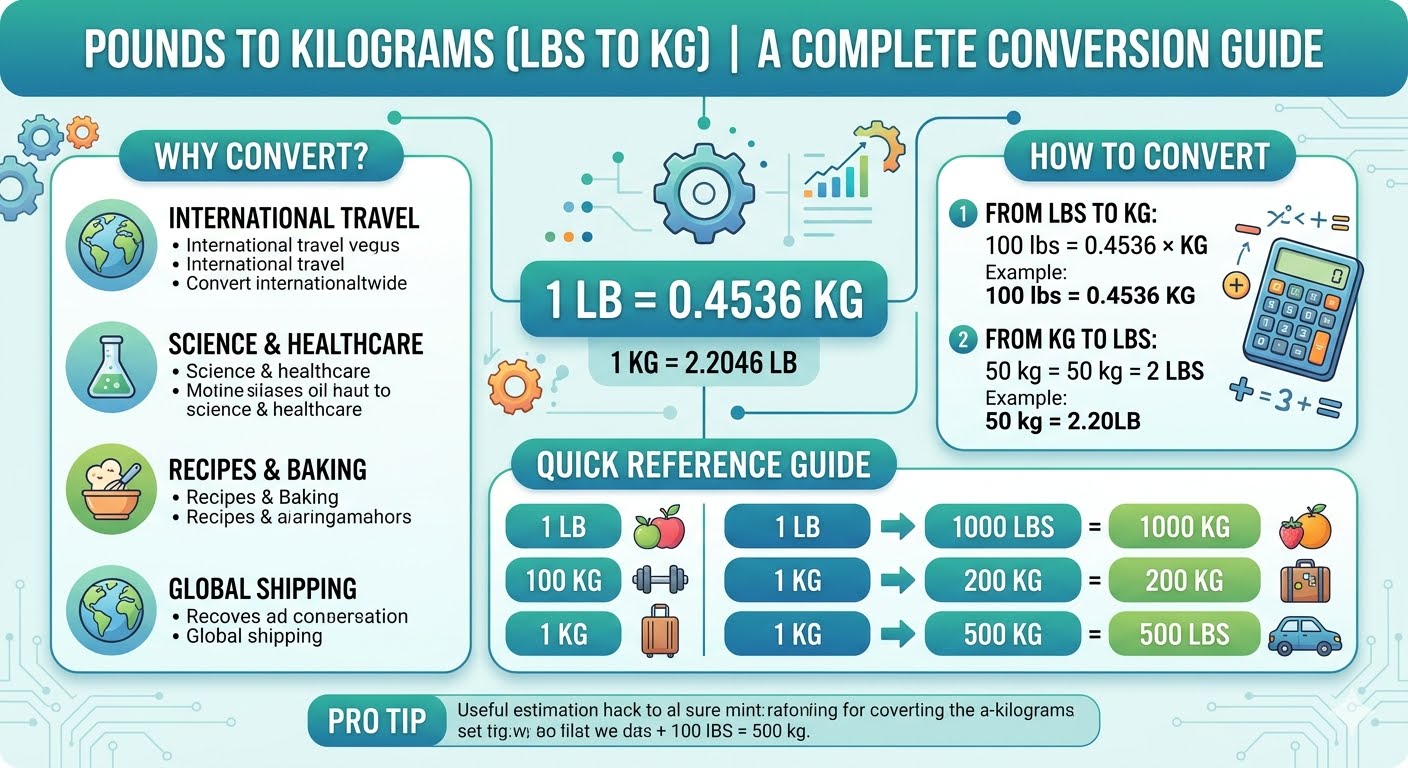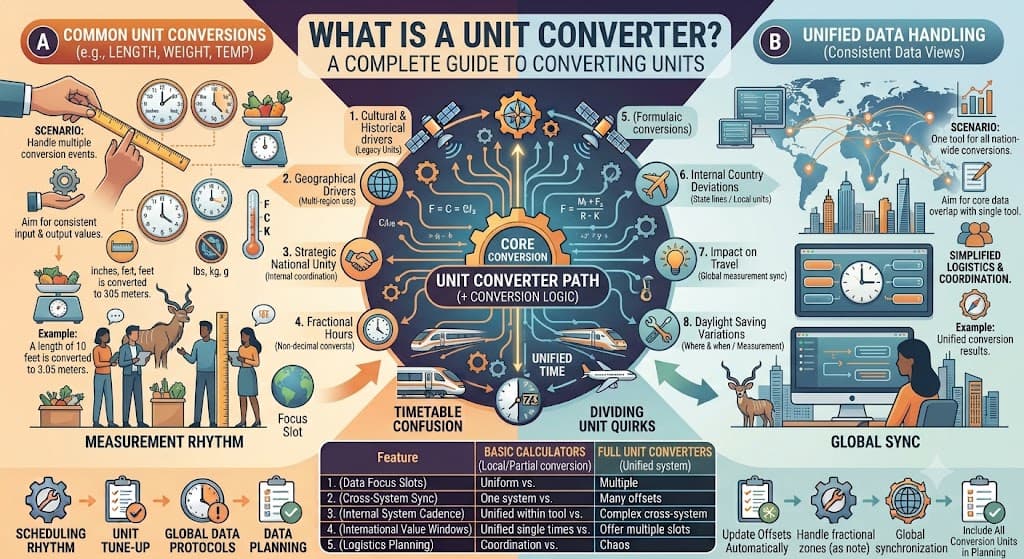
What Is a Unit Converter? A Complete Guide to Converting Units Easily
Have you ever found yourself staring at a recipe that calls for grams when all you have is a measuring cup in ounces? Or tried to understand the fuel efficiency of a car in kilometers per liter when you're used to miles per gallon? If so, you've experienced the universal need for a unit converter.
A unit converter is a tool—either a physical chart, a mental calculation, or more commonly today, a digital application—that helps you translate a quantity from one unit of measurement to another. It's the bridge between different measurement systems, allowing us to communicate, trade, and understand the world across borders and disciplines.
This comprehensive guide will explain everything you need to know about unit converters: what they are, how they work, why they matter, and how to use them effectively.
Quick access: Use our free unit converter here
What Is a Unit Converter?
A unit converter is a tool that converts a physical quantity expressed in one unit of measurement into the equivalent value in another unit of measurement. For example, it converts meters to feet, kilograms to pounds, Celsius to Fahrenheit, or kilometers per hour to miles per hour.
The fundamental principle behind unit conversion is that the physical quantity itself doesn't change—only the way we express it changes. A length of 1 meter is exactly the same physical distance as 3.28084 feet. The unit converter simply applies the correct mathematical relationship to show you that equivalence.
Simple Analogy
Imagine you have a piece of string that's exactly 12 inches long. If you cut it into 12 equal pieces, each piece is 1 inch long. If instead you mark it at 1-foot intervals, you'd have exactly 1 foot. The string hasn't changed—you're just measuring the same thing using different units. A unit converter does this same thing, but with numbers instead of physical string.
Why Do We Need Unit Converters?
1. Different Countries Use Different Systems
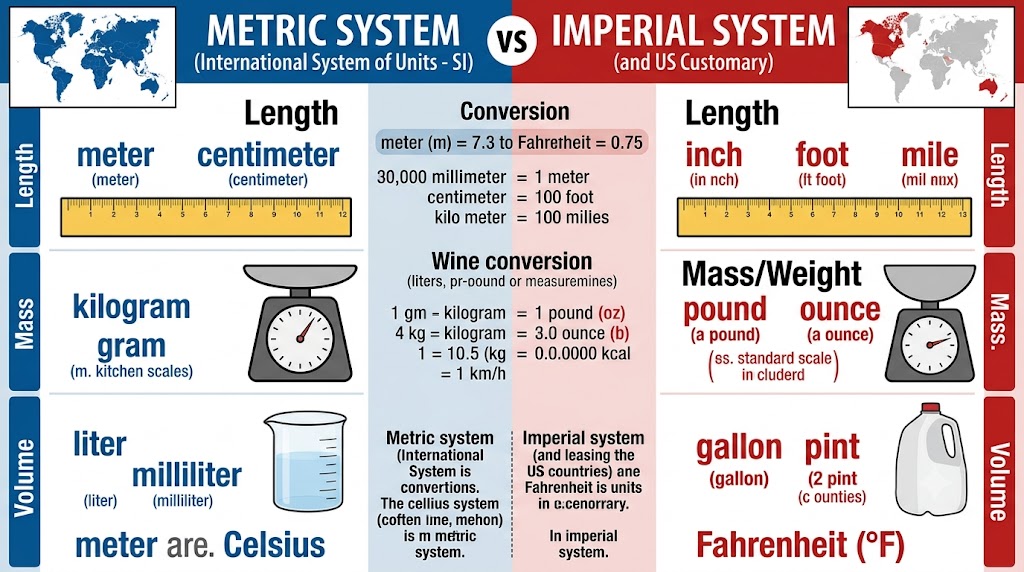
- Metric System (SI): Used by most countries (meters, kilograms, liters, Celsius)
- Imperial System: Used in the US and a few other places (feet, pounds, gallons, Fahrenheit)
- US Customary Units: Similar to Imperial but with some differences (fluid ounces, cups, etc.)
2. Different Disciplines Use Different Conventions
- Science & Engineering: SI units are standard (meters, kilograms, seconds)
- Everyday Life: Local units are more practical (miles, pounds, gallons)
- Aviation: Uses knots, nautical miles, and feet
- Cooking: Uses cups, tablespoons, teaspoons, grams, or ounces depending on region
3. Accuracy and Precision
Manual conversions using mental math can introduce errors. A unit converter ensures you get an accurate result every time, especially for complex conversions like °F to °C.
4. Time Savings
Converting units manually takes time. A unit converter handles the math instantly, freeing you up to focus on the task at hand.
Types of Unit Converters
1. Online Unit Converters (Web-Based)
These are websites or web apps that allow you to enter a value and get conversions instantly. They're the most popular type because they're accessible from any device with an internet connection.
Pros: Always up to date, handles many categories, often free Cons: Requires internet connection
2. Mobile Unit Converter Apps
Smartphone apps that let you convert on the go. Many offer offline functionality.
Pros: Available offline, convenient, often have voice input Cons: Takes up storage space, may contain ads
3. Desktop Software
Standalone applications for Windows, macOS, or Linux. More powerful but less common today.
4. Physical Unit Converter Tools
- Conversion Charts: Printed tables showing conversion factors
- Slide Rules: Old-school mechanical calculators
- Measurement Tools: Rulers with both metric and imperial markings
5. Embedded Converters (Within Other Apps)
Many apps include unit conversion features. For example:
- Google Search: "10 cm to inches"
- Calculator apps on phones
- Smart assistants: "Hey Google, convert 5 miles to kilometers"
Common Unit Conversion Categories
Length / Distance
| From | To | Conversion Factor |
|---|---|---|
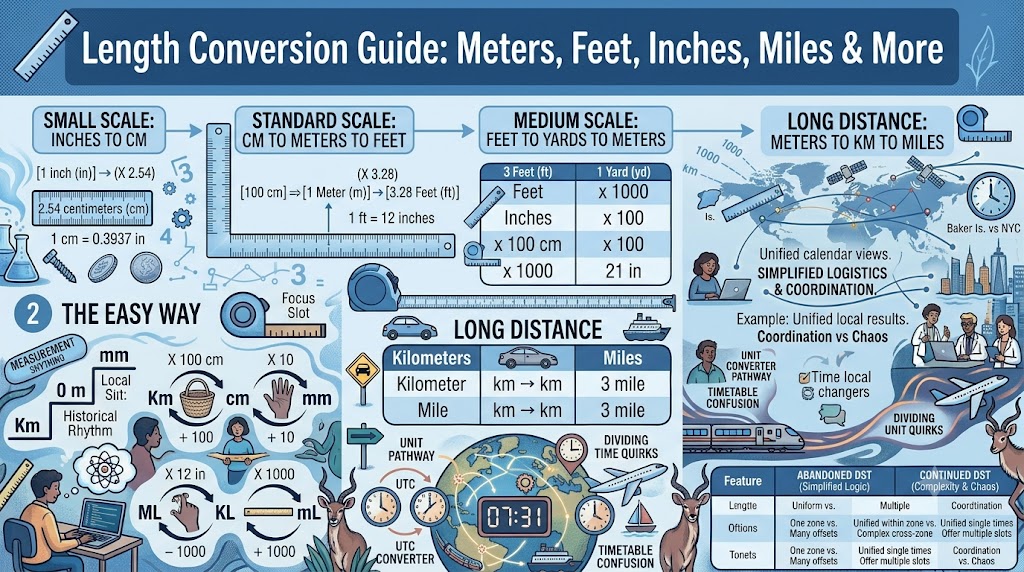
| 1 inch | cm | 2.54 |
| 1 foot | meters | 0.3048 |
| 1 mile | km | 1.60934 |
| 1 meter | feet | 3.28084 |
| 1 km | miles | 0.621371 |
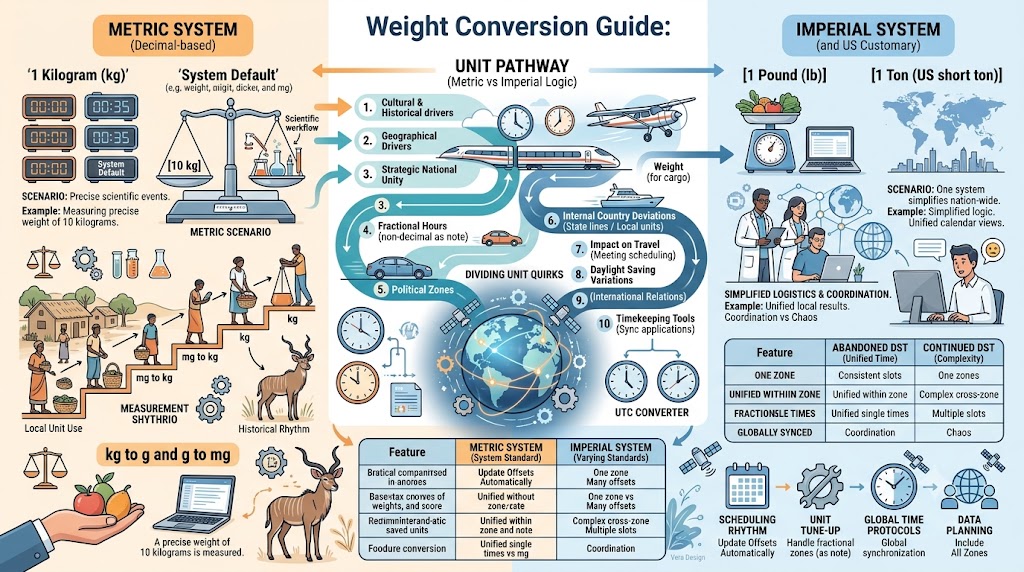
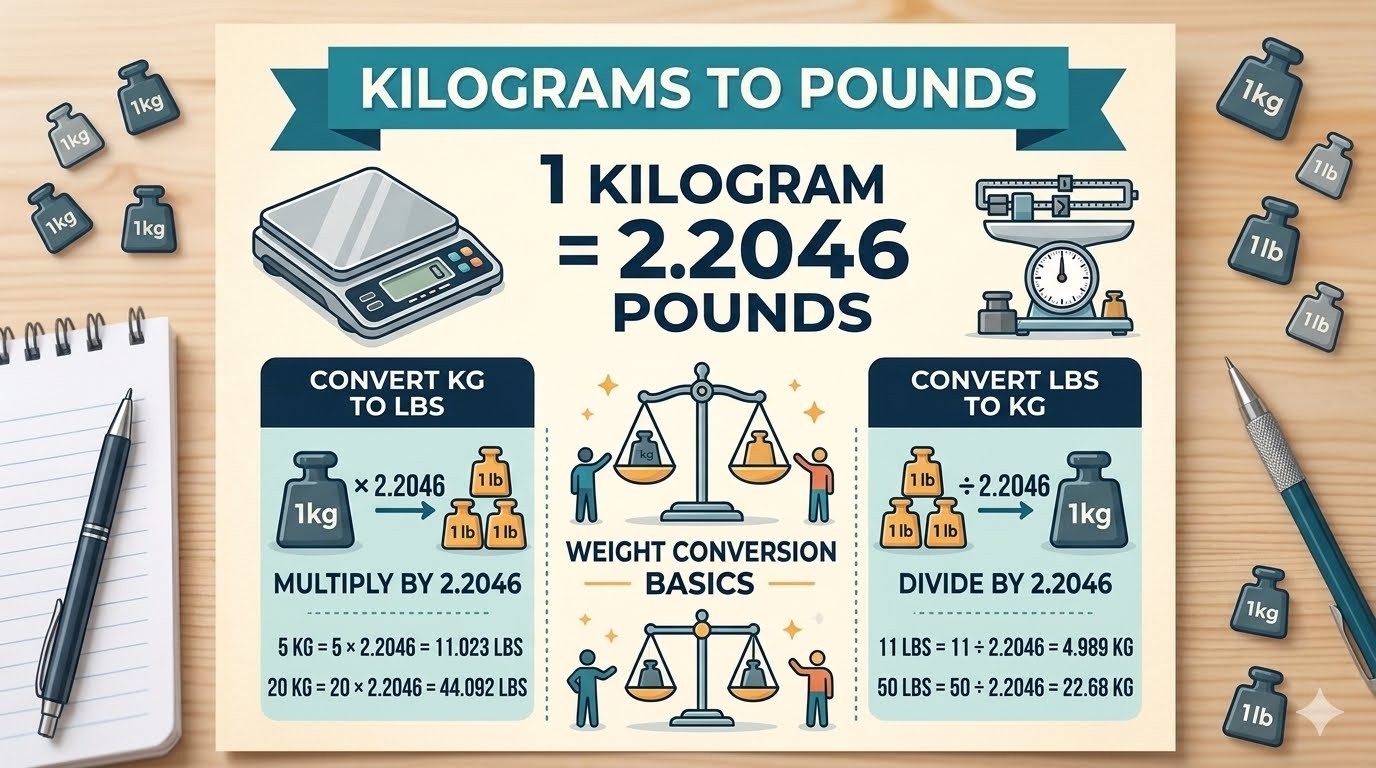
Mass / Weight
| From | To | Conversion Factor |
|---|---|---|
| 1 ounce | grams | 28.3495 |
| 1 pound | kg | 0.453592 |
| 1 stone | kg | 6.35029 |
| 1 kg | pounds | 2.20462 |
| 1 ton (US) | kg | 907.185 |
Temperature
Formulas:
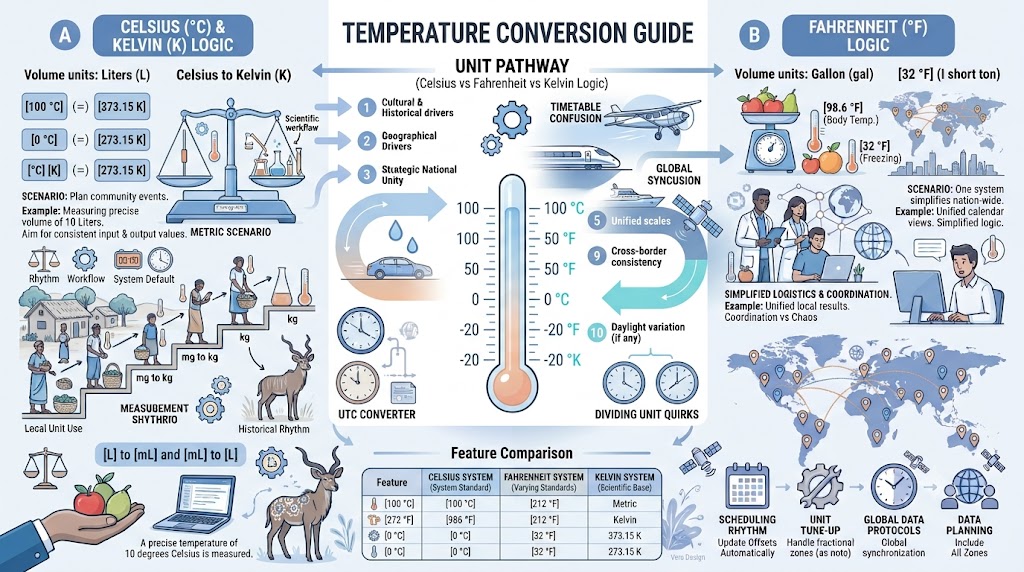
- °C to °F: (°C × 9/5) + 32
- °F to °C: (°F − 32) × 5/9
- °C to K: °C + 273.15
- K to °C: K − 273.15
- °F to K: (°F − 32) × 5/9 + 273.15
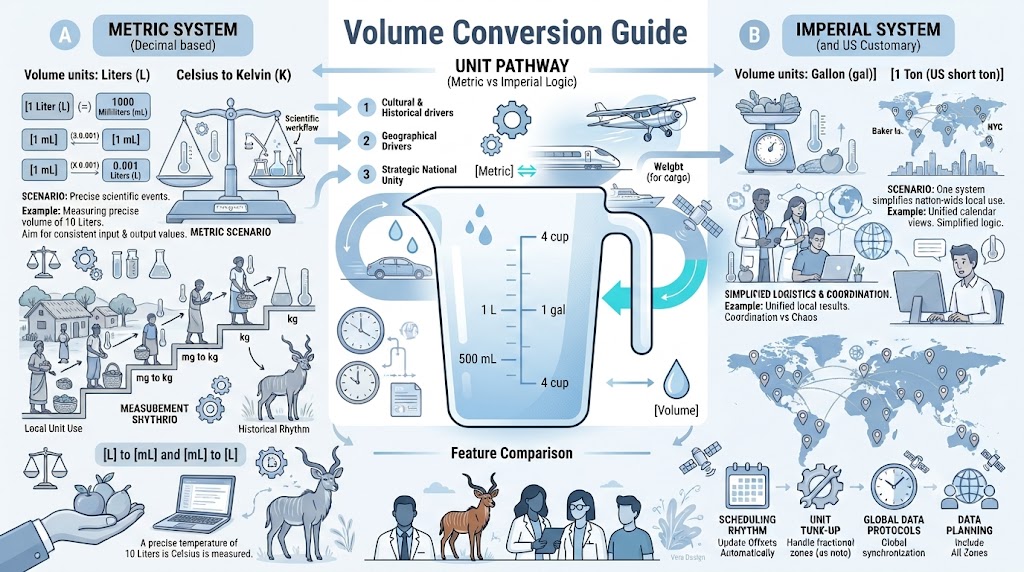
Volume / Capacity
| From | To | Conversion Factor |
|---|---|---|
| 1 US gallon | liters | 3.78541 |
| 1 UK gallon | liters | 4.54609 |
| 1 cup | ml | 236.588 |
| 1 liter | US gallons | 0.264172 |
| 1 fluid ounce | ml | 29.5735 |
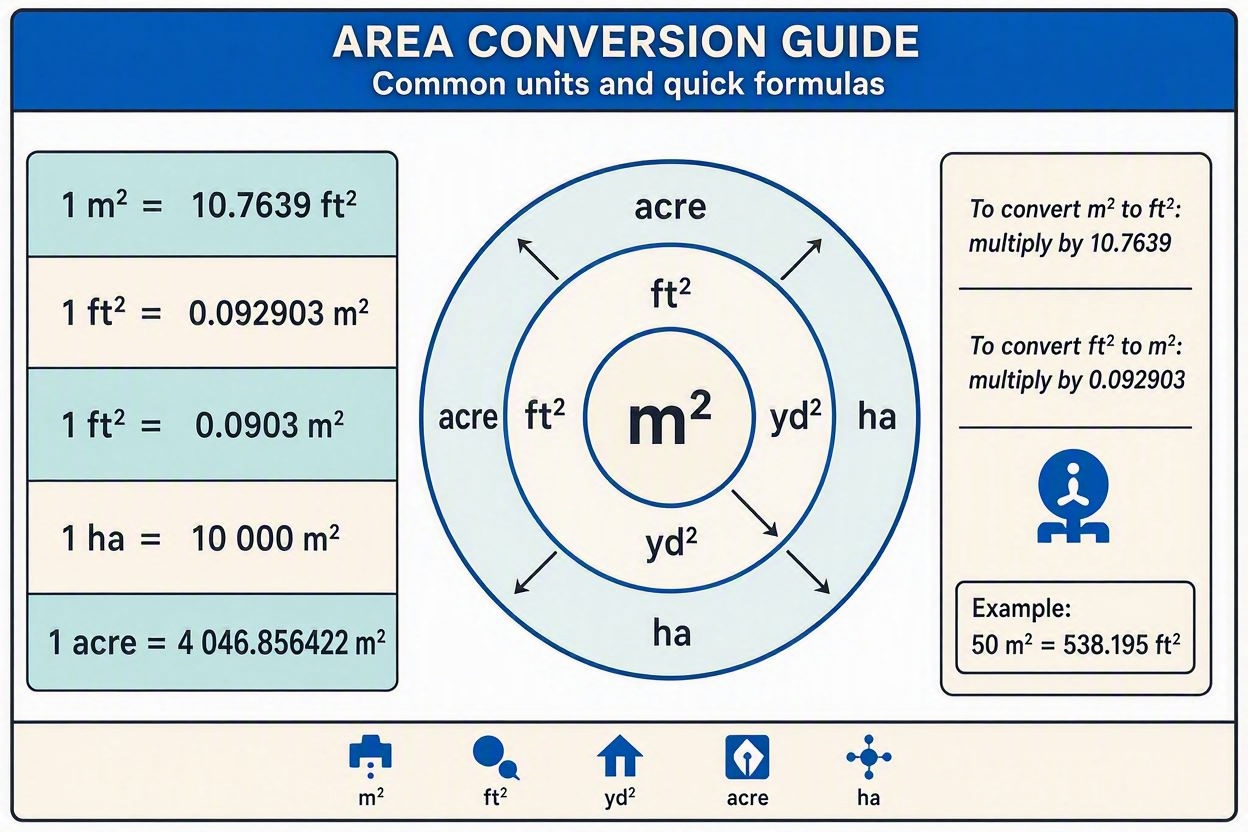
Area
| From | To | Conversion Factor |
|---|---|---|
| 1 sq ft | sq meters | 0.092903 |
| 1 acre | sq meters | 4046.86 |
| 1 hectare | acres | 2.47105 |
| 1 sq km | sq miles | 0.386102 |
Speed
| From | To | Conversion Factor |
|---|---|---|
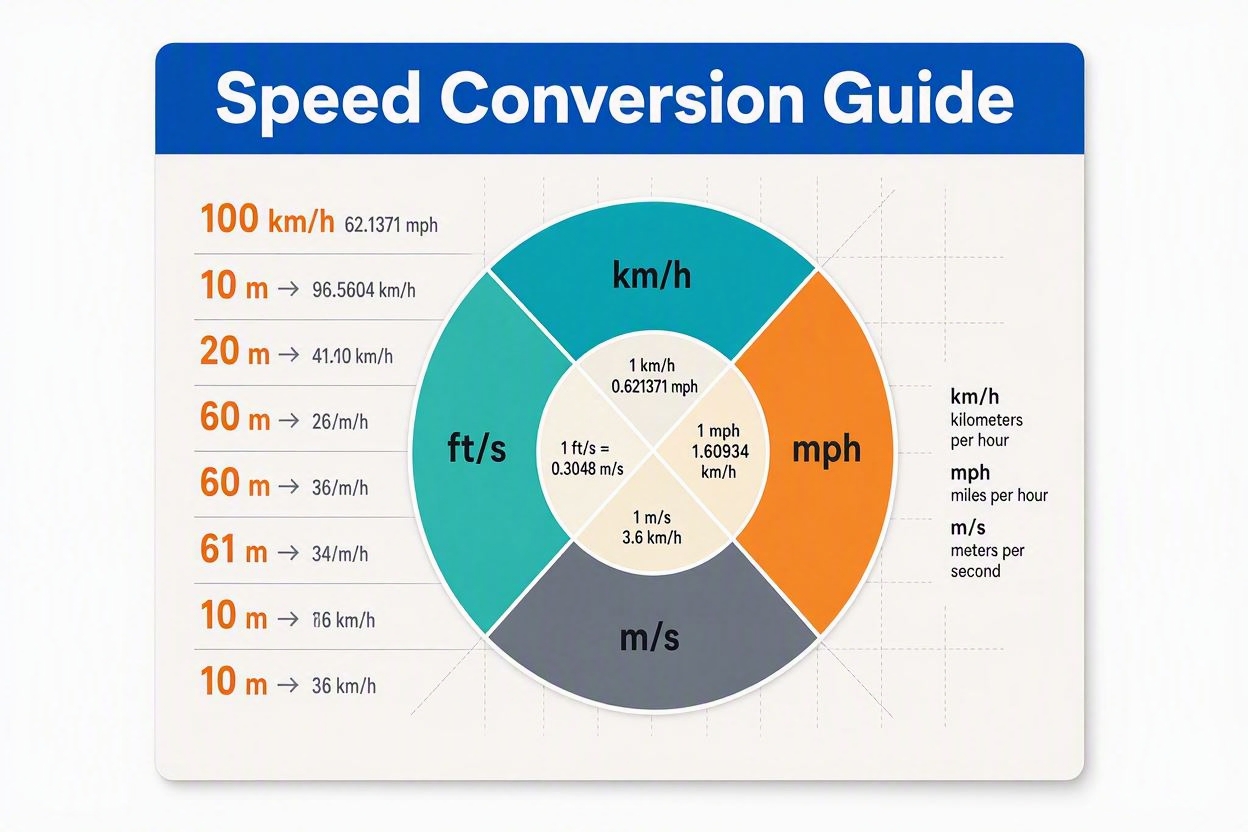
| 1 mph | km/h | 1.60934 |
| 1 km/h | mph | 0.621371 |
| 1 knot | km/h | 1.852 |
| 1 m/s | km/h | 3.6 |
Time
| From | To | Conversion Factor |
|---|---|---|
| 1 minute | seconds | 60 |
| 1 hour | minutes | 60 |
| 1 day | hours | 24 |
| 1 week | days | 7 |
Pressure
| From | To | Conversion Factor |
|---|---|---|
| 1 atm | Pa | 101,325 |
| 1 psi | kPa | 6.89476 |
| 1 bar | Pa | 100,000 |
| 1 mmHg | Pa | 133.322 |
Energy
| From | To | Conversion Factor |
|---|---|---|
| 1 calorie | Joules | 4.184 |
| 1 BTU | Joules | 1055.06 |
| 1 kWh | Joules | 3,600,000 |
| 1 eV | Joules | 1.602 × 10⁻¹⁹ |
Step-by-Step Examples
Example 1: Length Conversion
Problem: Convert 10 miles to kilometers.
Step 1: Identify the conversion factor
- 1 mile = 1.60934 km
Step 2: Set up the calculation
- kilometers = miles × 1.60934
Step 3: Calculate
- 10 × 1.60934 = 16.0934 km
Result: 10 miles = 16.09 km
Example 2: Temperature Conversion
Problem: Convert 100°F to Celsius.
Step 1: Use the formula
- °C = (°F − 32) × 5/9
Step 2: Substitute
- °C = (100 − 32) × 5/9
- °C = 68 × 5/9
- °C = 37.78°C
Result: 100°F = 37.8°C
Example 3: Mass Conversion
Problem: Convert 150 pounds to kilograms.
Step 1: Identify the conversion factor
- 1 lb = 0.453592 kg
Step 2: Set up the calculation
- kg = pounds × 0.453592
Step 3: Calculate
- 150 × 0.453592 = 68.0388 kg
Result: 150 lb = 68.0 kg
Example 4: Volume Conversion
Problem: Convert 2 US gallons to liters.
Step 1: Identify the conversion factor
- 1 US gallon = 3.78541 L
Step 2: Set up the calculation
- liters = gallons × 3.78541
Step 3: Calculate
- 2 × 3.78541 = 7.57082 L
Result: 2 US gal = 7.57 L
Example 5: Speed Conversion
Problem: Convert 60 mph to km/h.
Step 1: Identify the conversion factor
- 1 mph = 1.60934 km/h
Step 2: Set up the calculation
- km/h = mph × 1.60934
Step 3: Calculate
- 60 × 1.60934 = 96.5604 km/h
Result: 60 mph = 96.6 km/h
Common Conversion Mistakes to Avoid
1. Confusing Temperature Scales
Common Mistake: Simply multiplying by a factor like other conversions.
Why It's Wrong: Temperature scales (Celsius, Fahrenheit, Kelvin) have different zero points and intervals. You must use the correct formulas.
Correct: °C to °F requires adding/subtracting 32 in addition to the 9/5 factor.
2. Mixing Up US and Imperial Units
Common Mistake: Treating US gallons and UK gallons as the same.
Why It's Wrong: US gallon = 3.785 L, UK gallon = 4.546 L.
Example: 10 UK gallons = 45.46 L, but 10 US gallons = 37.85 L. That's a 20% difference!
3. Using the Wrong Prefix
Common Mistake: Confusing megawatts (MW) with milliwatts (mW) or kilometers (km) with millimeters (mm).
Why It's Wrong: Prefixes matter.
- kilo = 1,000
- mega = 1,000,000
- milli = 0.001
- micro = 0.000001
4. Forgetting to Convert Units on Both Sides
Common Mistake: Converting the numerator but not the denominator.
Example: Converting 10 kg/m³ to g/cm³. You need to convert both kg to g AND m³ to cm³.
5. Rounding Too Early
Common Mistake: Rounding intermediate values in multi-step conversions.
Why It's Wrong: Rounding errors compound. Wait until the final step to round.
How to Use a Digital Unit Converter Effectively
Step 1: Select the Category
Choose the right category for your conversion (length, mass, temperature, etc.).
Step 2: Choose Input and Output Units
Select the unit you have (e.g., miles) and the unit you want (e.g., kilometers).
Step 3: Enter the Value
Type or paste the number you want to convert.
Step 4: Read the Result
The converted value appears instantly, usually with 2-4 decimal places.
Step 5: Check for Additional Information
Many converters also show:
- The formula used
- Step-by-step calculation
- Related conversions (e.g., 10 miles = 16.09 km = 17,600 yards)
Unit Converter Comparison: Metric vs. Imperial
| Metric | Imperial/US Customary |
|---|---|
| Length: meters, centimeters, kilometers | Length: feet, inches, miles, yards |
| Mass: kilograms, grams | Mass: pounds, ounces, tons |
| Volume: liters, milliliters | Volume: gallons, quarts, cups, fluid ounces |
| Temperature: Celsius, Kelvin | Temperature: Fahrenheit |
| Pros: Decimal-based, easy math, globally used | Pros: Familiar in US, intuitive for everyday use |
The Science Behind Unit Conversion
Dimensional Analysis (Factor-Label Method)
The most reliable way to convert units is using dimensional analysis:
- Start with the value you have
- Multiply by conversion factors (fractions equal to 1)
- Cancel units like algebraic variables
- The remaining units are your answer
Example: Convert 100 km/h to m/s
100 km/h × (1000 m / 1 km) × (1 h / 3600 s)
= 100 × 1000 / 3600 m/s
= 27.78 m/s
This method works for any conversion, no matter how complex. The key is that the conversion factor must equal 1 (e.g., 1 km = 1000 m, so 1000 m/1 km = 1).
When to Use a Unit Converter (vs. Doing It Mentally)
Use a Unit Converter when:
- You need high precision (scientific, engineering, or medical applications)
- You're converting complex units (e.g., m/s to mph, °F to K)
- You're working with unfamiliar units
- You need to check your manual calculations
- You're in a hurry
- You're teaching or learning and want to verify
Do it mentally when:
- You need a rough estimate (e.g., "5 km is about 3 miles")
- The conversion is simple (e.g., minutes to seconds)
- You're doing a quick sanity check
- No calculator is available
Real-World Applications of Unit Converters
1. Cooking and Baking
Recipes from different countries use different units. A US recipe might call for 2 cups of flour (≈ 240g) while a European recipe might call for 250g. Get it wrong, and your cake will be a disaster!
2. Travel and Navigation
- Speed limits: mph in the US, km/h in Europe
- Gas mileage: mpg in the US, L/100km in Europe
- Distances: "How far is 10 km in miles?"
3. Science and Engineering
Researchers and engineers often need to convert between units when reading international papers, collaborating across borders, or working with different equipment.
4. Shopping and E-commerce
- Clothing sizes: US vs. UK vs. EU
- Product dimensions: inches vs. centimeters
- Weight: pounds vs. kilograms
5. Weather and Climate
- Temperature: °F in the US vs. °C elsewhere
- Wind speed: mph, km/h, or knots
- Precipitation: inches vs. millimeters
6. Health and Fitness
- Body weight: pounds vs. kilograms
- Running pace: min/mile vs. min/km
- Calorie consumption: calories vs. kilojoules
7. Manufacturing and Construction
- Material dimensions: inches vs. millimeters
- Pressure ratings: PSI vs. bar vs. kPa
- Torque specs: lb-ft vs. Nm
Why Digital Unit Converters Are Better Than Paper Charts
| Feature | Digital | Paper Chart |
|---|---|---|
| Accuracy | High (up to 15+ decimals) | Limited (usually 2-3 decimals) |
| Speed | Instant | Time-consuming to look up |
| Range | Infinite | Limited to what's printed |
| Updates | Can be updated | Outdated once printed |
| Unit coverage | Hundreds of units | Dozens at most |
| Complex conversions | Handles easily | Difficult or impossible |
| History/recent conversions | Available | Not available |
| Extra info | Formulas, steps, related info | Just the number |
Tips for Choosing a Unit Converter Tool
Look for a tool that offers:
- Broad category coverage – Length, mass, temperature, speed, volume, area, pressure, energy, time, and more
- Many units per category – Not just basic ones but specialized units too
- Two-way conversion – Convert in either direction easily
- Step-by-step solutions – Shows how the answer was derived
- Unit grouping – Easy navigation to find what you need
- Accurate conversion factors – Using up-to-date, standardized values
- Reverse conversion – One-click swap of input/output units
- Copy results – Easily copy the converted value to the clipboard
- No ads or minimal ads – For a clean experience
- Mobile-friendly – Works well on phones and tablets
Advanced Unit Conversion Topics
Compound Units
Sometimes you need to convert units that are combinations of multiple base units:
- Speed: km/h → m/s (length ÷ time)
- Density: kg/m³ → g/cm³ (mass ÷ volume)
- Pressure: N/m² → psi (force ÷ area)
- Torque: Nm → lb-ft (force × distance)
Derived Units
Some units are derived from base units and require understanding the physics:
- Joule = N·m = kg·m²/s²
- Watt = J/s = kg·m²/s³
- Pascal = N/m² = kg/(m·s²)
Unit Prefixes (SI Prefixes)
| Prefix | Symbol | Factor |
|---|---|---|
| pico | p | 10⁻¹² |
| nano | n | 10⁻⁹ |
| micro | μ | 10⁻⁶ |
| milli | m | 10⁻³ |
| centi | c | 10⁻² |
| deci | d | 10⁻¹ |
| kilo | k | 10³ |
| mega | M | 10⁶ |
| giga | G | 10⁹ |
| tera | T | 10¹² |
Common Unit Converter Use Cases (With Examples)
Traveling to Europe
- Problem: Speed limit sign says 130 km/h. How fast is that in mph?
- Solution: 130 × 0.621 = 80.7 mph
- Answer: About 81 mph
International Recipe
- Problem: Recipe needs 500g of flour, but your scale measures in ounces.
- Solution: 500 × 0.035274 = 17.64 oz
- Answer: About 17.6 oz
Buying Property Abroad
- Problem: Property is advertised as 2,000 sq ft. How many sq meters is that?
- Solution: 2000 × 0.092903 = 185.8 m²
- Answer: About 186 m²
Science Homework
- Problem: Convert 25°C to Kelvin and Fahrenheit.
- Solution:
- K = 25 + 273.15 = 298.15 K
- °F = (25 × 9/5) + 32 = 77°F
- Answer: 298.15 K, 77°F
Car Fuel Efficiency
- Problem: Car gets 30 mpg. What is that in L/100km?
- Solution: 235.215 / 30 = 7.84 L/100km
- Answer: About 7.84 L/100km
Frequently Asked Questions About Unit Converters
Q: What is a unit converter?
A unit converter is a tool that translates a measurement from one unit to another (e.g., inches to centimeters, pounds to kilograms).
Q: How do unit converters work?
Unit converters use mathematical relationships called conversion factors. For example, 1 inch = 2.54 cm, so to convert inches to cm, you multiply by 2.54.
Q: What units can be converted?
Almost any measurable quantity has units: length, mass, temperature, speed, volume, area, pressure, energy, time, power, angle, data storage, and many more.
Q: Are digital unit converters accurate?
Yes. Professional unit converters use standardized conversion factors (like those defined by NIST or international standards).
Q: Can unit converters handle compound units?
Yes. Good converters can handle units like km/h to m/s, lb/ft³ to kg/m³, etc.
Q: Is it better to convert manually or use a tool?
Use a tool for precision and complex conversions. Use mental math for rough estimates when precision isn't critical.
Q: Why do different countries use different units?
Historical reasons. The metric system was developed in France and spread globally. The US and a few others kept the Imperial system due to established infrastructure and cultural habits.
Q: What is the most common unit conversion?
Probably temperature (Celsius ↔ Fahrenheit) and length (inches ↔ centimeters, miles ↔ kilometers).
Q: Are all unit converters free?
Many are free, but some advanced tools or apps may charge a fee for premium features.
Final Thoughts
Unit conversion is a fundamental skill in our globalized world. Whether you're a student, professional, traveler, or home cook, understanding how to convert between units is essential. A good unit converter removes the mental burden, ensures accuracy, and saves time.
The best unit converter is one that's comprehensive, accurate, easy to use, and fits your specific needs. With the rise of digital tools, unit conversion has never been easier. From simple length conversions to complex scientific unit conversions, there's a tool for every need.
Try Our Free Unit Converter Now
Tags: unit converter, unit conversion, measurement converter, length converter, mass converter, temperature converter, speed converter, area converter, volume converter, time converter, pressure converter, energy converter, power converter, online unit converter, free unit converter, metric converter, imperial converter, how to convert units, unit conversion formula, conversion factors, SI units, imperial units, US customary units, unit conversion table, physics unit converter, engineering unit converter, math converter, best unit converter, unit conversion tool, measurement calculator