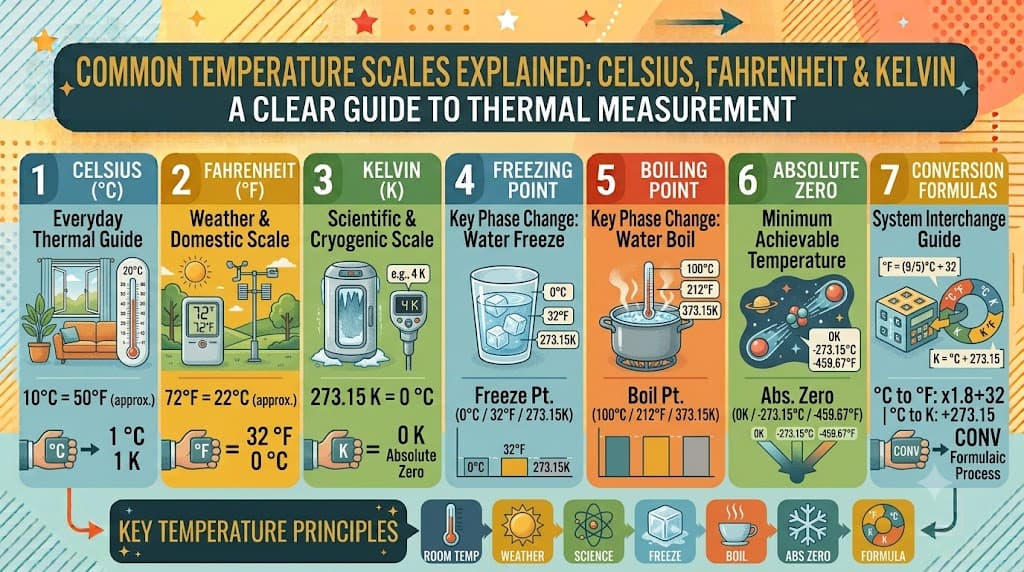
Common Temperature Scales Explained: Celsius, Fahrenheit & Kelvin – Complete Guide
Temperature is one of the most frequently measured quantities in our daily lives. From checking the weather to cooking food to scientific research, temperature measurements are everywhere.
But did you know there are three different temperature scales used around the world? Celsius, Fahrenheit, and Kelvin each have their own unique characteristics, uses, and conversion formulas.
In this comprehensive guide, we'll explain everything you need to know about temperature scales, including:
- ✅ What each scale is and how it works
- ✅ Key reference points (freezing, boiling, absolute zero)
- ✅ Conversion formulas with examples
- ✅ Real-world applications
- ✅ Quick estimation tricks
- ✅ Common mistakes to avoid
Try it now: Use our free temperature converter here
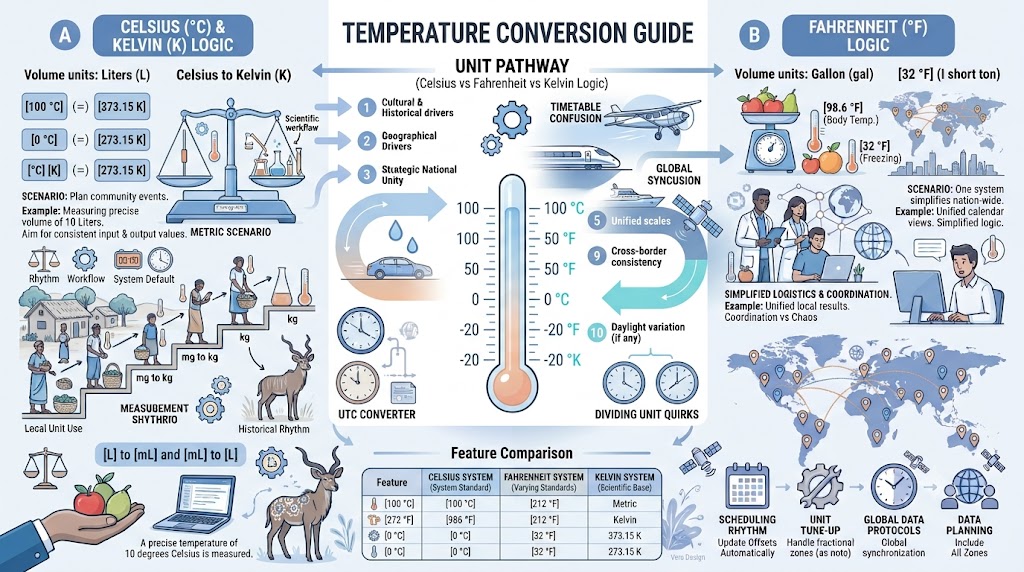
Temperature Scales at a Glance
| Scale | Symbol | Freezing Point | Boiling Point | Absolute Zero | Common Use |
|---|---|---|---|---|---|
| Celsius | °C | 0°C | 100°C | -273.15°C | Worldwide everyday use |
| Fahrenheit | °F | 32°F | 212°F | -459.67°F | US everyday use |
| Kelvin | K | 273.15 K | 373.15 K | 0 K | Science, engineering |
Understanding Each Temperature Scale
1. Celsius (°C) — The Global Standard
Celsius (also called Centigrade) is the most widely used temperature scale in the world. It's the standard for everyday temperature measurement in almost every country except the United States.
Key Reference Points
| Description | Celsius |
|---|---|
| Absolute Zero | -273.15°C |
| Water Freezes | 0°C |
| Room Temperature | 20-22°C |
| Body Temperature | 37°C |
| Water Boils | 100°C |
How It Works
The Celsius scale is based on the properties of water:
- 0°C — Water freezes at standard pressure
- 100°C — Water boils at standard pressure
- The scale is divided into 100 equal degrees between these points
Common Uses
- Weather forecasts (outside the US)
- Cooking (outside the US)
- Science and medicine
- Most everyday temperature measurements worldwide
2. Fahrenheit (°F) — The US Standard
Fahrenheit is the primary temperature scale used in the United States and a few other countries (Bahamas, Belize, Cayman Islands, Palau).
Key Reference Points
| Description | Fahrenheit |
|---|---|
| Absolute Zero | -459.67°F |
| Water Freezes | 32°F |
| Room Temperature | 68-72°F |
| Body Temperature | 98.6°F |
| Water Boils | 212°F |
How It Works
The Fahrenheit scale was developed by Daniel Gabriel Fahrenheit in 1724:
- 32°F — Water freezes
- 212°F — Water boils
- The scale has 180 degrees between freezing and boiling
- Originally based on a mixture of ice, water, and salt (0°F)
Common Uses
- Weather forecasts (US)
- Cooking temperatures (US)
- Everyday temperature measurement (US)
- Body temperature (US)
3. Kelvin (K) — The Scientific Standard
Kelvin is the SI base unit for temperature and the scientific standard used worldwide. It's an absolute temperature scale, meaning it starts at absolute zero — the lowest possible temperature.
Key Reference Points
| Description | Kelvin |
|---|---|
| Absolute Zero | 0 K |
| Water Freezes | 273.15 K |
| Room Temperature | 293-295 K |
| Body Temperature | 310.15 K |
| Water Boils | 373.15 K |
How It Works
The Kelvin scale is based on absolute zero:
- 0 K — Absolute zero (lowest possible temperature)
- 273.15 K — Water freezes
- 373.15 K — Water boils
- The scale has the same interval as Celsius (1 K = 1°C)
- No degree symbol — it's just "K" (not "°K")
Common Uses
- Physics and chemistry
- Engineering
- Astronomy and space science
- Thermodynamics
- Cryogenics
- Scientific research
Why Kelvin is Important
Kelvin is an absolute scale, meaning it has a true zero point (absolute zero). This makes it essential for scientific calculations because many physical laws (like the ideal gas law) require absolute temperature measurements.
Visual Temperature Comparison
┌─────────────────────────────────────────────────────────────────────────┐
│                    TEMPERATURE SCALE COMPARISON                         │
├─────────────────────────────────────────────────────────────────────────┤
│                                                                         │
│   ─────────────────────────────────────────────────────────────────     │
│   °C    -273.15   -200   -100    0     50    100    200    300    400  │
│          │        │      │       │     │      │      │      │      │    │
│   ─────────────────────────────────────────────────────────────────     │
│   °F    -459.67   -328   -148   32    122    212    392    572    752  │
│          │        │      │       │     │      │      │      │      │    │
│   ─────────────────────────────────────────────────────────────────     │
│    K      0        73    173    273   323    373    473    573    673  │
│          │        │      │       │     │      │      │      │      │    │
│          ▲        ▲      ▲       ▲     ▲      ▲      ▲      ▲      ▲    │
│       Absolute   │      │    Water  Body  Water   │      │      │      │
│         Zero     │      │   Freeze Temp   Boil    │      │      │      │
│                 │      │           (37°C)         │      │      │      │
│                                                                         │
│   Common Reference Points:                                              │
│   ─────────────────────────────────────────────────────────────────     │
│   Absolute Zero:  0 K = -273.15°C = -459.67°F                          │
│   Water Freezes:  273.15 K = 0°C = 32°F                                │
│   Room Temp:      293-295 K = 20-22°C = 68-72°F                       │
│   Body Temp:      310.15 K = 37°C = 98.6°F                            │
│   Water Boils:    373.15 K = 100°C = 212°F                            │
│                                                                         │
└─────────────────────────────────────────────────────────────────────────┘
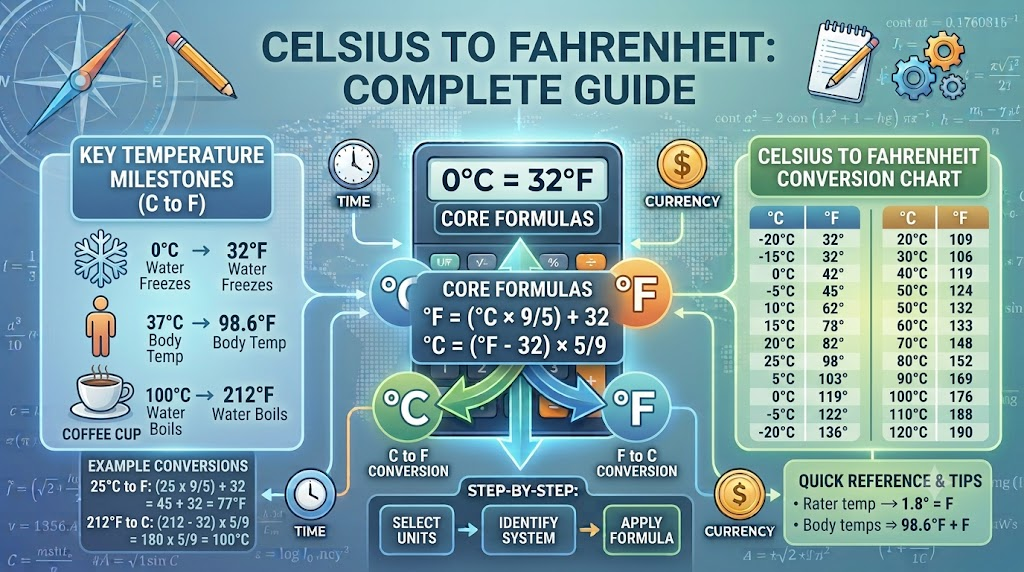
Temperature Conversion Formulas
Celsius ↔ Fahrenheit
Celsius to Fahrenheit:
°F = (°C × 9/5) + 32
Fahrenheit to Celsius:
°C = (°F − 32) × 5/9
Celsius ↔ Kelvin
Celsius to Kelvin:
K = °C + 273.15
Kelvin to Celsius:
°C = K − 273.15
Fahrenheit ↔ Kelvin
Fahrenheit to Kelvin:
K = (°F − 32) × 5/9 + 273.15
Kelvin to Fahrenheit:
°F = (K − 273.15) × 9/5 + 32
Step-by-Step Conversion Examples
Example 1: Celsius to Fahrenheit
Problem: Convert 25°C to Fahrenheit.
Step 1: Use the formula
°F = (°C × 9/5) + 32
Step 2: Substitute
°F = (25 × 9/5) + 32
Step 3: Calculate
°F = (25 × 1.8) + 32
°F = 45 + 32
°F = 77°F
Answer: 25°C = 77°F
Example 2: Fahrenheit to Celsius
Problem: Convert 98.6°F to Celsius.
Step 1: Use the formula
°C = (°F − 32) × 5/9
Step 2: Substitute
°C = (98.6 − 32) × 5/9
Step 3: Calculate
°C = 66.6 × 5/9
°C = 333/9
°C = 37°C
Answer: 98.6°F = 37°C
Example 3: Celsius to Kelvin
Problem: Convert 25°C to Kelvin.
Step 1: Use the formula
K = °C + 273.15
Step 2: Substitute
K = 25 + 273.15
Step 3: Calculate
K = 298.15 K
Answer: 25°C = 298.15 K
Example 4: Kelvin to Celsius
Problem: Convert 300 K to Celsius.
Step 1: Use the formula
°C = K − 273.15
Step 2: Substitute
°C = 300 − 273.15
Step 3: Calculate
°C = 26.85°C
Answer: 300 K = 26.85°C
Example 5: Fahrenheit to Kelvin
Problem: Convert 77°F to Kelvin.
Step 1: Use the formula
K = (°F − 32) × 5/9 + 273.15
Step 2: Substitute
K = (77 − 32) × 5/9 + 273.15
Step 3: Calculate
K = 45 × 5/9 + 273.15
K = 25 + 273.15
K = 298.15 K
Answer: 77°F = 298.15 K
Example 6: Kelvin to Fahrenheit
Problem: Convert 298.15 K to Fahrenheit.
Step 1: Use the formula
°F = (K − 273.15) × 9/5 + 32
Step 2: Substitute
°F = (298.15 − 273.15) × 9/5 + 32
Step 3: Calculate
°F = 25 × 9/5 + 32
°F = 45 + 32
°F = 77°F
Answer: 298.15 K = 77°F
Quick Reference Conversion Table
Common Temperatures
| Description | °C | °F | K |
|---|---|---|---|
| Absolute Zero | -273.15°C | -459.67°F | 0 K |
| Liquid Nitrogen | -196°C | -321°F | 77 K |
| Dry Ice | -78.5°C | -109.3°F | 194.7 K |
| Very Cold Day | -20°C | -4°F | 253.15 K |
| Cold Day | -10°C | 14°F | 263.15 K |
| Freezing Point | 0°C | 32°F | 273.15 K |
| Chilly Day | 5°C | 41°F | 278.15 K |
| Cool Day | 10°C | 50°F | 283.15 K |
| Room Temperature | 21°C | 70°F | 294.15 K |
| Warm Day | 25°C | 77°F | 298.15 K |
| Hot Day | 30°C | 86°F | 303.15 K |
| Very Hot Day | 35°C | 95°F | 308.15 K |
| Body Temperature | 37°C | 98.6°F | 310.15 K |
| Extremely Hot | 40°C | 104°F | 313.15 K |
| Boiling Point | 100°C | 212°F | 373.15 K |
| Oven Temperature | 180°C | 356°F | 453.15 K |
Quick Estimation Tricks
Celsius to Fahrenheit (Mental Math)
Quick Method: Double it and add 30
| Exact | Quick Estimate |
|---|---|
| 0°C = 32°F | 0 × 2 + 30 = 30°F (close!) |
| 10°C = 50°F | 10 × 2 + 30 = 50°F (exact!) |
| 20°C = 68°F | 20 × 2 + 30 = 70°F (close) |
| 30°C = 86°F | 30 × 2 + 30 = 90°F (close) |
| 40°C = 104°F | 40 × 2 + 30 = 110°F (close) |
Note: This trick works best for temperatures between 0-40°C.
Fahrenheit to Celsius (Mental Math)
Quick Method: Subtract 30 and halve it
| Exact | Quick Estimate |
|---|---|
| 32°F = 0°C | (32 − 30) ÷ 2 = 1°C (close!) |
| 50°F = 10°C | (50 − 30) ÷ 2 = 10°C (exact!) |
| 68°F = 20°C | (68 − 30) ÷ 2 = 19°C (close) |
| 86°F = 30°C | (86 − 30) ÷ 2 = 28°C (close) |
| 104°F = 40°C | (104 − 30) ÷ 2 = 37°C (close) |
Memory Aids
Key Reference Points to Memorize:
- 0°C = 32°F (Water freezes)
- 10°C ≈ 50°F (Cool)
- 20°C ≈ 68°F (Room temperature)
- 30°C ≈ 86°F (Warm)
- 37°C = 98.6°F (Body temperature)
- 40°C = 104°F (Hot)
- 100°C = 212°F (Water boils)
The "-40" Rule:
-40°C = -40°F — The only temperature where Celsius and Fahrenheit are equal!
Real-World Temperature Examples
1. Weather Forecasts
| Weather Description | °C | °F |
|---|---|---|
| Freezing | 0°C | 32°F |
| Cold | 5°C | 41°F |
| Cool | 10°C | 50°F |
| Mild | 15°C | 59°F |
| Warm | 20°C | 68°F |
| Hot | 30°C | 86°F |
| Very Hot | 35°C | 95°F |
| Extremely Hot | 40°C | 104°F |
2. Cooking Temperatures
| Food | °C | °F |
|---|---|---|
| Slow oven | 150°C | 300°F |
| Moderate oven | 180°C | 350°F |
| Hot oven | 200°C | 400°F |
| Very hot oven | 230°C | 450°F |
| Boiling water | 100°C | 212°F |
| Simmering water | 85°C | 185°F |
3. Body Temperature
| Condition | °C | °F |
|---|---|---|
| Normal | 36.5-37.5°C | 97.7-99.5°F |
| Fever | >38°C | >100.4°F |
| High Fever | >39.5°C | >103.1°F |
| Hypothermia | <35°C | <95°F |
4. Science and Industry
| Application | K | °C | °F |
|---|---|---|---|
| Absolute zero | 0 K | -273.15°C | -459.67°F |
| Liquid nitrogen | 77 K | -196°C | -321°F |
| Dry ice | 194.7 K | -78.5°C | -109.3°F |
| Room temperature | 294 K | 21°C | 70°F |
| Boiling water | 373.15 K | 100°C | 212°F |
| Oven cleaning | ~773 K | ~500°C | ~932°F |
Complete Conversion Reference
Quick Conversion Card
╔══════════════════════════════════════════════════════════════════╗
║                    TEMPERATURE CONVERSIONS                        ║
╠══════════════════════════════════════════════════════════════════╣
║                                                                  ║
║  °C → °F    (°C × 9/5) + 32                                      ║
║  °F → °C    (°F − 32) × 5/9                                      ║
║  °C → K     °C + 273.15                                          ║
║  K → °C     K − 273.15                                           ║
║  °F → K     (°F − 32) × 5/9 + 273.15                            ║
║  K → °F     (K − 273.15) × 9/5 + 32                             ║
║                                                                  ║
║  COMMON VALUES:                                                  ║
║  0°C  = 32°F  = 273.15 K  (Water freezes)                       ║
║  21°C = 70°F  = 294.15 K  (Room temperature)                    ║
║  37°C = 98.6°F = 310.15 K  (Body temperature)                   ║
║  100°C = 212°F = 373.15 K  (Water boils)                        ║
║  -40°C = -40°F = 233.15 K  (They are equal!)                    ║
║                                                                  ║
║  QUICK ESTIMATES:                                                ║
║  °C → °F:  × 2 + 30                                             ║
║  °F → °C:  (− 30) ÷ 2                                           ║
║  °C → K:   + 273                                                ║
║  K → °C:   − 273                                                ║
║                                                                  ║
╚══════════════════════════════════════════════════════════════════╝
Common Mistakes in Temperature Conversion
Mistake 1: Forgetting to Add/Subtract 32
Mistake: Converting °C to °F by just multiplying by 9/5.
Correct: °F = (°C × 9/5) + 32
Example:
- ❌ 25°C × 9/5 = 45°F (wrong!)
- ✅ (25 × 9/5) + 32 = 77°F (correct)
Mistake 2: Using 273 Instead of 273.15
Mistake: Using 273 instead of 273.15 for exact calculations.
Correct: Use 273.15 for precision.
Example:
- ❌ 25°C + 273 = 298 K (close but less precise)
- ✅ 25°C + 273.15 = 298.15 K (correct)
Mistake 3: Using Degree Symbol with Kelvin
Mistake: Writing "°K" (degree Kelvin).
Correct: Just "K" — Kelvin is an absolute scale, not a degree scale.
Example:
- ❌ 298.15 °K
- ✅ 298.15 K
Mistake 4: Confusing Fahrenheit and Celsius Values
Mistake: Thinking 40°C = 40°F.
Correct: They only intersect at -40°C = -40°F.
Example:
- 40°C = 104°F (very hot)
- 40°F = 4.44°C (cold)
Mistake 5: Rounding Too Early
Mistake: Rounding intermediate values in multi-step conversions.
Correct: Keep full precision until the final answer, then round.
How to Use the Temperature Converter
- Select the category: Temperature
- Choose your input unit: e.g.,
celsiusorfahrenheit - Choose your output unit: e.g.,
fahrenheitorkelvin - Enter the value: Type the number you want to convert
- Get the result: Instant, accurate conversion
Available Temperature Units
The converter supports all 3 temperature units:
| Unit Value | Display Label | Symbol |
|---|---|---|
celsius |
Celsius | °C |
fahrenheit |
Fahrenheit | °F |
kelvin |
Kelvin | K |
Frequently Asked Questions
Q: What are the three temperature scales?
The three temperature scales are Celsius (°C), Fahrenheit (°F), and Kelvin (K).
Q: Which temperature scale is used in the US?
Fahrenheit is used for everyday temperature measurement in the US.
Q: Which temperature scale is used in most countries?
Celsius is used in most countries for everyday temperature measurement.
Q: What is the scientific temperature standard?
Kelvin is the SI base unit for temperature, used worldwide in science.
Q: What is absolute zero?
Absolute zero is the lowest possible temperature: 0 K = -273.15°C = -459.67°F.
Q: How do I convert Celsius to Fahrenheit?
°F = (°C × 9/5) + 32
Q: How do I convert Fahrenheit to Celsius?
°C = (°F − 32) × 5/9
Q: How do I convert Celsius to Kelvin?
K = °C + 273.15
Q: What temperature is the same in Celsius and Fahrenheit?
-40°C = -40°F — the only temperature where they are equal.
Q: Why is Kelvin important in science?
Kelvin is an absolute scale (true zero at 0 K), which is essential for many physical laws and calculations.
Try the Temperature Converter
Ready to convert temperatures? Use our free temperature converter at:
https://www.easyconvertunits.com/temperature
It supports all 3 temperature scales with instant, accurate conversions and a clean, easy-to-use interface.
Final Thoughts
Understanding temperature scales is essential for everyday life, travel, cooking, and science. Whether you're checking the weather, cooking a meal, or studying physics, knowing how to convert between Celsius, Fahrenheit, and Kelvin helps you communicate and understand temperature measurements across different systems.
Key takeaways:
- Celsius is used worldwide for everyday temperature
- Fahrenheit is used primarily in the US
- Kelvin is the scientific standard (SI base unit)
- -40°C = -40°F — the only temperature where they're equal
- Absolute zero is the lowest possible temperature
- Use a converter tool for precision and speed
Remember: Temperature conversion isn't as simple as multiplying by a factor like other unit conversions. You must use the correct formulas, especially when converting between Fahrenheit and Celsius!
Tags: temperature scales, Celsius, Fahrenheit, Kelvin, temperature conversion, measurement guide, thermometer, unit conversion, weather temperature, science temperature, absolute zero, boiling point, freezing point, temperature comparison, Celsius to Fahrenheit, Fahrenheit to Celsius, Celsius to Kelvin, Kelvin to Celsius, Fahrenheit to Kelvin, Kelvin to Fahrenheit, temperature scale comparison, what is Celsius, what is Fahrenheit, what is Kelvin, SI temperature unit