Measurement Conversion Made Easy: A Beginner's Guide to Converting Units
Have you ever looked at a recipe that calls for cups when you only have a measuring cup in milliliters? Or tried to understand a road sign in kilometers when you're used to miles? If so, you've needed to convert units.
But here's the good news: unit conversion is not as hard as it seems!
Once you understand a few basic principles, you'll be able to convert any measurement with confidence. This beginner's guide will walk you through everything you need to know, step by step.
In this guide, we'll cover:
- ✅ What unit conversion is and why it matters
- ✅ The simple "multiply or divide" method
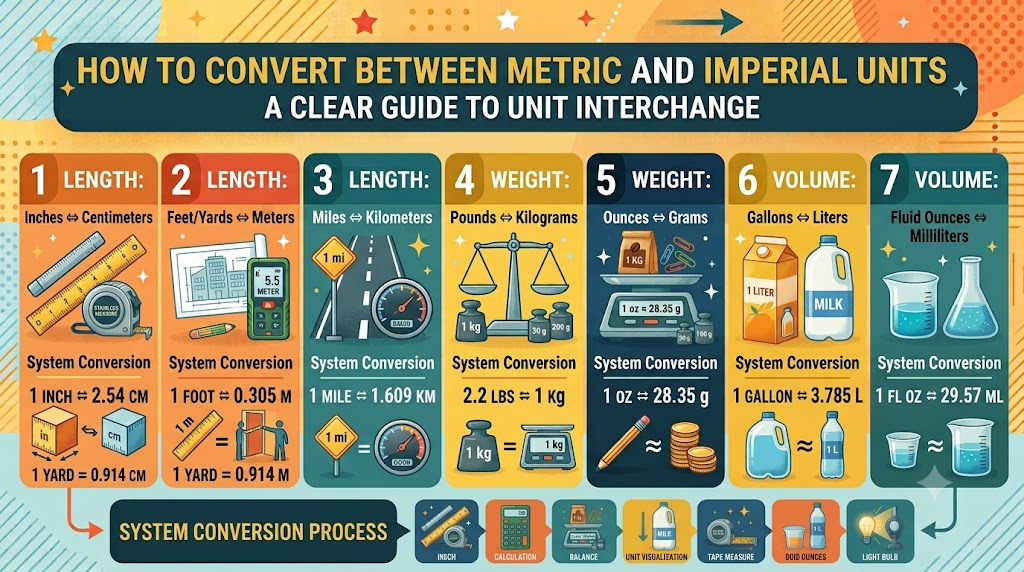
- ✅ Common conversions you'll use every day
- ✅ Easy memory tricks and shortcuts
- ✅ Real-world examples
- ✅ Common mistakes to avoid
Try it now: Use our free unit converter here
What Is Unit Conversion?
Unit conversion is simply changing a measurement from one unit to another without changing the actual amount.
The Key Idea
The number changes, but the physical quantity stays the same.
| Example | Same Amount, Different Units |
|---|---|
| 1 meter | = 3.28 feet |
| 1 kilogram | = 2.20 pounds |
| 1 liter | = 0.26 gallons |
| 0°C | = 32°F |
Why Do We Need Unit Conversion?
- Different countries use different systems — Some use metric, others use imperial
- Different fields use different units — Science uses metric, everyday life may use imperial
- Understanding information — Product labels, recipes, and signs come in different units
- Avoiding mistakes — Getting units wrong can lead to errors in cooking, medicine, travel, and more
The Golden Rule of Unit Conversion
To convert units, you just multiply or divide by a conversion factor.
The Two Simple Steps
- Find the conversion factor (the number that relates the two units)
- Multiply or divide depending on which way you're going
When to Multiply vs Divide
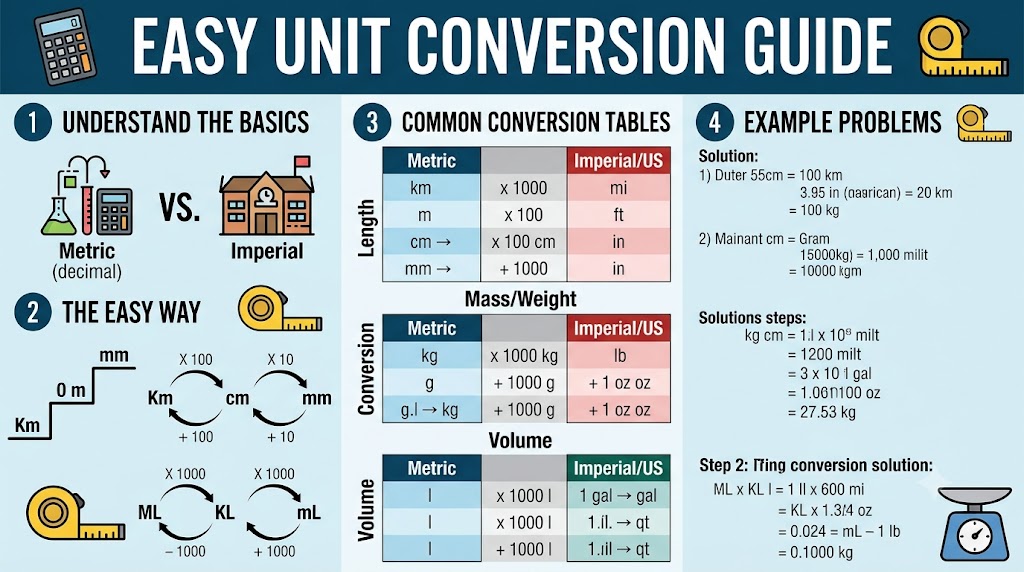
| Direction | Operation | Example |
|---|---|---|
| Going to a bigger unit | ÷ (divide) | 100 cm → 1 m |
| Going to a smaller unit | × (multiply) | 1 m → 100 cm |
Visual Guide
┌─────────────────────────────────────────────────────────────────────┐
│                     WHEN TO MULTIPLY OR DIVIDE                      │
├─────────────────────────────────────────────────────────────────────┤
│                                                                     │
│   SMALLER UNIT → LARGER UNIT:  DIVIDE                              │
│                                                                     │
│   100 cm     →    1 m          (100 ÷ 100 = 1)                     │
│   1000 mL    →    1 L          (1000 ÷ 1000 = 1)                   │
│   1000 g     →    1 kg         (1000 ÷ 1000 = 1)                   │
│                                                                     │
│   LARGER UNIT → SMALLER UNIT:  MULTIPLY                            │
│                                                                     │
│   1 m        →    100 cm       (1 × 100 = 100)                     │
│   1 L        →    1000 mL      (1 × 1000 = 1000)                   │
│   1 kg       →    1000 g       (1 × 1000 = 1000)                   │
│                                                                     │
└─────────────────────────────────────────────────────────────────────┘
The Two Measurement Systems
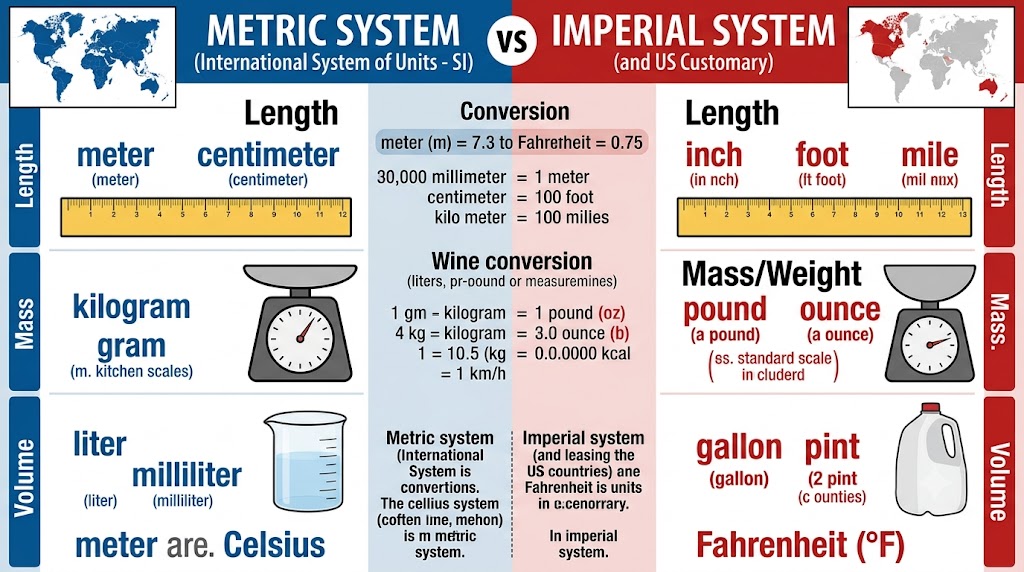
Metric System (Most of the World)
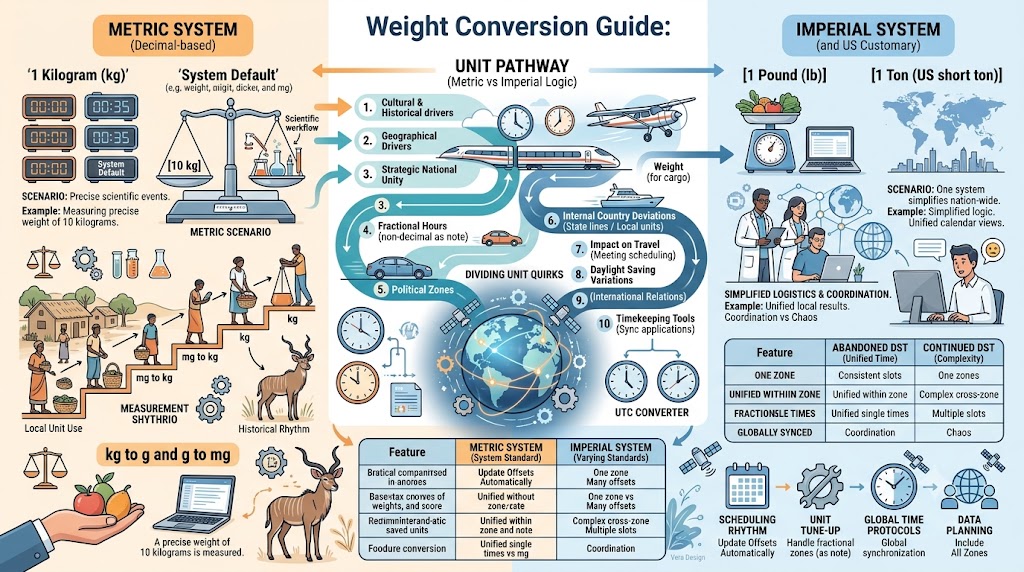
The metric system is based on powers of 10, which makes conversions very easy.
| Unit | Symbol |
|---|---|
| Length | meter (m), kilometer (km), centimeter (cm) |
| Weight | gram (g), kilogram (kg), milligram (mg) |
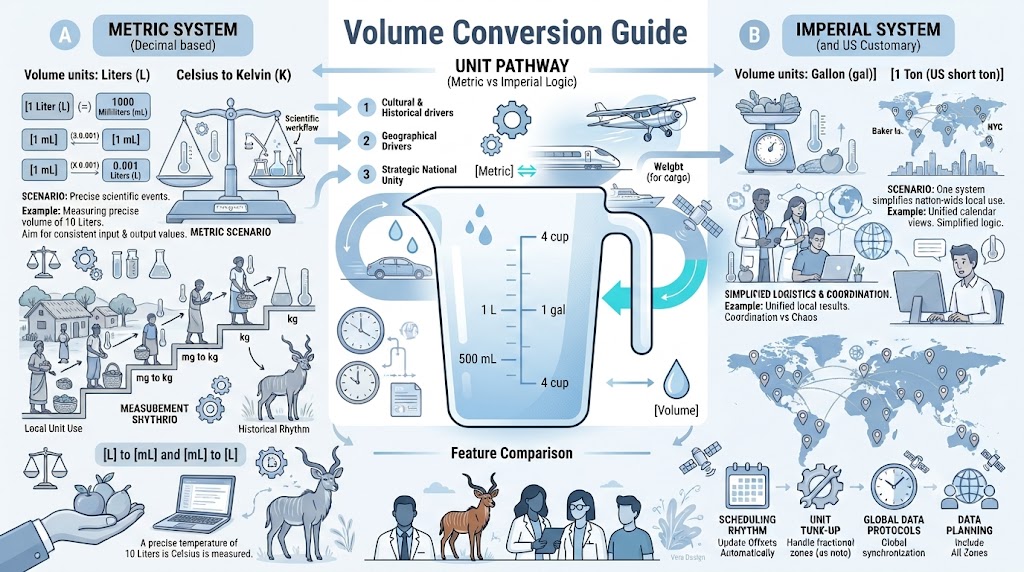
| Volume | liter (L), milliliter (mL) |
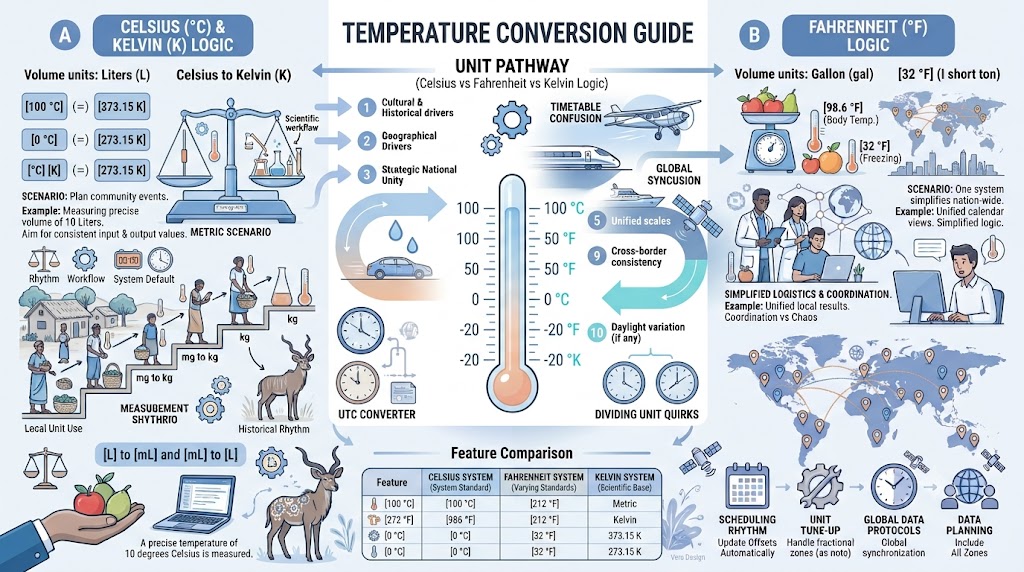
| Temperature | Celsius (°C) |
Key rule: Just move the decimal point!
| Conversion | How to Do It |
|---|---|
| km → m | Multiply by 1,000 (move decimal 3 right) |
| m → cm | Multiply by 100 (move decimal 2 right) |
| cm → m | Divide by 100 (move decimal 2 left) |
| kg → g | Multiply by 1,000 |
| L → mL | Multiply by 1,000 |
Imperial System (US and a few others)
The imperial system uses different numbers for each conversion, which takes more memorization.
| Unit | Symbol | Relationships |
|---|---|---|
| Length | inch (in), foot (ft), yard (yd), mile (mi) | 1 ft = 12 in, 1 yd = 3 ft, 1 mi = 5,280 ft |
| Weight | ounce (oz), pound (lb), ton (T) | 1 lb = 16 oz, 1 T = 2,000 lb |
| Volume | gallon (gal), quart (qt), pint (pt), cup (c) | 1 gal = 4 qt = 8 pt = 16 c |
| Temperature | Fahrenheit (°F) | — |
Most Common Everyday Conversions
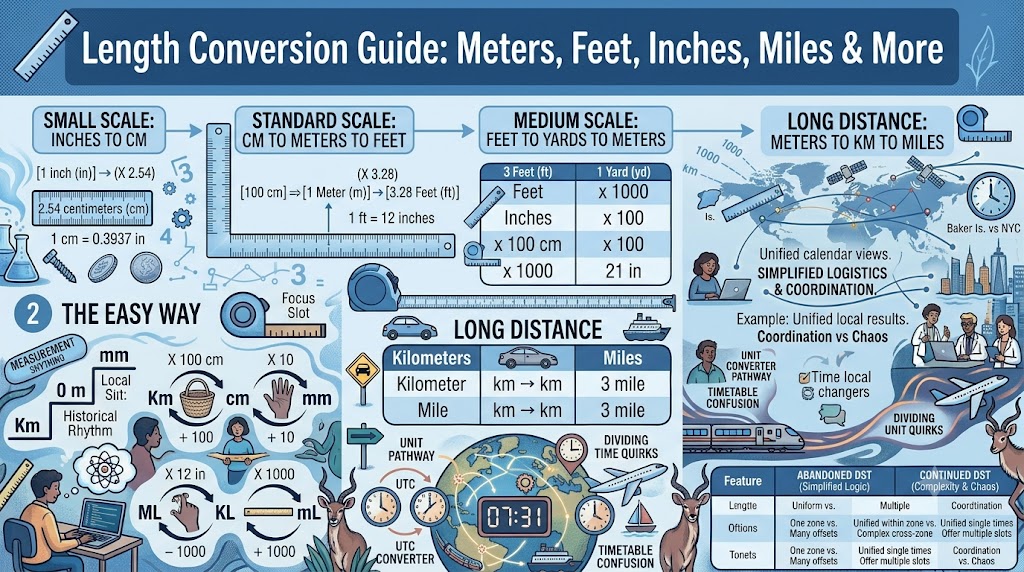
Length
| From | To | Multiply By |
|---|---|---|
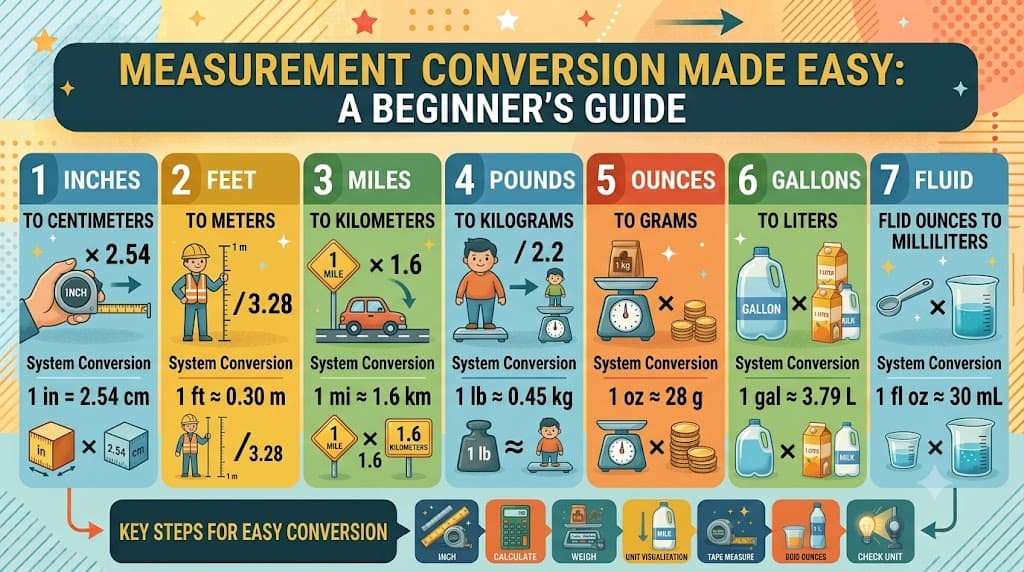
| Inches | Centimeters | 2.54 |
| Feet | Meters | 0.3048 |
| Miles | Kilometers | 1.60934 |
| Centimeters | Inches | 0.393701 |
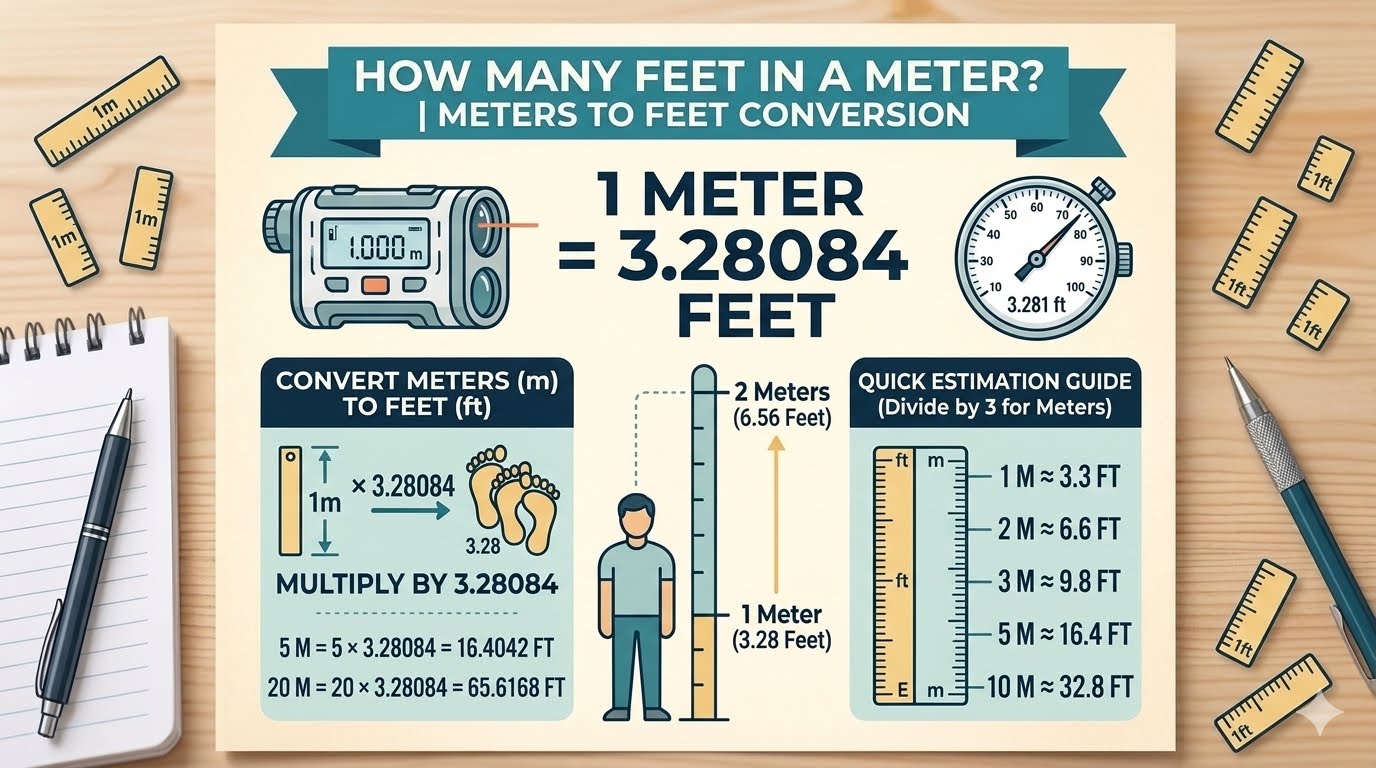
| Meters | Feet | 3.28084 |
| Kilometers | Miles | 0.621371 |
Weight
| From | To | Multiply By |
|---|---|---|
| Pounds | Kilograms | 0.453592 |
| Ounces | Grams | 28.3495 |
| Kilograms | Pounds | 2.20462 |
| Grams | Ounces | 0.035274 |
Volume
| From | To | Multiply By |
|---|---|---|
| US Gallons | Liters | 3.78541 |
| Liters | US Gallons | 0.264172 |
| Cups | Milliliters | 236.588 |
| Milliliters | Cups | 0.00422675 |
| Fluid Ounces | Milliliters | 29.5735 |
| Milliliters | Fluid Ounces | 0.033814 |
Temperature
| From | To | Formula |
|---|---|---|
| Celsius | Fahrenheit | °F = (°C × 9/5) + 32 |
| Fahrenheit | Celsius | °C = (°F − 32) × 5/9 |
Speed
| From | To | Multiply By |
|---|---|---|
| mph | km/h | 1.60934 |
| km/h | mph | 0.621371 |
| m/s | km/h | 3.6 |
| km/h | m/s | 0.277778 |
Step-by-Step Examples
Example 1: Convert 10 Inches to Centimeters
Problem: How many centimeters are in 10 inches?
Step 1: Find the conversion factor
- 1 inch = 2.54 cm
Step 2: Set up the calculation
- cm = in × 2.54
Step 3: Calculate
- 10 × 2.54 = 25.4 cm
Answer: 10 inches = 25.4 cm
Example 2: Convert 150 Pounds to Kilograms
Problem: How many kilograms are in 150 pounds?
Step 1: Find the conversion factor
- 1 lb = 0.453592 kg
Step 2: Set up the calculation
- kg = lb × 0.453592
Step 3: Calculate
- 150 × 0.453592 = 68.04 kg
Answer: 150 lb = 68.04 kg
Example 3: Convert 5 Kilometers to Miles
Problem: How many miles are in 5 kilometers?
Step 1: Find the conversion factor
- 1 km = 0.621371 mi
Step 2: Set up the calculation
- mi = km × 0.621371
Step 3: Calculate
- 5 × 0.621371 = 3.11 mi
Answer: 5 km = 3.11 miles
Example 4: Convert 1 Gallon to Liters
Problem: How many liters are in 1 US gallon?
Step 1: Find the conversion factor
- 1 gal = 3.78541 L
Step 2: Set up the calculation
- L = gal × 3.78541
Step 3: Calculate
- 1 × 3.78541 = 3.79 L
Answer: 1 US gal = 3.79 L
Example 5: Convert 25°C to Fahrenheit
Problem: What is 25°C in Fahrenheit?
Step 1: Use the formula
°F = (°C × 9/5) + 32
Step 2: Substitute
°F = (25 × 9/5) + 32
Step 3: Calculate
°F = 45 + 32
°F = 77°F
Answer: 25°C = 77°F
Memory Tricks and Shortcuts
The "King Henry" Trick for Metric
King Henry Died By Drinking Chocolate Milk
| Letter | Prefix | Factor |
|---|---|---|
| K | Kilo | 1,000 |
| H | Hecto | 100 |
| D | Deca | 10 |
| B | Base (m, g, L) | 1 |
| D | Deci | 0.1 |
| C | Centi | 0.01 |
| M | Milli | 0.001 |
Temperature Memory Tricks
Celsius to Fahrenheit: Double it and add 30
- 20°C × 2 + 30 = 70°F (exact: 68°F)
- 30°C × 2 + 30 = 90°F (exact: 86°F)
Fahrenheit to Celsius: Subtract 30 and halve it
- 80°F − 30 = 50; 50 ÷ 2 = 25°C (exact: 26.7°C)
Length Memory Tricks
| Estimate | Exact |
|---|---|
| 1 inch ≈ 2.5 cm | 1 in = 2.54 cm |
| 1 meter ≈ 3.3 ft | 1 m = 3.28 ft |
| 1 mile ≈ 1.6 km | 1 mi = 1.61 km |
Weight Memory Tricks
| Estimate | Exact |
|---|---|
| 1 kg ≈ 2.2 lb | 1 kg = 2.20 lb |
| 1 lb ≈ 0.45 kg | 1 lb = 0.45 kg |
| 1 oz ≈ 30 g | 1 oz = 28.35 g |
Volume Memory Tricks
| Estimate | Exact |
|---|---|
| 1 gal ≈ 4 L | 1 gal = 3.79 L |
| 1 L ≈ 0.25 gal | 1 L = 0.26 gal |
| 1 cup ≈ 240 mL | 1 cup = 236.6 mL |
| 1 fl oz ≈ 30 mL | 1 fl oz = 29.57 mL |
Real-World Conversion Scenarios
1. Traveling Internationally
Scenario: You're driving in Europe and see a speed limit sign: 100 km/h.
Quick mental math: 100 × 0.6 = 60 mph
Answer: 100 km/h ≈ 62 mph
2. Following a Recipe
Scenario: A recipe calls for 2 cups of flour, but your measuring cup is in milliliters.
Quick mental math: 2 × 240 = 480 mL
Answer: 2 cups ≈ 480 mL
3. Buying Furniture
Scenario: A TV is 55 inches. You want to know the size in centimeters.
Quick mental math: 55 × 2.5 = 137.5 cm
Answer: 55 in ≈ 140 cm
4. Weight Tracking
Scenario: You weigh 70 kg and want to know your weight in pounds.
Quick mental math: 70 × 2.2 = 154 lb
Answer: 70 kg ≈ 154 lb
5. Fuel Purchase
Scenario: You buy 50 liters of gas and want to know how many gallons that is.
Quick mental math: 50 × 0.26 = 13 gallons
Answer: 50 L ≈ 13.2 gallons
6. Weather
Scenario: The weather forecast says 25°C. You want to know the temperature in Fahrenheit.
Quick mental math: 25 × 2 + 30 = 80°F
Answer: 25°C ≈ 77°F
Conversion Cheat Sheet
Quick Reference Card
╔══════════════════════════════════════════════════════════════════╗
║                    CONVERSION CHEAT SHEET                         ║
╠══════════════════════════════════════════════════════════════════╣
║                                                                  ║
║  LENGTH:                                                         ║
║  1 in  = 2.54 cm      |     1 cm  = 0.394 in                   ║
║  1 ft  = 0.305 m      |     1 m   = 3.281 ft                   ║
║  1 mi  = 1.609 km     |     1 km  = 0.621 mi                   ║
║                                                                  ║
║  WEIGHT:                                                         ║
║  1 lb  = 0.454 kg     |     1 kg  = 2.205 lb                   ║
║  1 oz  = 28.35 g      |     1 g   = 0.035 oz                   ║
║                                                                  ║
║  VOLUME:                                                         ║
║  1 gal = 3.785 L      |     1 L   = 0.264 gal                  ║
║  1 cup = 236.6 mL     |     1 mL  = 0.004 cup                  ║
║  1 fl oz = 29.57 mL   |     1 mL  = 0.034 fl oz                ║
║                                                                  ║
║  TEMPERATURE:                                                    ║
║  °C → °F: (°C × 9/5) + 32                                       ║
║  °F → °C: (°F − 32) × 5/9                                       ║
║  0°C = 32°F     |     100°C = 212°F                            ║
║  20°C = 68°F    |     37°C = 98.6°F                            ║
║                                                                  ║
║  SPEED:                                                          ║
║  1 mph = 1.609 km/h |     1 km/h = 0.621 mph                   ║
║  1 knot = 1.852 km/h |     1 m/s = 3.6 km/h                    ║
║                                                                  ║
╚══════════════════════════════════════════════════════════════════╝
Common Mistakes to Avoid
Mistake 1: Multiplying Instead of Dividing
Mistake: Converting 100 cm to meters by multiplying.
Correct: 100 cm ÷ 100 = 1 m
Mistake 2: Using the Wrong Temperature Formula
Mistake: Using °C × 1.8 without adding 32.
Correct: °F = (°C × 1.8) + 32
Mistake 3: Confusing US and UK Gallons
Mistake: Using 3.785 L for a UK gallon.
Correct: US gallon = 3.785 L, UK gallon = 4.546 L
Mistake 4: Forgetting 16 Ounces in a Pound
Mistake: Thinking there are 12 ounces in a pound.
Correct: 1 pound = 16 ounces
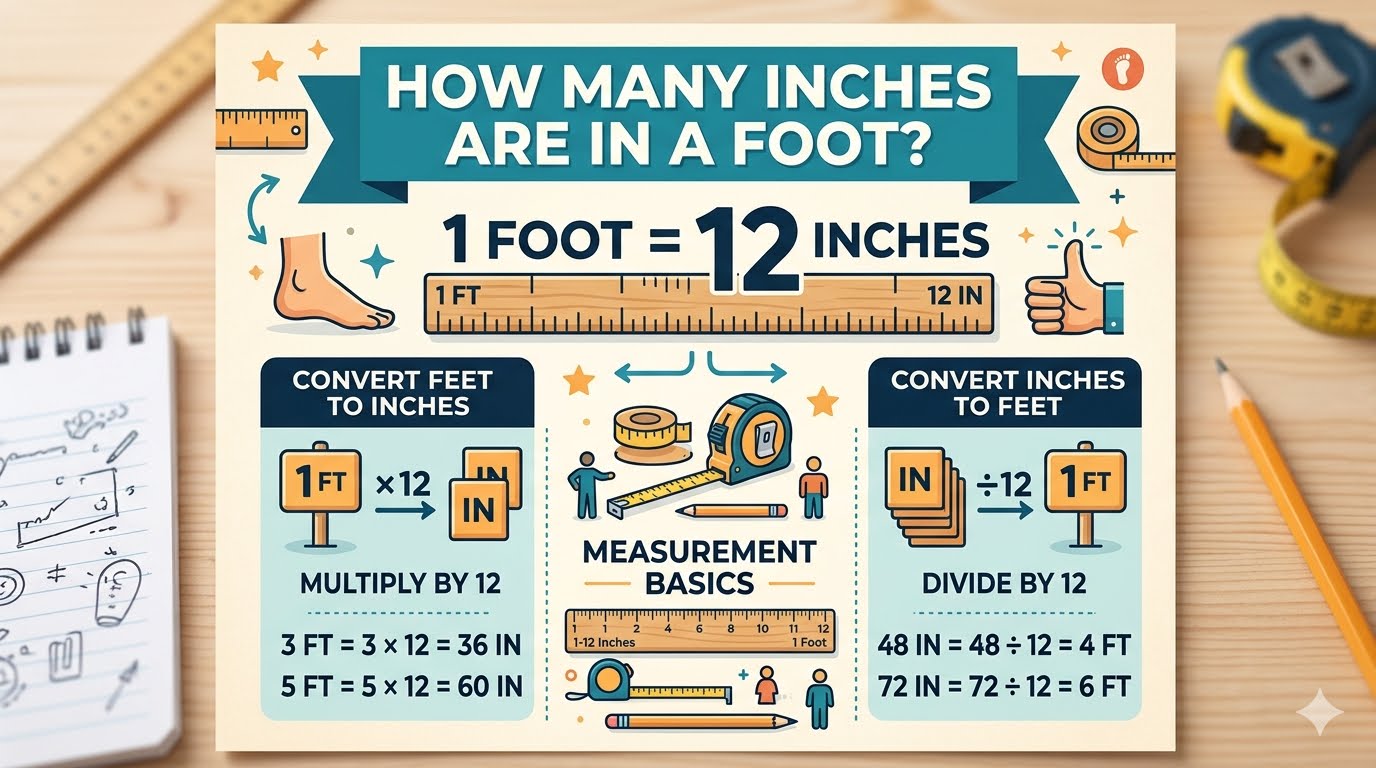
Mistake 5: Forgetting 12 Inches in a Foot
Mistake: Thinking there are 10 inches in a foot.
Correct: 1 foot = 12 inches
Mistake 6: Rounding Too Early
Mistake: Rounding intermediate values in multi-step conversions.
Correct: Keep full precision until the final answer, then round.
How to Use a Unit Converter Tool
Using a digital unit converter is the easiest and most accurate way to convert units:
- Select the category — Length, Weight, Volume, Temperature, etc.
- Choose the input unit — What unit do you have?
- Choose the output unit — What unit do you want?
- Enter the value — Type the number you want to convert
- Get the result — Instant, accurate answer
Why Use a Converter Tool?
| Advantage | Benefit |
|---|---|
| Accuracy | No math errors |
| Speed | Instant results |
| Convenience | No memorizing formulas |
| Units | Supports hundreds of units |
| Step-by-step | Shows how the answer was found |
Frequently Asked Questions
Q: What is the easiest way to convert units?
Use a unit converter tool. For mental math, memorize the most common conversion factors.
Q: How do I know whether to multiply or divide?
If you're going to a larger unit, divide. If you're going to a smaller unit, multiply.
Q: What's the difference between metric and imperial?
Metric is decimal-based (powers of 10) and used by most countries. Imperial has inconsistent factors and is used primarily in the US.
Q: How do I convert temperatures?
°F = (°C × 9/5) + 32
°C = (°F − 32) × 5/9
Q: How many inches are in a foot?
1 foot = 12 inches
Q: How many ounces are in a pound?
1 pound = 16 ounces
Q: How many cups are in a gallon?
1 US gallon = 16 cups
Q: How do I convert units quickly in my head?
Use shortcuts: 1 kg ≈ 2.2 lb, 1 mile ≈ 1.6 km, 1 inch ≈ 2.5 cm.
Q: What is the most common unit conversion?
Length conversions (inches to cm, miles to km) and temperature conversions (°F to °C) are the most common.
Q: Which countries use metric vs imperial?
Metric: Most countries. Imperial: US, UK (some), and a few others.
Try the Unit Converter
Ready to convert units the easy way? Use our free unit converter at:
https://www.easyconvertunits.com/
It supports all common measurement units with instant, accurate conversions and a clean, easy-to-use interface.
Final Thoughts
Unit conversion doesn't have to be scary. Once you understand the basic principles — multiply or divide by a conversion factor — you're ready to convert any measurement.
Key takeaways for beginners:
- Unit conversion is just multiplying or dividing
- Going to a bigger unit? Divide.
- Going to a smaller unit? Multiply.
- Start with common conversions — length, weight, volume, temperature
- Use memory tricks to remember key conversions
- Use a converter tool for precision and speed
Remember: The number changes, but the actual amount stays the same. 1 meter is still 1 meter, whether you call it 3.28 feet or 100 centimeters!
Tags: measurement conversion, beginners guide, how to convert units, unit conversion, metric system, imperial system, length conversion, weight conversion, volume conversion, temperature conversion, speed conversion, conversion tips, easy conversion, measurement guide, learn unit conversion, convert units easily, unit conversion for beginners, measurement basics, understanding units, conversion made simple, free unit converter, online unit converter