How to Convert Between Metric and Imperial Units – Complete Guide
If you've ever traveled internationally, followed a foreign recipe, or tried to understand product dimensions from another country, you've faced the challenge of converting between metric and imperial units. These two measurement systems are used around the world, and knowing how to switch between them is essential.
In this comprehensive guide, we'll cover everything you need to know about converting between metric and imperial units, including:
- ✅ The key differences between the two systems
- ✅ Step-by-step conversion methods
- ✅ Formulas for length, weight, volume, temperature, and speed
- ✅ Quick reference tables
- ✅ Mental math shortcuts
- ✅ Real-world examples
Try it now: Use our free unit converter here
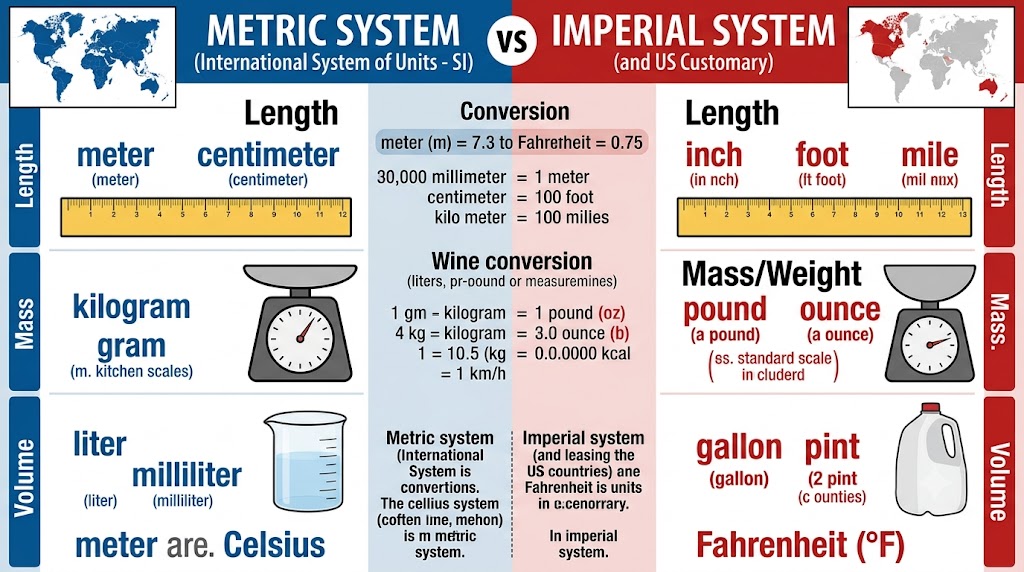
Metric vs Imperial: Quick Overview
Metric System (SI)
- Used by: Most countries worldwide
- Base units: Meter (length), Kilogram (mass), Liter (volume), Celsius (temperature)
- Key feature: Decimal-based (powers of 10)
- Example: 1 km = 1,000 m = 100,000 cm = 1,000,000 mm
Imperial System (US Customary)
- Used by: United States, UK (some), few others
- Base units: Foot (length), Pound (mass), Gallon (volume), Fahrenheit (temperature)
- Key feature: Inconsistent conversion factors
- Example: 1 mile = 1,760 yd = 5,280 ft = 63,360 in
Why Convert?
| Reason | Example |
|---|---|
| Travel | Understanding speed limits abroad |
| Cooking | Following international recipes |
| Shopping | Buying products from other countries |
| Science | Reading international research |
| Work | Collaborating with global teams |
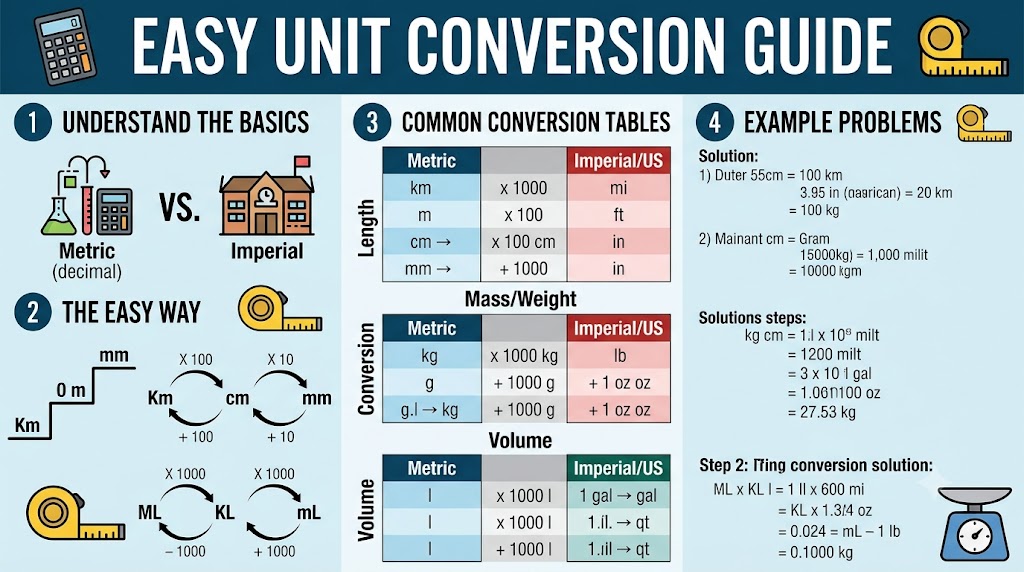
Length Conversions
Metric → Imperial
| From (Metric) | To (Imperial) | Formula | Example |
|---|---|---|---|
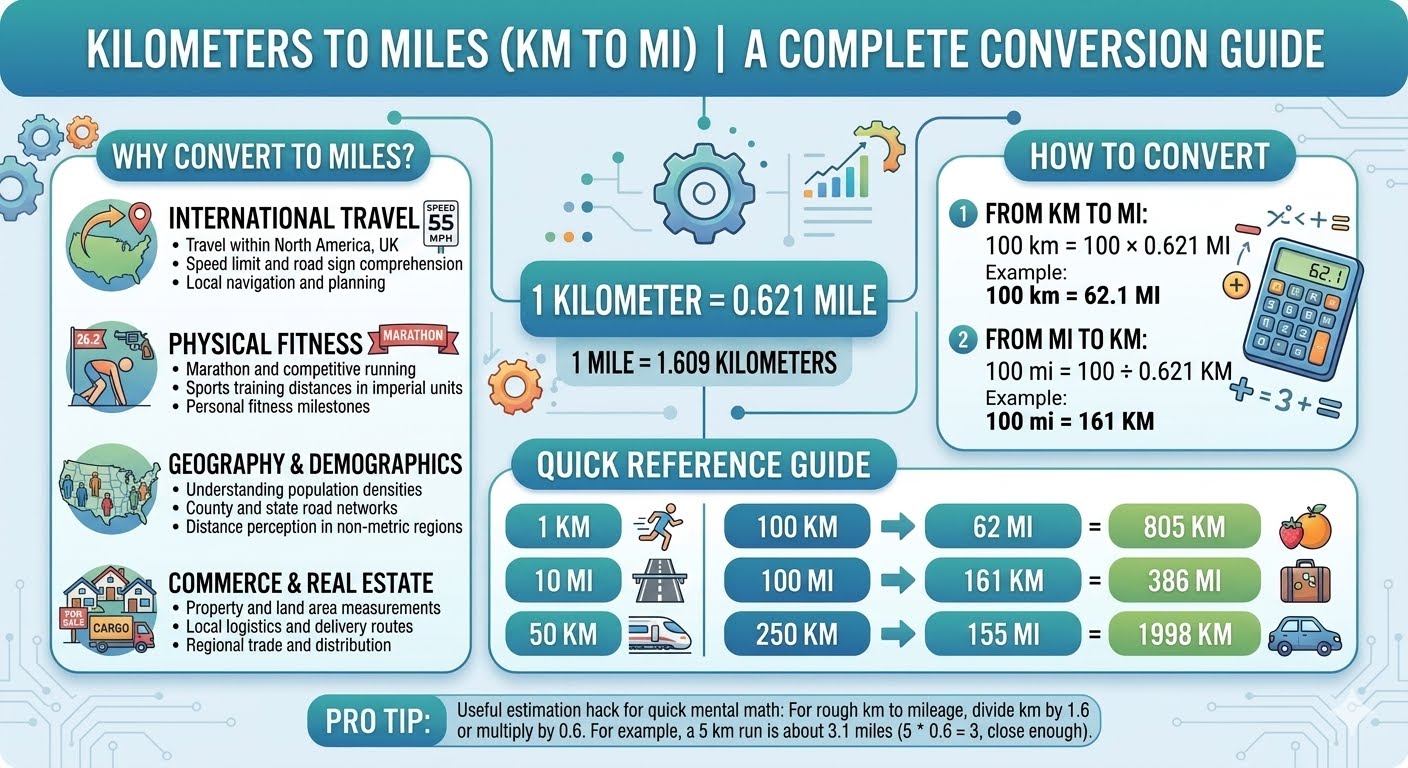
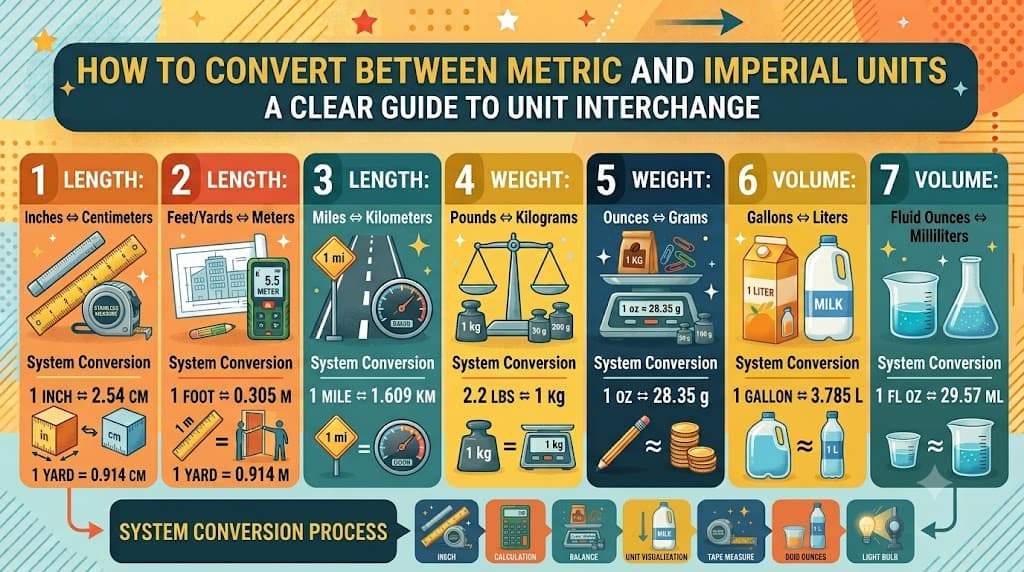
| Kilometers (km) | Miles (mi) | mi = km × 0.621371 | 10 km = 6.21 mi |
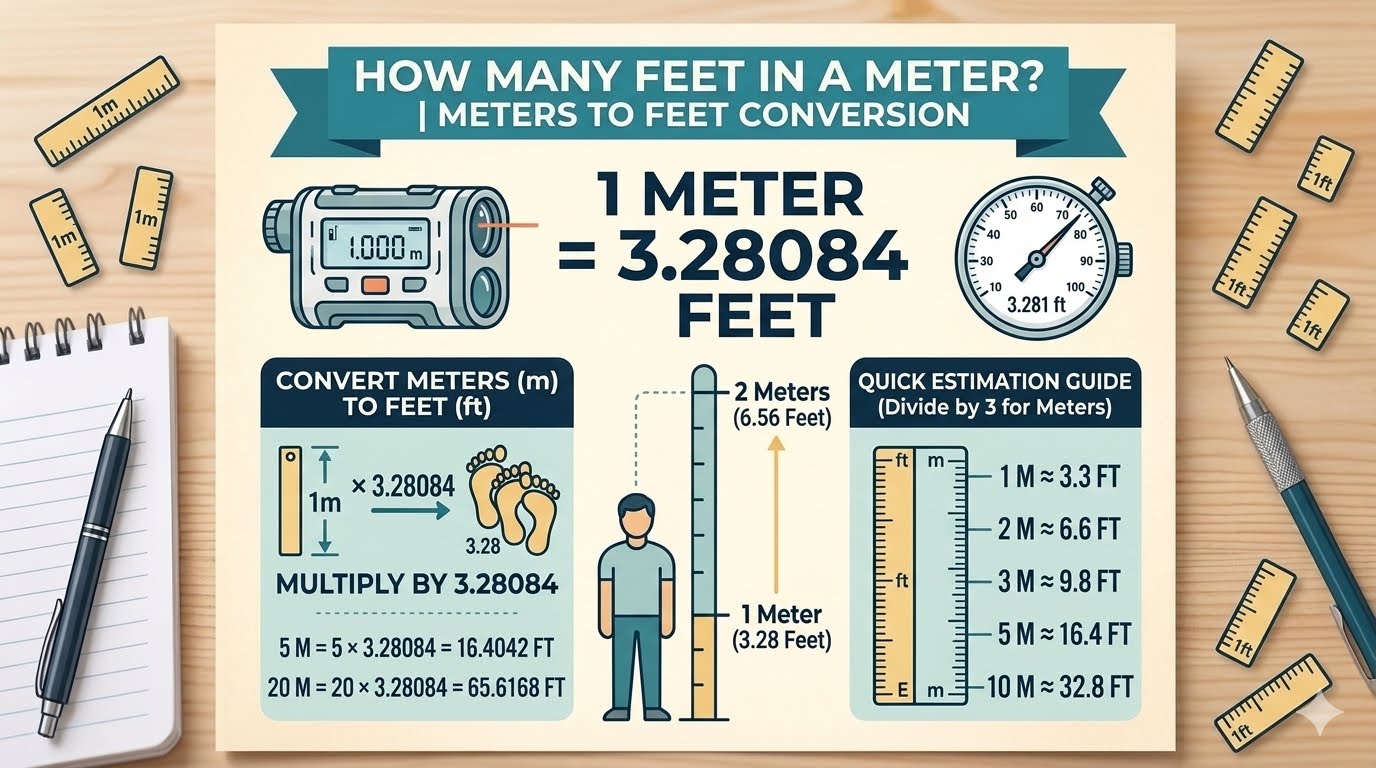
| Meters (m) | Feet (ft) | ft = m × 3.28084 | 10 m = 32.81 ft |
| Meters (m) | Yards (yd) | yd = m × 1.09361 | 10 m = 10.94 yd |
| Centimeters (cm) | Inches (in) | in = cm × 0.393701 | 10 cm = 3.94 in |
| Millimeters (mm) | Inches (in) | in = mm × 0.039370 | 10 mm = 0.39 in |
Imperial → Metric
| From (Imperial) | To (Metric) | Formula | Example |
|---|---|---|---|
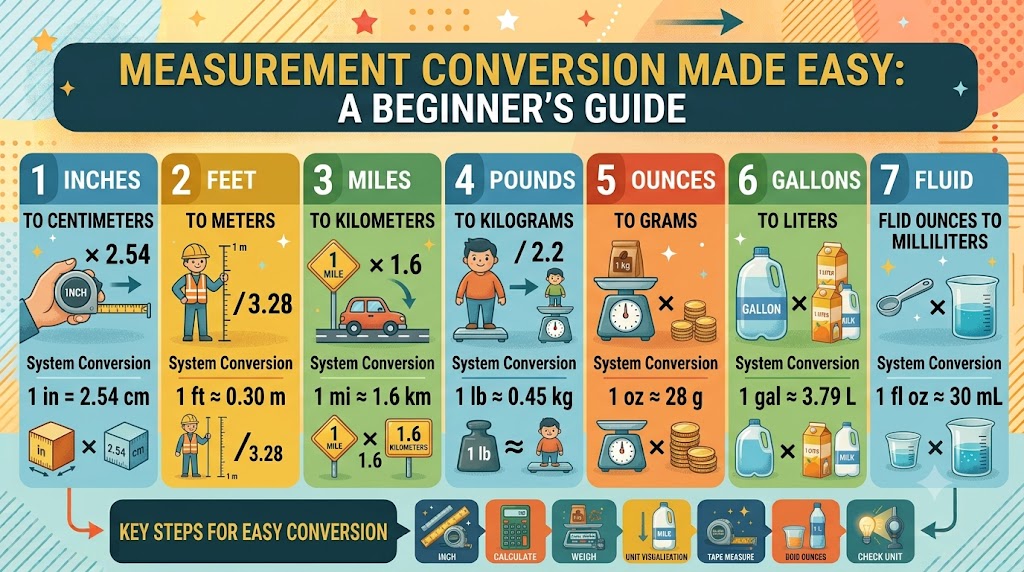
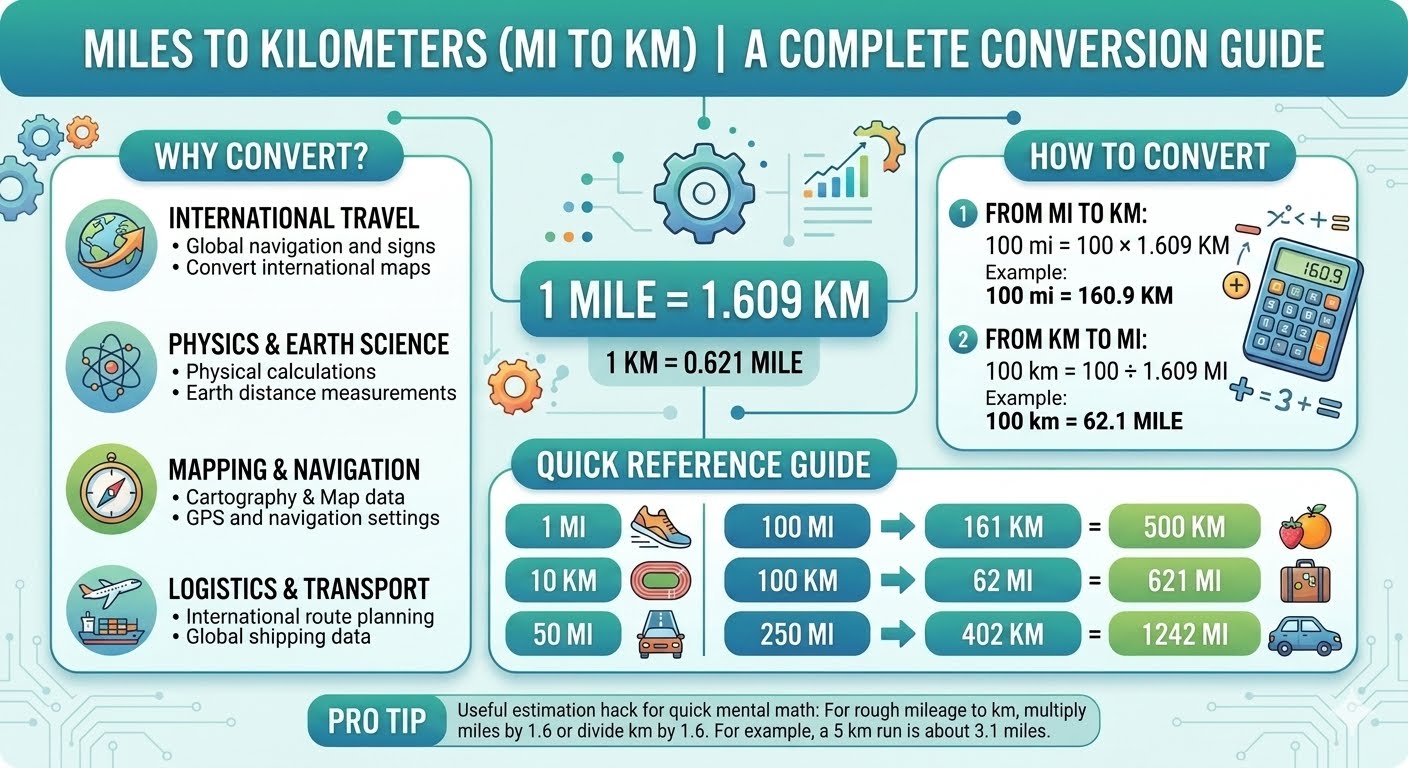
| Miles (mi) | Kilometers (km) | km = mi × 1.60934 | 10 mi = 16.09 km |
| Feet (ft) | Meters (m) | m = ft × 0.3048 | 10 ft = 3.05 m |
| Yards (yd) | Meters (m) | m = yd × 0.9144 | 10 yd = 9.14 m |
| Inches (in) | Centimeters (cm) | cm = in × 2.54 | 10 in = 25.4 cm |
| Inches (in) | Millimeters (mm) | mm = in × 25.4 | 10 in = 254 mm |
Quick Length Estimates
| Conversion | Quick Mental Math |
|---|---|
| km → mi | ÷ 1.6 (or × 0.6) |
| mi → km | × 1.6 (or × 8/5) |
| m → ft | × 3.3 |
| ft → m | ÷ 3.3 |
| cm → in | ÷ 2.5 |
| in → cm | × 2.5 |
Example: 100 km to Miles
Problem: Convert 100 kilometers to miles.
Step 1: Use the formula
mi = km × 0.621371
Step 2: Substitute
mi = 100 × 0.621371
Step 3: Calculate
mi = 62.14 mi
Answer: 100 km = 62.14 miles
Weight Conversions
Metric → Imperial
| From (Metric) | To (Imperial) | Formula | Example |
|---|---|---|---|
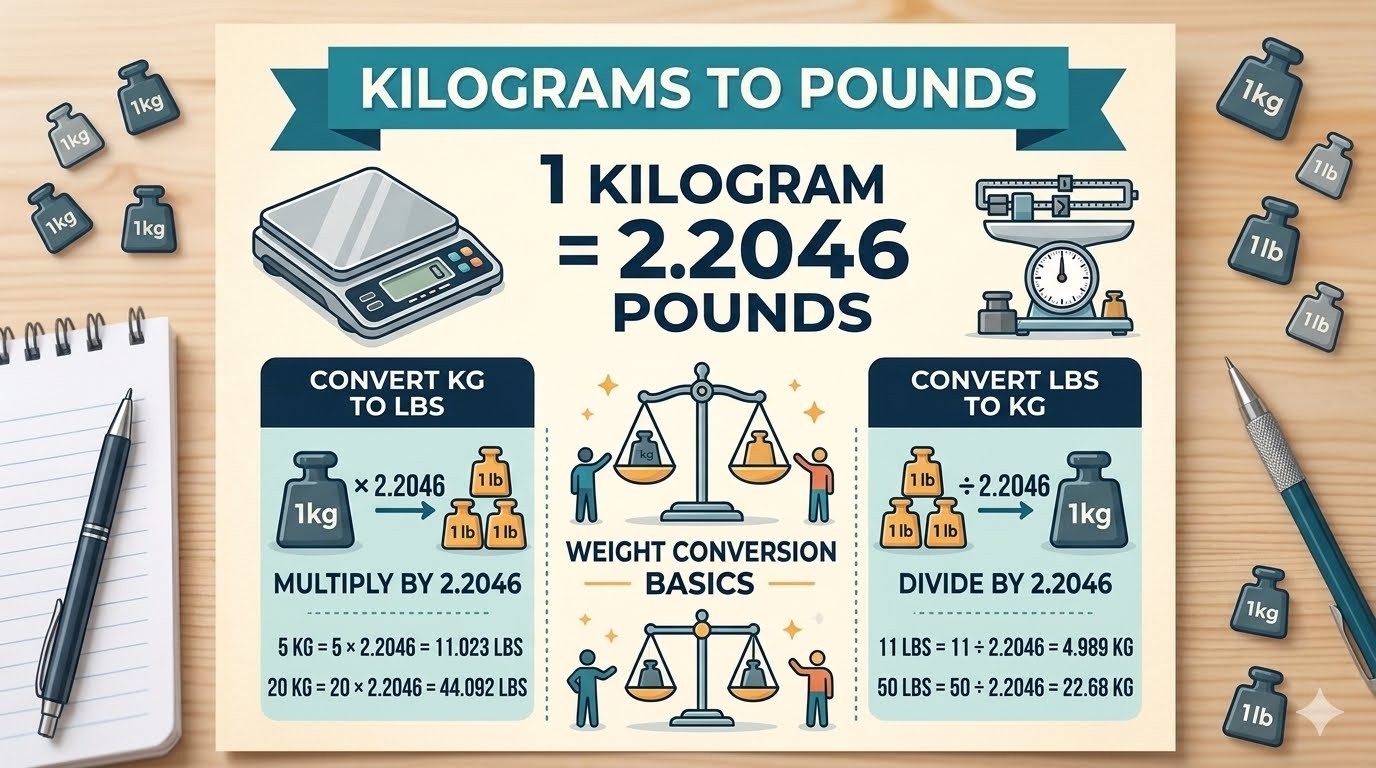
| Kilograms (kg) | Pounds (lb) | lb = kg × 2.20462 | 10 kg = 22.05 lb |
| Kilograms (kg) | Ounces (oz) | oz = kg × 35.274 | 10 kg = 352.74 oz |
| Grams (g) | Ounces (oz) | oz = g × 0.035274 | 100 g = 3.53 oz |
| Metric Tons (t) | Short Tons (T) | T = t × 1.10231 | 1 t = 1.10 T |
Imperial → Metric
| From (Imperial) | To (Metric) | Formula | Example |
|---|---|---|---|
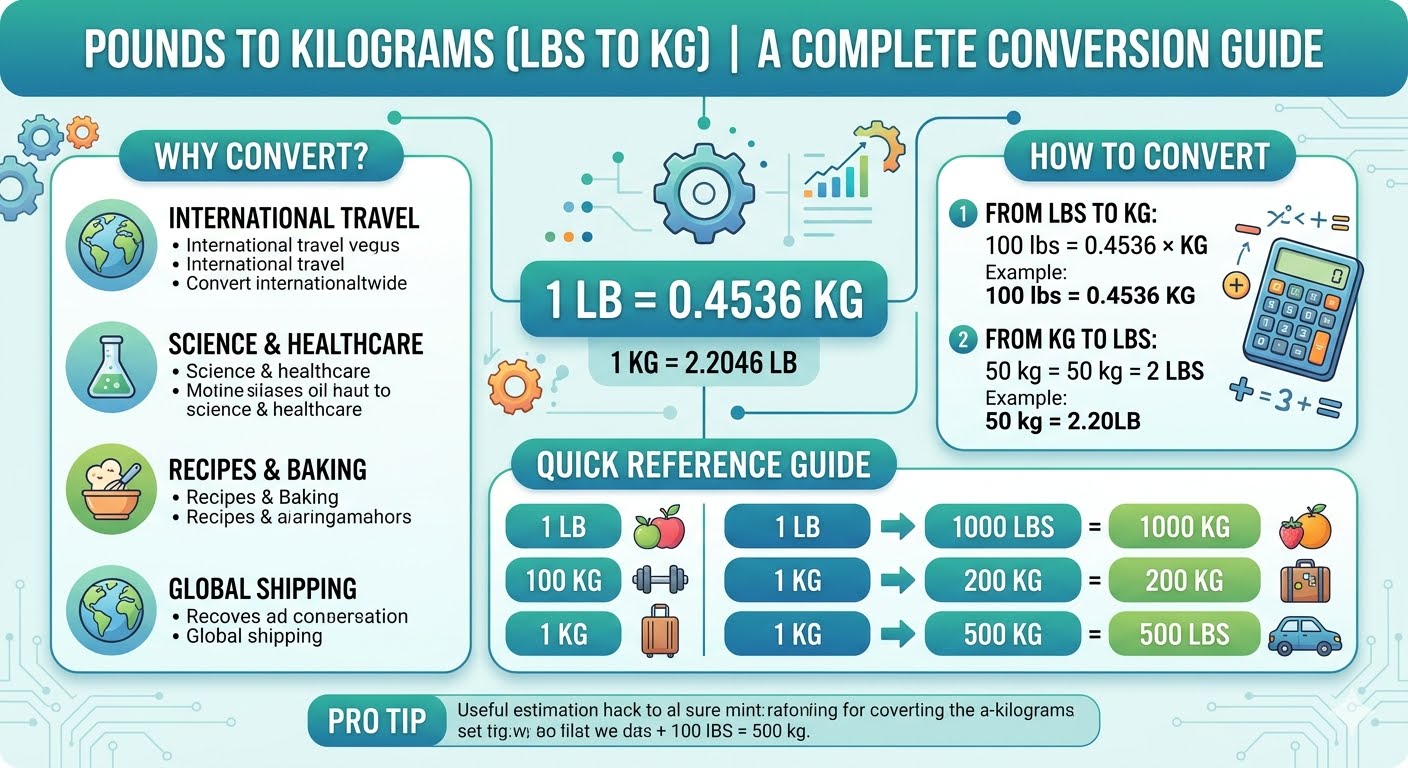
| Pounds (lb) | Kilograms (kg) | kg = lb × 0.453592 | 10 lb = 4.54 kg |
| Ounces (oz) | Grams (g) | g = oz × 28.3495 | 10 oz = 283.5 g |
| Ounces (oz) | Kilograms (kg) | kg = oz × 0.0283495 | 10 oz = 0.283 kg |
| Stones (st) | Kilograms (kg) | kg = st × 6.35029 | 10 st = 63.50 kg |
| Short Tons (T) | Metric Tons (t) | t = T × 0.907185 | 1 T = 0.907 t |
Quick Weight Estimates
| Conversion | Quick Mental Math |
|---|---|
| kg → lb | × 2.2 (or × 2 + 10%) |
| lb → kg | ÷ 2.2 (or ÷ 2 - 10%) |
| g → oz | ÷ 28 |
| oz → g | × 28 |
Example: 150 lb to kg
Problem: Convert 150 pounds to kilograms.
Step 1: Use the formula
kg = lb × 0.453592
Step 2: Substitute
kg = 150 × 0.453592
Step 3: Calculate
kg = 68.04 kg
Answer: 150 lb = 68.04 kg
Volume Conversions
Metric → Imperial
| From (Metric) | To (Imperial) | Formula | Example |
|---|---|---|---|
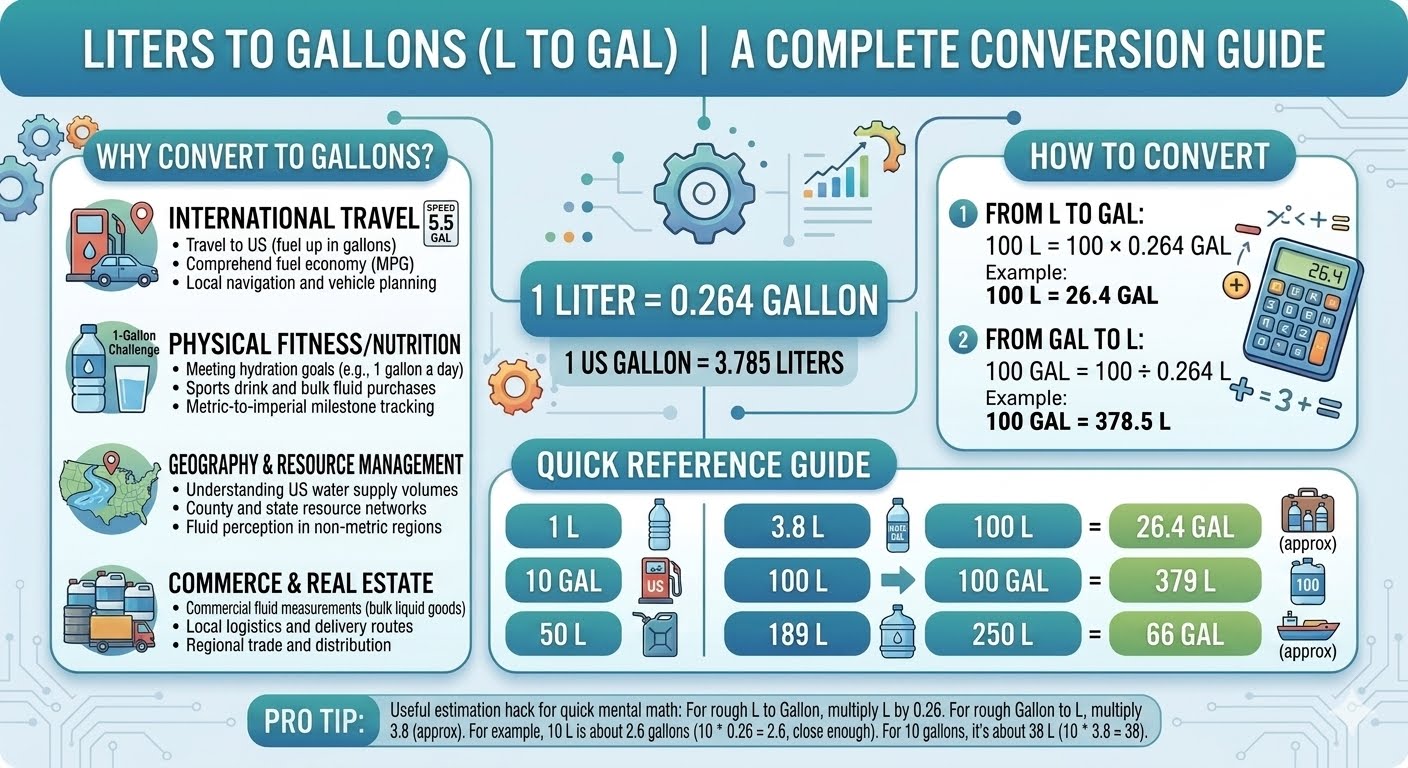
| Liters (L) | US Gallons (gal) | gal = L × 0.264172 | 10 L = 2.64 gal |
| Liters (L) | US Quarts (qt) | qt = L × 1.05669 | 10 L = 10.57 qt |
| Liters (L) | US Pints (pt) | pt = L × 2.11338 | 10 L = 21.13 pt |
| Liters (L) | US Cups (cup) | cup = L × 4.22675 | 10 L = 42.27 cup |
| Milliliters (mL) | US Fluid Ounces (fl oz) | fl oz = mL × 0.033814 | 100 mL = 3.38 fl oz |
Imperial → Metric
| From (Imperial) | To (Metric) | Formula | Example |
|---|---|---|---|
| US Gallons (gal) | Liters (L) | L = gal × 3.78541 | 1 gal = 3.79 L |
| US Quarts (qt) | Liters (L) | L = qt × 0.946353 | 1 qt = 0.946 L |
| US Pints (pt) | Liters (L) | L = pt × 0.473176 | 1 pt = 0.473 L |
| US Cups (cup) | Milliliters (mL) | mL = cup × 236.588 | 1 cup = 236.6 mL |
| US Fluid Ounces (fl oz) | Milliliters (mL) | mL = fl oz × 29.5735 | 1 fl oz = 29.57 mL |
⚠️ Important: US vs UK Gallons
| US Gallon | UK (Imperial) Gallon | |
|---|---|---|
| Liters | 3.785 L | 4.546 L |
| Difference | Smaller | About 20% larger |
Quick Volume Estimates
| Conversion | Quick Mental Math |
|---|---|
| L → gal | × 0.26 (or ÷ 4) |
| gal → L | × 3.8 (or × 4) |
| mL → fl oz | ÷ 30 |
| fl oz → mL | × 30 |
| L → cups | × 4.2 |
| cup → mL | × 240 |
Example: 5 Gallons to Liters
Problem: Convert 5 US gallons to liters.
Step 1: Use the formula
L = gal × 3.78541
Step 2: Substitute
L = 5 × 3.78541
Step 3: Calculate
L = 18.93 L
Answer: 5 US gal = 18.93 L
Temperature Conversions
Metric ↔ Imperial
| From | To | Formula | Example |
|---|---|---|---|
| Celsius (°C) | Fahrenheit (°F) | °F = (°C × 9/5) + 32 | 25°C = 77°F |
| Fahrenheit (°F) | Celsius (°C) | °C = (°F − 32) × 5/9 | 77°F = 25°C |
| Celsius (°C) | Kelvin (K) | K = °C + 273.15 | 25°C = 298.15 K |
| Kelvin (K) | Celsius (°C) | °C = K − 273.15 | 298.15 K = 25°C |
| Fahrenheit (°F) | Kelvin (K) | K = (°F − 32) × 5/9 + 273.15 | 77°F = 298.15 K |
| Kelvin (K) | Fahrenheit (°F) | °F = (K − 273.15) × 9/5 + 32 | 298.15 K = 77°F |
Common Temperature Reference Points
| Description | °C | °F | K |
|---|---|---|---|
| Absolute Zero | -273.15°C | -459.67°F | 0 K |
| Water Freezes | 0°C | 32°F | 273.15 K |
| Room Temperature | 20-22°C | 68-72°F | 293-295 K |
| Body Temperature | 37°C | 98.6°F | 310.15 K |
| Water Boils | 100°C | 212°F | 373.15 K |
Quick Temperature Estimates
| Conversion | Quick Mental Math |
|---|---|
| °C → °F | × 2 + 30 |
| °F → °C | (− 30) ÷ 2 |
| °C → K | + 273 |
| K → °C | − 273 |
Example: 68°F to Celsius
Problem: Convert 68°F to Celsius.
Step 1: Use the formula
°C = (°F − 32) × 5/9
Step 2: Substitute
°C = (68 − 32) × 5/9
Step 3: Calculate
°C = 36 × 5/9
°C = 20°C
Answer: 68°F = 20°C
Speed Conversions
Metric → Imperial
| From (Metric) | To (Imperial) | Formula | Example |
|---|---|---|---|
| km/h | mph | mph = km/h × 0.621371 | 100 km/h = 62.1 mph |
| m/s | mph | mph = m/s × 2.23694 | 10 m/s = 22.37 mph |
| m/s | ft/s | ft/s = m/s × 3.28084 | 10 m/s = 32.81 ft/s |
Imperial → Metric
| From (Imperial) | To (Metric) | Formula | Example |
|---|---|---|---|
| mph | km/h | km/h = mph × 1.60934 | 60 mph = 96.56 km/h |
| mph | m/s | m/s = mph × 0.44704 | 60 mph = 26.82 m/s |
| ft/s | m/s | m/s = ft/s × 0.3048 | 10 ft/s = 3.05 m/s |
| knots | km/h | km/h = kn × 1.852 | 10 kn = 18.52 km/h |
Quick Speed Estimates
| Conversion | Quick Mental Math |
|---|---|
| km/h → mph | × 0.6 (or ÷ 1.6) |
| mph → km/h | × 1.6 |
| m/s → km/h | × 3.6 |
| km/h → m/s | ÷ 3.6 |
| knots → km/h | × 1.85 |
Example: 60 mph to km/h
Problem: Convert 60 mph to km/h.
Step 1: Use the formula
km/h = mph × 1.60934
Step 2: Substitute
km/h = 60 × 1.60934
Step 3: Calculate
km/h = 96.56 km/h
Answer: 60 mph = 96.56 km/h
Complete Conversion Reference Tables
Length
| Unit | Abbrev. | Metric Value | Imperial Value |
|---|---|---|---|
| Meter | m | 1 m | 3.28084 ft |
| Kilometer | km | 1,000 m | 0.621371 mi |
| Centimeter | cm | 0.01 m | 0.393701 in |
| Millimeter | mm | 0.001 m | 0.039370 in |
| Inch | in | 0.0254 m | 1 in |
| Foot | ft | 0.3048 m | 1 ft |
| Yard | yd | 0.9144 m | 3 ft |
| Mile | mi | 1,609.34 m | 5,280 ft |
Weight
| Unit | Abbrev. | Metric Value | Imperial Value |
|---|---|---|---|
| Kilogram | kg | 1 kg | 2.20462 lb |
| Gram | g | 0.001 kg | 0.035274 oz |
| Pound | lb | 0.453592 kg | 1 lb |
| Ounce | oz | 0.0283495 kg | 1 oz |
| Stone | st | 6.35029 kg | 14 lb |
| Metric Ton | t | 1,000 kg | 1.10231 T |
| Short Ton | T | 907.185 kg | 1 T |
Volume
| Unit | Abbrev. | Metric Value | Imperial Value |
|---|---|---|---|
| Liter | L | 1 L | 0.264172 gal |
| Milliliter | mL | 0.001 L | 0.033814 fl oz |
| US Gallon | us_gal | 3.78541 L | 1 gal |
| US Quart | us_qt | 0.946353 L | 1 qt |
| US Pint | us_pt | 0.473176 L | 1 pt |
| US Cup | us_cup | 0.236588 L | 1 cup |
| US Fluid Ounce | us_floz | 0.0295735 L | 1 fl oz |
Mental Math Cheat Sheet
Quick Reference Card
╔══════════════════════════════════════════════════════════════════╗
║              METRIC ↔ IMPERIAL CONVERSION CHEAT SHEET            ║
╠══════════════════════════════════════════════════════════════════╣
║                                                                  ║
║  LENGTH:                                                         ║
║  1 km ≈ 0.6 mi     |     1 mi ≈ 1.6 km                        ║
║  1 m ≈ 3.3 ft      |     1 ft ≈ 0.3 m                         ║
║  1 cm ≈ 0.4 in     |     1 in ≈ 2.5 cm                        ║
║                                                                  ║
║  WEIGHT:                                                         ║
║  1 kg ≈ 2.2 lb     |     1 lb ≈ 0.45 kg                       ║
║  1 g ≈ 0.04 oz     |     1 oz ≈ 28 g                          ║
║                                                                  ║
║  VOLUME:                                                         ║
║  1 L ≈ 0.26 gal    |     1 gal ≈ 3.8 L                        ║
║  1 L ≈ 4.2 cups    |     1 cup ≈ 240 mL                       ║
║  1 mL ≈ 0.034 fl oz |     1 fl oz ≈ 30 mL                     ║
║                                                                  ║
║  TEMPERATURE:                                                    ║
║  °C → °F:  × 2 + 30                                             ║
║  °F → °C:  (− 30) ÷ 2                                           ║
║  0°C = 32°F     |     100°C = 212°F                            ║
║                                                                  ║
║  SPEED:                                                          ║
║  1 mph ≈ 1.6 km/h |   1 km/h ≈ 0.6 mph                        ║
║  1 knot ≈ 1.85 km/h |  1 km/h ≈ 0.54 knots                    ║
║                                                                  ║
╚══════════════════════════════════════════════════════════════════╝
Real-World Conversion Examples
1. Travel: Speed Limit
Scenario: You're driving in Europe and see a speed limit sign: 130 km/h. Your car's speedometer shows mph.
Question: How fast is 130 km/h in mph?
Solution: 130 × 0.621371 = 80.78 mph
Answer: 130 km/h ≈ 81 mph
2. Cooking: Recipe
Scenario: You find a US recipe that calls for 2 cups of flour. Your measuring cup is in milliliters.
Question: How many mL is 2 cups?
Solution: 2 × 236.588 = 473.18 mL
Answer: 2 cups ≈ 473 mL
3. Travel: Distance
Scenario: A European road sign says "Paris 120 km". You want to know the distance in miles.
Question: How many miles is 120 km?
Solution: 120 × 0.621371 = 74.56 mi
Answer: 120 km ≈ 74.6 miles
4. Health: Body Weight
Scenario: You weigh 150 lb and want to know your weight in kg.
Question: How many kg is 150 lb?
Solution: 150 × 0.453592 = 68.04 kg
Answer: 150 lb = 68.04 kg
5. Shopping: Product Dimensions
Scenario: A TV is 55 inches diagonally. You want to know the size in cm.
Question: How many cm is 55 inches?
Solution: 55 × 2.54 = 139.7 cm
Answer: 55 in = 139.7 cm
6. Fuel: Gas Purchase
Scenario: You buy 15 US gallons of gas. You want to know how many liters that is.
Question: How many liters is 15 gallons?
Solution: 15 × 3.78541 = 56.78 L
Answer: 15 gal = 56.78 L
7. Weather: Temperature
Scenario: The weather forecast says 75°F. You want to know the temperature in Celsius.
Question: What is 75°F in Celsius?
Solution: (75 − 32) × 5/9 = 23.89°C
Answer: 75°F = 23.9°C
Common Mistakes to Avoid
Mistake 1: Confusing US and UK Gallons
Mistake: Using 3.785 L for a UK gallon.
Correct: US gallon = 3.785 L, UK gallon = 4.546 L.
Mistake 2: Forgetting 16 Ounces in a Pound
Mistake: Thinking there are 12 ounces in a pound.
Correct: 1 pound = 16 ounces (not 12!)
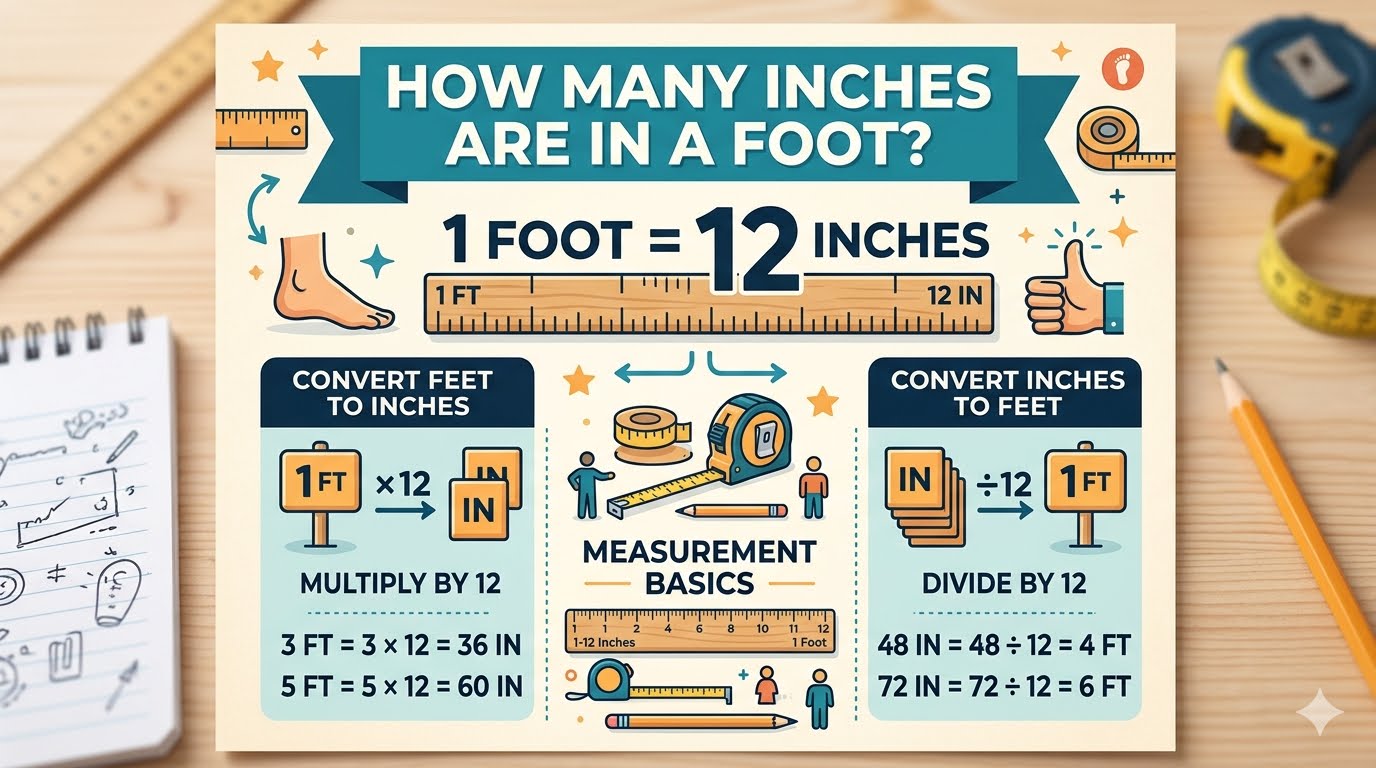
Mistake 3: Forgetting 12 Inches in a Foot
Mistake: Thinking there are 10 inches in a foot.
Correct: 1 foot = 12 inches (not 10!)
Mistake 4: Confusing Fluid Ounces and Weight Ounces
Mistake: Using fluid ounces (volume) instead of weight ounces (mass).
Correct: Fluid ounces measure volume; weight ounces measure mass.
Mistake 5: Using the Wrong Temperature Formula
Mistake: Using °C × 1.8 instead of (°C × 1.8) + 32.
Correct: °F = (°C × 9/5) + 32
Mistake 6: Rounding Too Early
Mistake: Rounding intermediate values in multi-step conversions.
Correct: Keep full precision until the final answer, then round.
How to Use the Unit Converter
- Select the category — Length, Weight, Volume, Temperature, Speed, etc.
- Choose your input unit — e.g.,
km(metric) ormi(imperial) - Choose your output unit — e.g.,
mi(imperial) orkm(metric) - Enter the value — Type the number you want to convert
- Get the result — Instant, accurate conversion
Available Categories
The converter supports all 15+ categories:
| Category | Metric Units | Imperial Units |
|---|---|---|
| Length | km, m, cm, mm | mi, ft, in, yd |
| Weight | kg, g, t | lb, oz, st, T |
| Volume | L, mL, m³ | gal, qt, pt, cup, fl oz |
| Temperature | °C, K | °F |
| Speed | km/h, m/s | mph, kn, ft/s |
| Area | m², km², ha | ft², yd², ac, mi² |
| Pressure | Pa, kPa, bar | psi, atm |
| Energy | J, kJ, cal | BTU |
| Power | W, kW | hp |
Frequently Asked Questions
Q: How do I convert kilometers to miles?
mi = km × 0.621371
Q: How do I convert miles to kilometers?
km = mi × 1.60934
Q: How do I convert kilograms to pounds?
lb = kg × 2.20462
Q: How do I convert pounds to kilograms?
kg = lb × 0.453592
Q: How do I convert liters to gallons?
gal = L × 0.264172
Q: How do I convert gallons to liters?
L = gal × 3.78541
Q: How do I convert Celsius to Fahrenheit?
°F = (°C × 9/5) + 32
Q: How do I convert Fahrenheit to Celsius?
°C = (°F − 32) × 5/9
Q: What is the easiest way to convert units?
Use our free unit converter at EasyConvertUnits.com
Q: Why are US and UK gallons different?
US gallon = 3.785 L, UK gallon = 4.546 L. UK gallon is about 20% larger.
Try the Unit Converter
Ready to convert between metric and imperial units? Use our free unit converter at:
https://www.easyconvertunits.com/
It supports all common measurement units with instant, accurate conversions and a clean, easy-to-use interface.
Final Thoughts
Converting between metric and imperial units is an essential skill in our globalized world. Whether you're traveling, cooking, shopping, or working, knowing how to switch between these two systems saves time, prevents mistakes, and helps you communicate effectively.
Key takeaways:
- Length: 1 km ≈ 0.6 mi, 1 m ≈ 3.3 ft, 1 in ≈ 2.5 cm
- Weight: 1 kg ≈ 2.2 lb, 1 lb ≈ 0.45 kg, 1 oz ≈ 28 g
- Volume: 1 L ≈ 0.26 gal, 1 gal ≈ 3.8 L, 1 cup ≈ 240 mL
- Temperature: °F = (°C × 9/5) + 32
- Speed: 1 mph ≈ 1.6 km/h
- Use mental math shortcuts for quick estimates
- Use a converter tool for precision and speed
Remember: With practice, you'll be able to convert between metric and imperial units in your head. Start with the key conversions and build from there!
Tags: metric to imperial, imperial to metric, unit conversion, metric imperial conversion, length conversion, weight conversion, volume conversion, temperature conversion, speed conversion, conversion guide, measurement tips, how to convert units, metric vs imperial, US customary units, SI units, convert between systems, metric system, imperial system, conversion formulas, conversion factors, unit converter, free unit converter