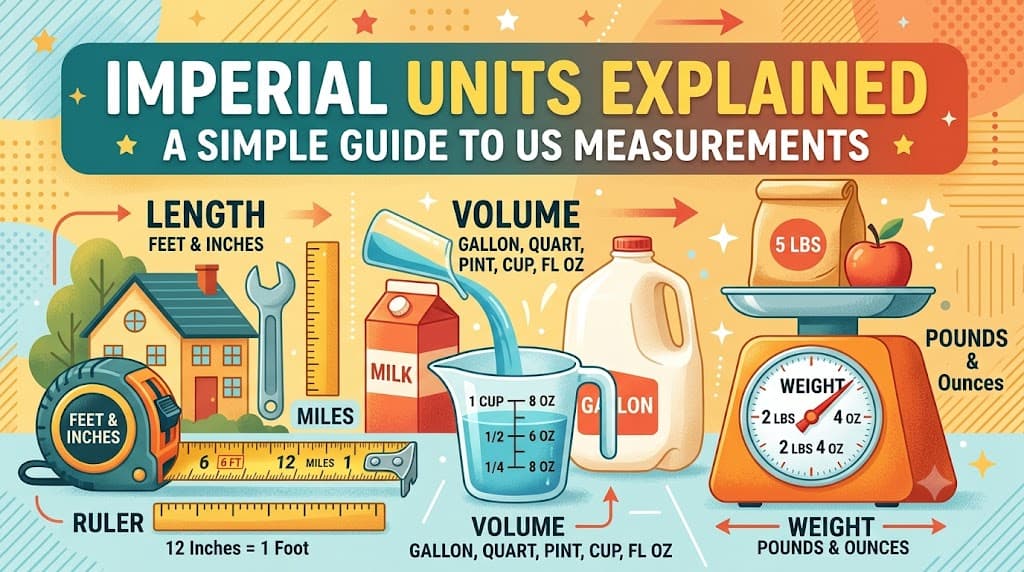
Imperial Units Explained: A Simple Guide to US Measurements
The imperial system (also called US customary units) is the measurement system used in the United States. While most of the world uses the metric system, the US continues to use imperial units for everyday measurements, road signs, recipes, and more.
Understanding imperial units is essential for anyone living in or interacting with the US. Whether you're reading a recipe, checking the weather, or driving, you need to know how these units work.
In this comprehensive guide, we'll cover everything you need to know about imperial units, including:
- ✅ What the imperial system is and how it works
- ✅ Length, weight, volume, and temperature units
- ✅ How to convert between imperial units
- ✅ Real-world examples
- ✅ Common mistakes to avoid
Try it now: Use our free unit converter here
What Is the Imperial System?
The imperial system (also called US customary units) is a system of measurement used primarily in the United States. It evolved from the British imperial system, which was used throughout the British Empire. While the UK and most other countries have switched to the metric system, the US has kept the imperial system for everyday use.
Key Features
- ✅ Historical — Based on traditional English units
- ✅ Inconsistent — Uses varying conversion factors
- ✅ Human-scale — Many units are based on human body parts
- ✅ US standard — Used in everyday life in the US
- ✅ Hybrid system — The US uses metric for some applications (science, medicine, military)
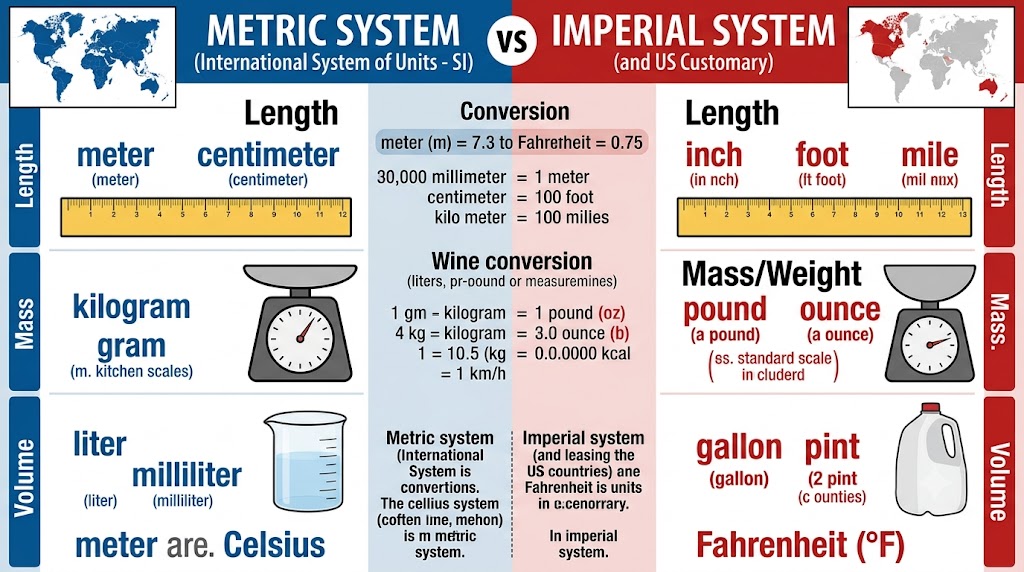
US vs Imperial vs Metric
| Aspect | Imperial/US Customary | Metric |
|---|---|---|
| Length | inches, feet, yards, miles | meters, kilometers |
| Weight | ounces, pounds, tons | grams, kilograms |
| Volume | gallons, quarts, pints, cups | liters, milliliters |
| Temperature | Fahrenheit (°F) | Celsius (°C), Kelvin |
| Conversions | Inconsistent factors | Decimal-based (powers of 10) |
| Global Use | US primarily | Most countries |
| Science | Rarely used | Standard |
Imperial Length Units
Length is one of the most commonly used measurements in the imperial system. Here are the main units:
| Unit | Symbol | Value in Feet | Value in Inches | Common Use |
|---|---|---|---|---|
| Inch | in | 1/12 ft | 1 in | Small items, screens |
| Foot | ft | 1 ft | 12 in | Height, room size |
| Yard | yd | 3 ft | 36 in | Sports, fabric |
| Mile | mi | 5,280 ft | 63,360 in | Road distances |
| Nautical Mile | nmi | 6,076 ft | 72,913 in | Aviation, maritime |
Imperial Length Relationships
1 mile = 1,760 yards = 5,280 feet = 63,360 inches
1 yard = 3 feet = 36 inches
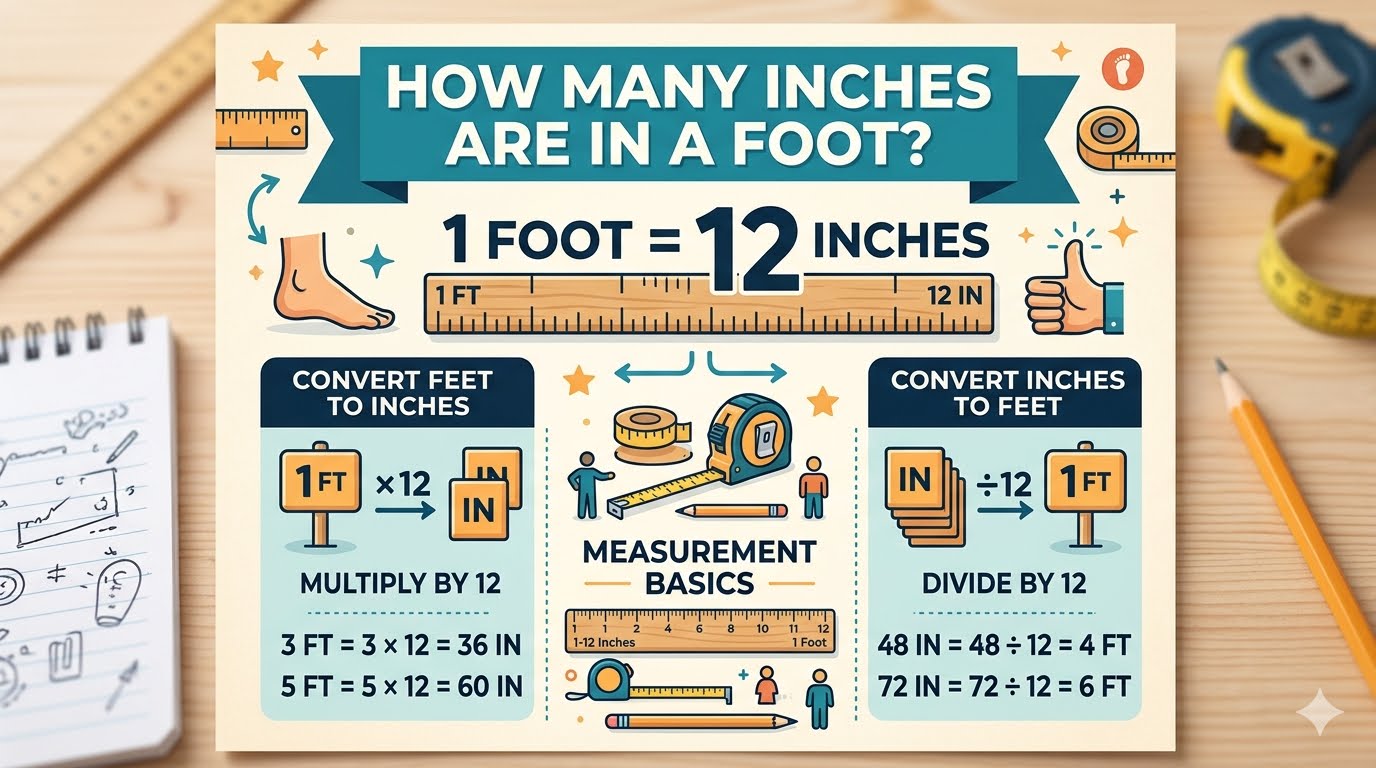
1 foot = 12 inches
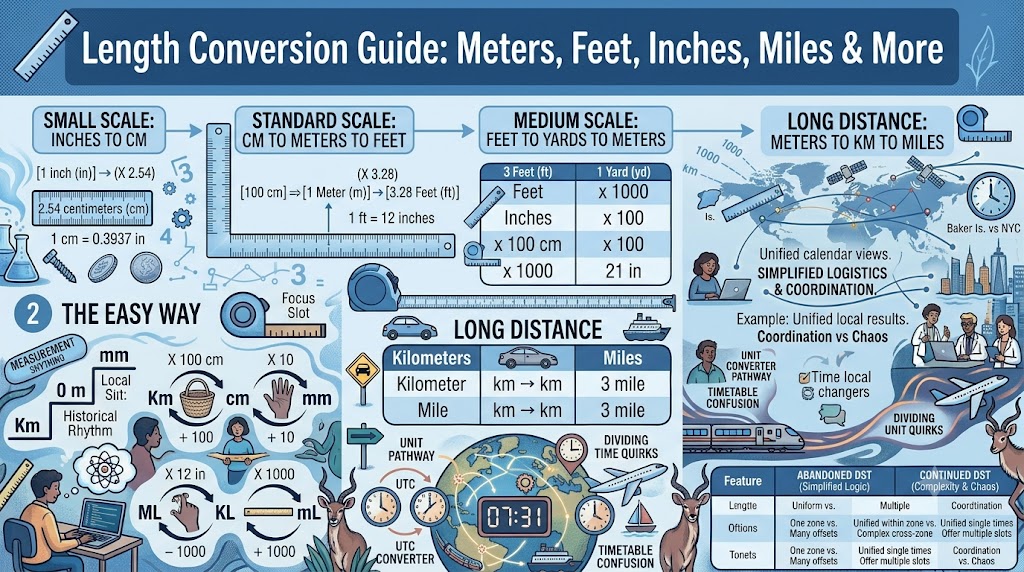
Common Length Conversions
| From | To | Calculation |
|---|---|---|
| Inches to feet | ft = in ÷ 12 | 12 in = 1 ft |
| Feet to inches | in = ft × 12 | 1 ft = 12 in |
| Feet to yards | yd = ft ÷ 3 | 3 ft = 1 yd |
| Yards to feet | ft = yd × 3 | 1 yd = 3 ft |
| Miles to feet | ft = mi × 5,280 | 1 mi = 5,280 ft |
| Feet to miles | mi = ft ÷ 5,280 | 5,280 ft = 1 mi |
Imperial Weight Units
Weight is another essential measurement in the imperial system:
| Unit | Symbol | Value in Ounces | Value in Pounds | Common Use |
|---|---|---|---|---|
| Ounce | oz | 1 oz | 1/16 lb | Small items, cooking |
| Pound | lb | 16 oz | 1 lb | Body weight, groceries |
| Stone | st | 224 oz | 14 lb | Body weight (UK) |
| Short Ton | T | 32,000 oz | 2,000 lb | Industrial, shipping |
| Long Ton | long_ton | 35,840 oz | 2,240 lb | Industrial (UK) |
Imperial Weight Relationships
1 short ton = 2,000 pounds = 32,000 ounces
1 long ton = 2,240 pounds = 35,840 ounces
1 stone = 14 pounds = 224 ounces
1 pound = 16 ounces
Common Weight Conversions
| From | To | Calculation |
|---|---|---|
| Ounces to pounds | lb = oz ÷ 16 | 16 oz = 1 lb |
| Pounds to ounces | oz = lb × 16 | 1 lb = 16 oz |
| Pounds to stones | st = lb ÷ 14 | 14 lb = 1 st |
| Pounds to tons | T = lb ÷ 2,000 | 2,000 lb = 1 T |
| Tons to pounds | lb = T × 2,000 | 1 T = 2,000 lb |
Imperial Volume Units
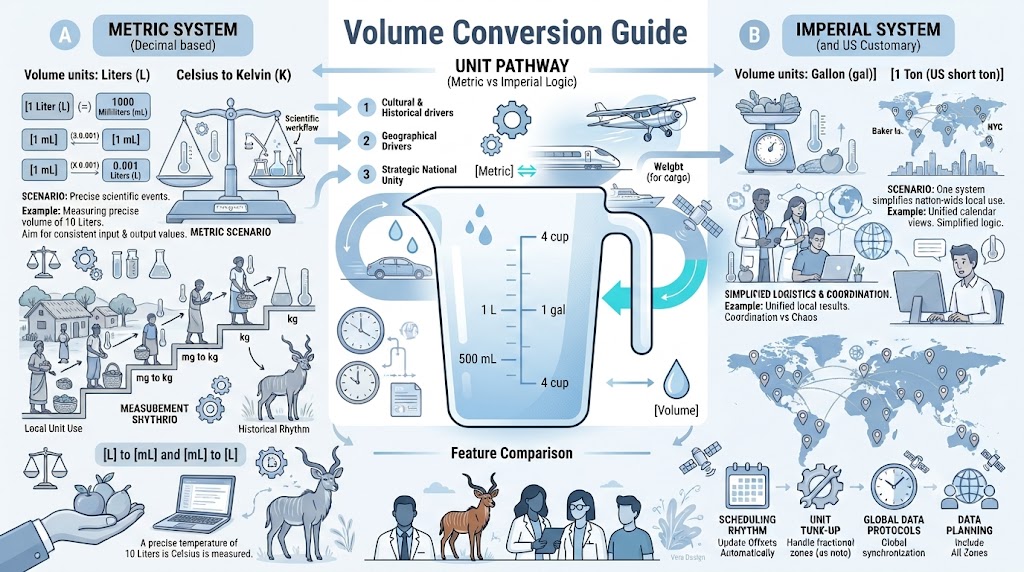
Volume units are used for liquids, cooking, and many other applications:
| Unit | Symbol | Value in US Gallons | Value in Liters | Common Use |
|---|---|---|---|---|
| US Gallon | us_gal | 1 gal | 3.785 L | Fuel, milk |
| US Quart | us_qt | 1/4 gal | 0.946 L | Milk, cooking |
| US Pint | us_pt | 1/8 gal | 0.473 L | Beer, ice cream |
| US Cup | us_cup | 1/16 gal | 0.237 L | Recipes |
| US Fluid Ounce | us_floz | 1/128 gal | 0.0296 L | Beverages |
| US Tablespoon | us_tbsp | 1/256 gal | 0.0148 L | Cooking |
| US Teaspoon | us_tsp | 1/768 gal | 0.00493 L | Cooking |
⚠️ Important: US vs UK Gallons
| US Gallon | UK (Imperial) Gallon | |
|---|---|---|
| Liters | 3.785 L | 4.546 L |
| Fluid Ounces | 128 fl oz | 160 fl oz |
| Difference | Smaller | About 20% larger |
US Volume Relationships
1 US gallon = 4 quarts = 8 pints = 16 cups = 128 fluid ounces
1 US quart = 2 pints = 4 cups = 32 fluid ounces
1 US pint = 2 cups = 16 fluid ounces
1 US cup = 8 fluid ounces = 16 tablespoons = 48 teaspoons
1 US tablespoon = 3 teaspoons
Common Volume Conversions
| From | To | Calculation |
|---|---|---|
| Gallons to quarts | qt = gal × 4 | 1 gal = 4 qt |
| Quarts to pints | pt = qt × 2 | 1 qt = 2 pt |
| Pints to cups | cup = pt × 2 | 1 pt = 2 cup |
| Cups to fluid ounces | fl oz = cup × 8 | 1 cup = 8 fl oz |
| Tablespoons to teaspoons | tsp = tbsp × 3 | 1 tbsp = 3 tsp |
| Gallons to fluid ounces | fl oz = gal × 128 | 1 gal = 128 fl oz |
Imperial Temperature: Fahrenheit
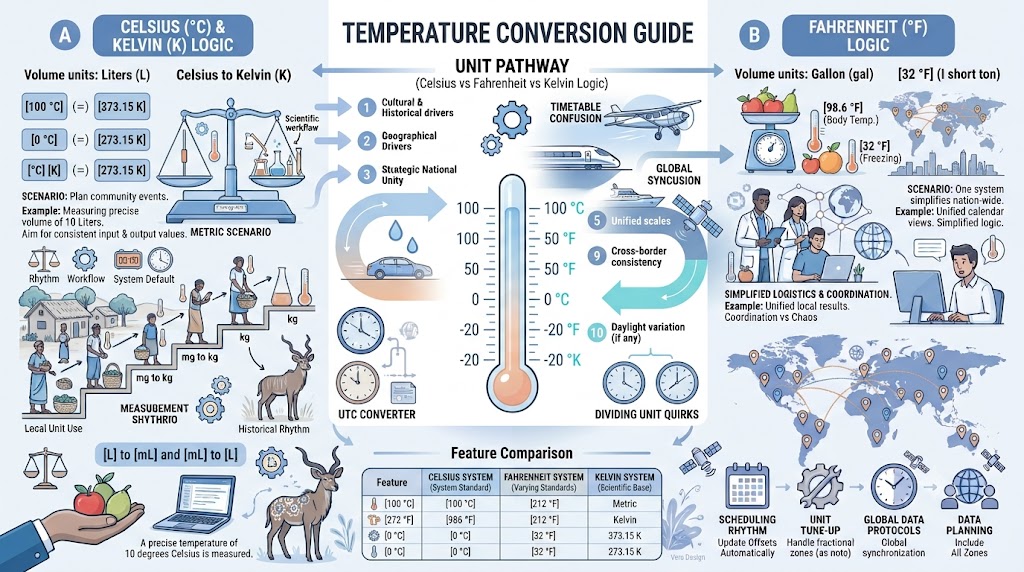
The imperial system uses Fahrenheit (°F) for temperature measurement. It's used in the US for weather, cooking, and everyday life.
Key Reference Points
| Description | Fahrenheit (°F) | Celsius (°C) |
|---|---|---|
| Absolute Zero | -459.67°F | -273.15°C |
| Water Freezes | 32°F | 0°C |
| Room Temperature | 68-72°F | 20-22°C |
| Body Temperature | 98.6°F | 37°C |
| Water Boils | 212°F | 100°C |
Fahrenheit Formula
Fahrenheit to Celsius:
°C = (°F − 32) × 5/9
Celsius to Fahrenheit:
°F = (°C × 9/5) + 32
Common Fahrenheit Values
| Weather Description | Fahrenheit | Celsius |
|---|---|---|
| Very Hot | 100°F | 37.8°C |
| Hot Day | 90°F | 32.2°C |
| Warm Day | 80°F | 26.7°C |
| Pleasant | 70°F | 21.1°C |
| Cool | 60°F | 15.6°C |
| Cold | 40°F | 4.4°C |
| Freezing | 32°F | 0°C |
| Very Cold | 20°F | -6.7°C |
Why Does the US Use Imperial Units?
The United States officially adopted the metric system in 1866, but it never fully transitioned. Here's why:
1. Cost of Conversion
Updating all road signs, packaging, manufacturing equipment, and education materials would cost billions of dollars. The US is simply too large and established to change easily.
2. Cultural Resistance
Americans are familiar and comfortable with imperial units. Changing would require retraining an entire population.
3. Piecemeal Adoption
The US actually uses metric in many areas: science, medicine, military, manufacturing. It's a hybrid system — metric where it matters, imperial where it's familiar.
4. Lack of Mandate
Unlike other countries, the US has never mandated a complete transition. Voluntary adoption hasn't been sufficient.
Imperial to Metric Conversions
Length
| Imperial | Metric | Conversion |
|---|---|---|
| 1 inch | 2.54 cm | in × 2.54 = cm |
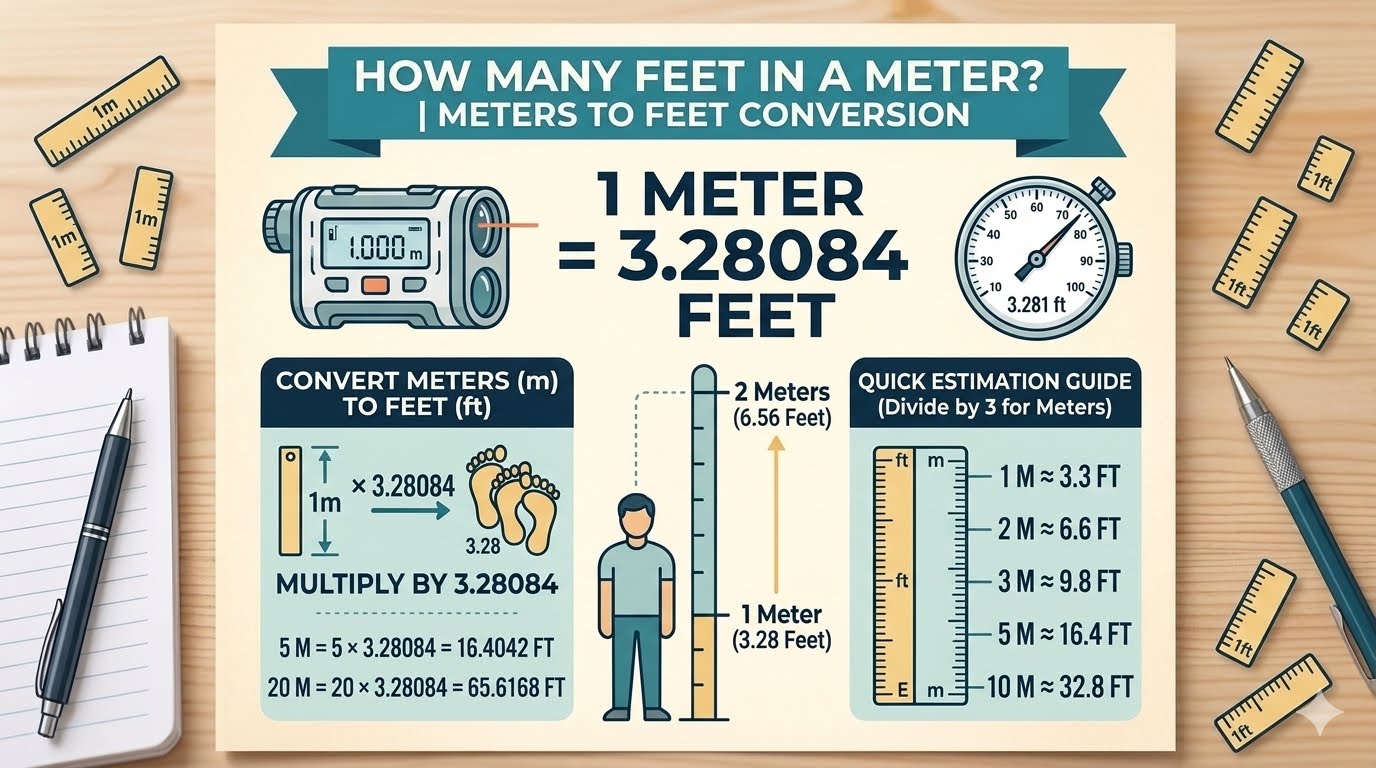
| 1 foot | 0.3048 m | ft × 0.3048 = m |
| 1 yard | 0.9144 m | yd × 0.9144 = m |
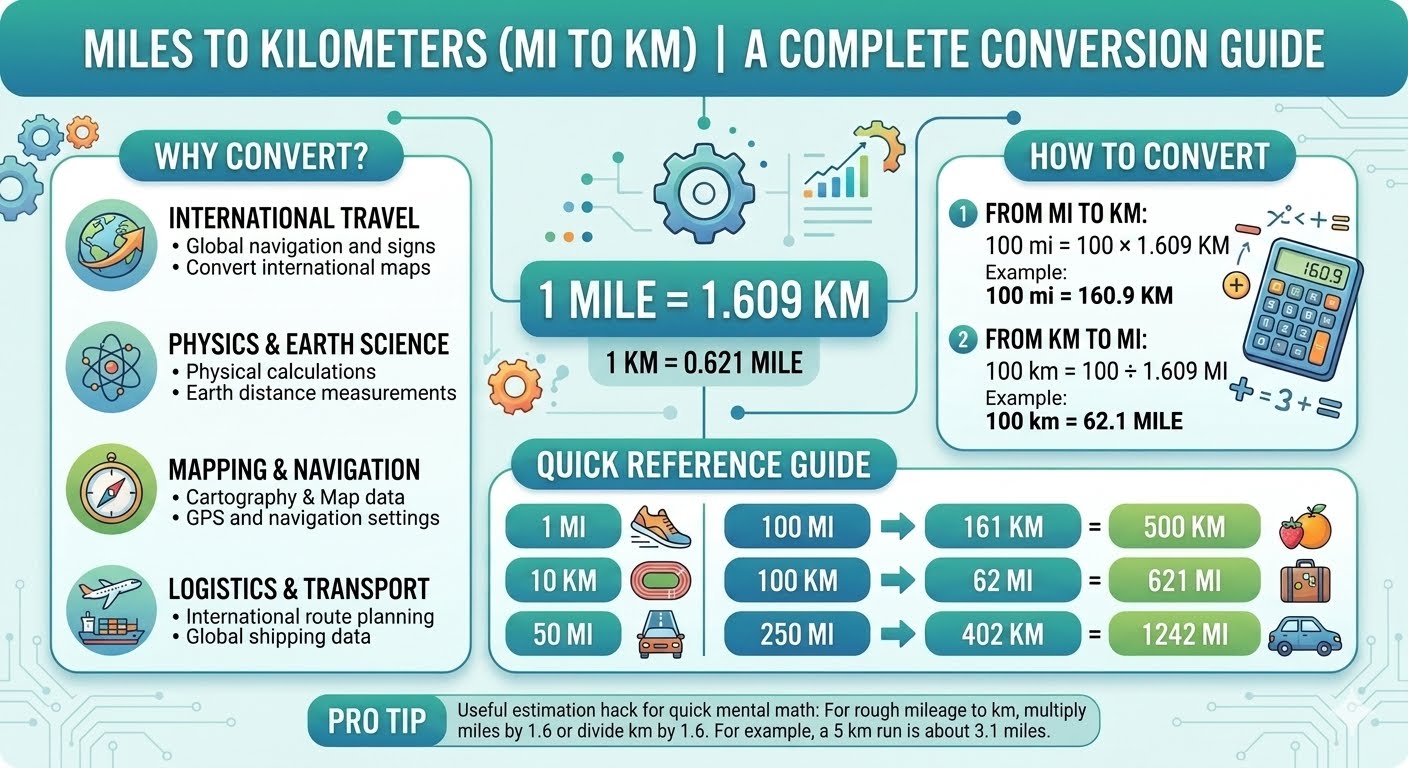
| 1 mile | 1.60934 km | mi × 1.60934 = km |
Weight
| Imperial | Metric | Conversion |
|---|---|---|
| 1 ounce | 28.35 g | oz × 28.35 = g |
| 1 pound | 0.454 kg | lb × 0.453592 = kg |
| 1 short ton | 907 kg | T × 907.185 = kg |
Volume
| Imperial | Metric | Conversion |
|---|---|---|
| 1 US gallon | 3.785 L | us_gal × 3.78541 = L |
| 1 US quart | 0.946 L | us_qt × 0.946353 = L |
| 1 US pint | 0.473 L | us_pt × 0.473176 = L |
| 1 US cup | 236.6 mL | us_cup × 236.588 = mL |
| 1 US fl oz | 29.57 mL | us_floz × 29.5735 = mL |
Step-by-Step Imperial Conversions
Example 1: Feet to Inches
Problem: Convert 5 feet to inches.
Step 1: Identify the conversion factor
- 1 ft = 12 in
Step 2: Set up the calculation
- in = ft × 12
Step 3: Calculate
- 5 × 12 = 60 in
Answer: 5 ft = 60 in
Example 2: Pounds to Ounces
Problem: Convert 3 pounds to ounces.
Step 1: Identify the conversion factor
- 1 lb = 16 oz
Step 2: Set up the calculation
- oz = lb × 16
Step 3: Calculate
- 3 × 16 = 48 oz
Answer: 3 lb = 48 oz
Example 3: Gallons to Cups
Problem: Convert 2 gallons to cups.
Step 1: Identify the conversion factor
- 1 gal = 16 cups
Step 2: Set up the calculation
- cups = gal × 16
Step 3: Calculate
- 2 × 16 = 32 cups
Answer: 2 gal = 32 cups
Example 4: Miles to Yards
Problem: Convert 2 miles to yards.
Step 1: Identify the conversion factor
- 1 mi = 1,760 yd
Step 2: Set up the calculation
- yd = mi × 1,760
Step 3: Calculate
- 2 × 1,760 = 3,520 yd
Answer: 2 mi = 3,520 yd
Real-World Imperial Examples
1. Driving
Scenario: You're driving 60 mph on a US highway. You want to know the speed in km/h.
Question: What is 60 mph in km/h?
Solution: 60 × 1.60934 = 96.56 km/h
Answer: 60 mph ≈ 97 km/h
2. Cooking
Scenario: A recipe calls for 2 cups of flour. Your measuring cup is in milliliters.
Question: How many mL is 2 cups?
Solution: 2 × 236.588 = 473.176 mL
Answer: 2 cups ≈ 473 mL
3. Body Weight
Scenario: You weigh 150 lbs. You want to know your weight in kilograms.
Question: How many kg is 150 lbs?
Solution: 150 × 0.453592 = 68.04 kg
Answer: 150 lbs = 68.04 kg
4. Weather
Scenario: The weather forecast says 75°F. You want to know the temperature in Celsius.
Question: What is 75°F in Celsius?
Solution: (75 − 32) × 5/9 = 23.89°C
Answer: 75°F = 23.9°C
5. Buying a TV
Scenario: You're buying a 65-inch TV. You want to know the diagonal length in centimeters.
Question: How many cm is 65 inches?
Solution: 65 × 2.54 = 165.1 cm
Answer: 65 in = 165.1 cm
6. Fuel Purchase
Scenario: You buy 15 gallons of gas. You want to know how many liters that is.
Question: How many liters is 15 gallons?
Solution: 15 × 3.78541 = 56.78 L
Answer: 15 gal = 56.78 L
7. Home Improvement
Scenario: You need a 2×4 board that is 8 feet long. You want to know the length in meters.
Question: How many meters is 8 feet?
Solution: 8 × 0.3048 = 2.4384 m
Answer: 8 ft = 2.44 m
Imperial Units Cheat Sheet
Length Cheat Sheet
╔══════════════════════════════════════════════════════════════════╗
║                    IMPERIAL LENGTH CONVERSIONS                   ║
╠══════════════════════════════════════════════════════════════════╣
║                                                                  ║
║  1 mile   = 1,760 yards  = 5,280 feet  = 63,360 inches          ║
║  1 yard   = 3 feet       = 36 inches                            ║
║  1 foot   = 12 inches                                           ║
║  1 inch   = 2.54 cm                                             ║
║  1 foot   = 0.3048 m                                            ║
║  1 yard   = 0.9144 m                                            ║
║  1 mile   = 1.609 km                                            ║
║                                                                  ║
║  QUICK ESTIMATES:                                               ║
║  1 mile ≈ 1.6 km     |    1 km ≈ 0.6 mi                       ║
║  1 foot ≈ 0.3 m      |    1 m ≈ 3.3 ft                        ║
║  1 inch ≈ 2.5 cm     |    1 cm ≈ 0.4 in                       ║
║                                                                  ║
╚══════════════════════════════════════════════════════════════════╝
Weight Cheat Sheet
╔══════════════════════════════════════════════════════════════════╗
║                    IMPERIAL WEIGHT CONVERSIONS                   ║
╠══════════════════════════════════════════════════════════════════╣
║                                                                  ║
║  1 short ton  = 2,000 lbs   = 32,000 oz                        ║
║  1 long ton   = 2,240 lbs   = 35,840 oz                        ║
║  1 stone      = 14 lbs      = 224 oz                            ║
║  1 pound      = 16 oz                                          ║
║  1 pound      = 0.454 kg                                        ║
║  1 kg         = 2.205 lbs                                       ║
║  1 ounce      = 28.35 g                                         ║
║                                                                  ║
║  QUICK ESTIMATES:                                               ║
║  1 lb ≈ 0.45 kg     |    1 kg ≈ 2.2 lb                        ║
║  1 oz ≈ 28 g        |    1 g ≈ 0.04 oz                        ║
║                                                                  ║
╚══════════════════════════════════════════════════════════════════╝
Volume Cheat Sheet
╔══════════════════════════════════════════════════════════════════╗
║                    IMPERIAL VOLUME CONVERSIONS                   ║
╠══════════════════════════════════════════════════════════════════╣
║                                                                  ║
║  1 US gallon = 4 quarts  = 8 pints  = 16 cups  = 128 fl oz     ║
║  1 US quart  = 2 pints   = 4 cups   = 32 fl oz                 ║
║  1 US pint   = 2 cups    = 16 fl oz                             ║
║  1 US cup    = 8 fl oz   = 16 tbsp  = 48 tsp                   ║
║  1 US fl oz  = 2 tbsp    = 6 tsp                                ║
║  1 US gal    = 3.785 L                                         ║
║  1 L         = 0.264 US gal                                    ║
║                                                                  ║
║  QUICK ESTIMATES:                                               ║
║  1 gal ≈ 3.8 L       |    1 L ≈ 0.26 gal                      ║
║  1 cup ≈ 240 mL      |    1 fl oz ≈ 30 mL                     ║
║                                                                  ║
╚══════════════════════════════════════════════════════════════════╝
Common Mistakes in Imperial Conversion
Mistake 1: Confusing US and UK Gallons
Mistake: Using 3.785 L for a UK gallon.
Correct: US gallon = 3.785 L, UK gallon = 4.546 L.
Mistake 2: Forgetting 16 Ounces in a Pound
Mistake: Thinking there are 12 ounces in a pound.
Correct: 1 pound = 16 ounces (not 12!)
Mistake 3: Forgetting 12 Inches in a Foot
Mistake: Thinking there are 10 inches in a foot.
Correct: 1 foot = 12 inches (not 10!)
Mistake 4: Confusing Fluid Ounces and Weight Ounces
Mistake: Using fluid ounces (volume) instead of weight ounces (mass).
Correct: Fluid ounces measure volume; weight ounces measure mass.
Mistake 5: Rounding Too Early
Mistake: Rounding intermediate values in multi-step conversions.
Correct: Keep full precision until the final answer, then round.
Frequently Asked Questions
Q: What is the imperial system?
The imperial system (US customary units) is the measurement system used primarily in the United States for everyday measurements.
Q: What units does the imperial system use?
Length: inches, feet, yards, miles. Weight: ounces, pounds, tons. Volume: gallons, quarts, pints, cups, fluid ounces. Temperature: Fahrenheit.
Q: Why does the US use imperial instead of metric?
Historical and economic reasons. The US is too large to convert easily, and there's cultural resistance. It was never mandated.
Q: What is the difference between US and UK gallons?
US gallon = 3.785 L, UK gallon = 4.546 L. UK gallon is about 20% larger.
Q: How many inches are in a foot?
There are 12 inches in 1 foot.
Q: How many ounces are in a pound?
There are 16 ounces in 1 pound.
Q: How many feet are in a mile?
There are 5,280 feet in 1 mile.
Q: How many cups are in a gallon?
There are 16 cups in 1 US gallon.
Q: How do I convert Fahrenheit to Celsius?
°C = (°F − 32) × 5/9
Q: How do I convert Celsius to Fahrenheit?
°F = (°C × 9/5) + 32
Try the Unit Converter
Ready to convert imperial units? Use our free unit converter at:
https://www.easyconvertunits.com/
It supports all imperial units with instant, accurate conversions and a clean, easy-to-use interface.
Final Thoughts
The imperial system is deeply embedded in American culture and daily life. While it may seem confusing compared to the metric system, understanding imperial units is essential for anyone in the US. Once you learn the key relationships — 12 inches in a foot, 16 ounces in a pound, 128 fluid ounces in a gallon — you'll be able to navigate the imperial system with confidence.
Key takeaways:
- Length: 1 mile = 5,280 ft, 1 ft = 12 in
- Weight: 1 ton = 2,000 lb, 1 lb = 16 oz
- Volume: 1 gallon = 4 quarts = 8 pints = 16 cups = 128 fl oz
- Temperature: Fahrenheit (°F) is used in the US
- US and UK gallons are different — be careful!
- Use a converter tool for precision and speed
Remember: The imperial system is inconsistent but learnable. With practice, you'll be able to convert between imperial units in your head!
Tags: imperial units, US customary units, imperial system, American measurements, US measurements, unit conversion, imperial vs metric, measurement guide, US units, imperial length, imperial weight, imperial volume, Fahrenheit, miles to km, pounds to kg, gallons to liters, what is imperial system, imperial units list, US customary units list, how to use imperial units, imperial vs metric comparison, US measurement system, American measurement system, imperial units explained