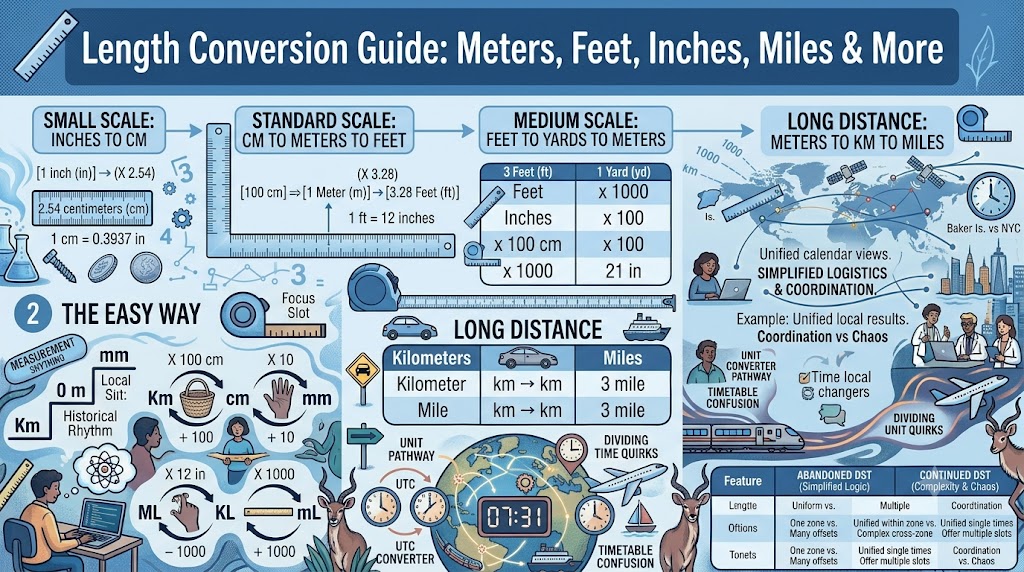
Length Conversion Guide: Meters, Feet, Inches, Miles & More – Complete Reference
Length is one of the most fundamental measurements in everyday life. Whether you're measuring your height, the distance to your destination, the size of a room, or the specifications of a tiny electronic component, you need a reliable way to understand and convert between different length units.
This comprehensive guide covers everything you need to know about length conversions, featuring all 19 length units available in the EasyConvertUnits tool.
Try it now: Use our free length converter here
What Is Length?
Length is a measure of distance. It's one of the seven base quantities in the International System of Units (SI). The standard unit of length in the metric system is the meter (m).
Length measurements are used in:
- Construction and architecture
- Science and engineering
- Travel and navigation
- Sports and fitness
- Manufacturing and design
- Everyday tasks
All Length Units at a Glance
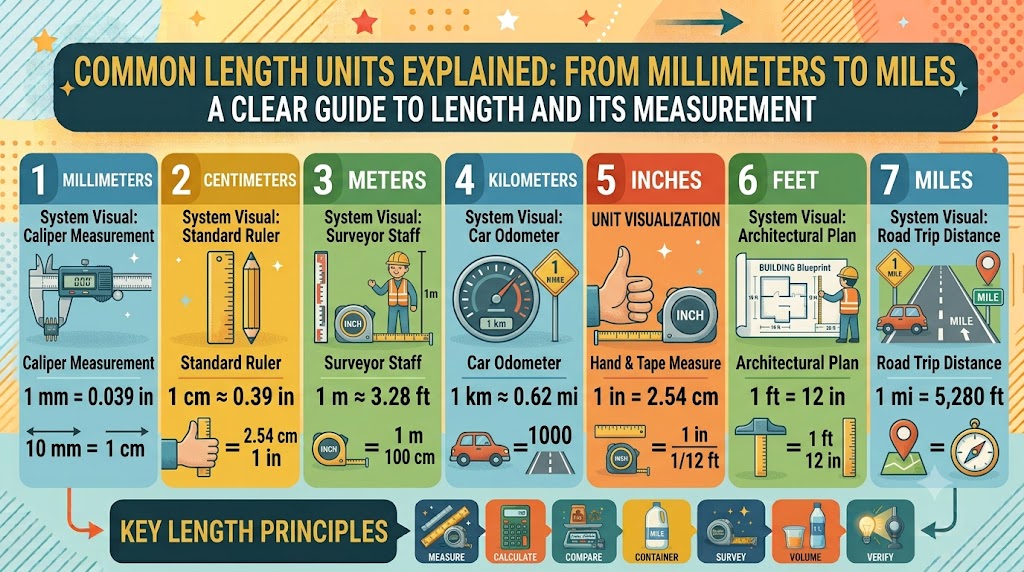
Based on the EasyConvertUnits data structure, here are all 19 supported length units:
| Unit | Symbol | Category | Value in Meters | Common Use |
|---|---|---|---|---|
| Angstrom | Å | Metric | 10⁻¹⁰ m | Atomic measurements, wavelengths |
| Centimeter | cm | Metric | 0.01 m | Everyday measurements, height, clothing |
| Decameter | dam | Metric | 10 m | Land measurement |
| Decimeter | dm | Metric | 0.1 m | Scientific measurements |
| Feet | ft | Imperial | 0.3048 m | Height, construction, aviation |
| Gigameter | Gm | Metric | 1,000,000,000 m | Astronomical distances |
| Hectometer | hm | Metric | 100 m | Land measurement |
| Inch | in | Imperial | 0.0254 m | Screen sizes, tools, clothing |
| Kilometer | km | Metric | 1,000 m | Road distances, running |
| Megameter | Mm | Metric | 1,000,000 m | Large-scale mapping |
| Meter | m | Metric (SI base) | 1 m | Standard scientific unit |
| Micrometer | μm | Metric | 10⁻⁶ m | Microscopic measurements |
| Mile | mi | Imperial | 1,609.344 m | Road distances, running |
| Millimeter | mm | Metric | 0.001 m | Small dimensions, engineering |
| Nanometer | nm | Metric | 10⁻⁹ m | Atomic scale, semiconductors |
| Nautical Mile | nmi | Special | 1,852 m | Maritime and aviation navigation |
| Picometer | pm | Metric | 10⁻¹² m | Subatomic measurements |
| Rod | rod | Imperial | 5.0292 m | Land surveying |
| Yard | yd | Imperial | 0.9144 m | Sports (football), fabric, landscaping |
Metric Length Units (SI System)
The metric system is decimal-based, making conversions simple: just multiply or divide by powers of 10.
From Smallest to Largest
| Unit | Symbol | Value in Meters |
|---|---|---|
| Picometer | pm | 10⁻¹² m |
| Angstrom | Å | 10⁻¹⁰ m |
| Nanometer | nm | 10⁻⁹ m |
| Micrometer | μm | 10⁻⁶ m |
| Millimeter | mm | 0.001 m |
| Centimeter | cm | 0.01 m |
| Decimeter | dm | 0.1 m |
| Meter | m | 1 m (base) |
| Decameter | dam | 10 m |
| Hectometer | hm | 100 m |
| Kilometer | km | 1,000 m |
| Megameter | Mm | 1,000,000 m |
| Gigameter | Gm | 1,000,000,000 m |
Common Metric Conversions
| From | To | Calculation |
|---|---|---|
| Kilometers to meters | m = km × 1,000 | 1 km = 1,000 m |
| Meters to centimeters | cm = m × 100 | 1 m = 100 cm |
| Centimeters to millimeters | mm = cm × 10 | 1 cm = 10 mm |
| Meters to millimeters | mm = m × 1,000 | 1 m = 1,000 mm |
| Kilometers to centimeters | cm = km × 100,000 | 1 km = 100,000 cm |
Quick Memory Tricks for Metric
King Henry Died By Drinking Chocolate Milk — A mnemonic for metric prefixes:
- Kilo (1,000)
- Hecto (100)
- Deca (10)
- Base (1)
- Deci (0.1)
- Centi (0.01)
- Milli (0.001)
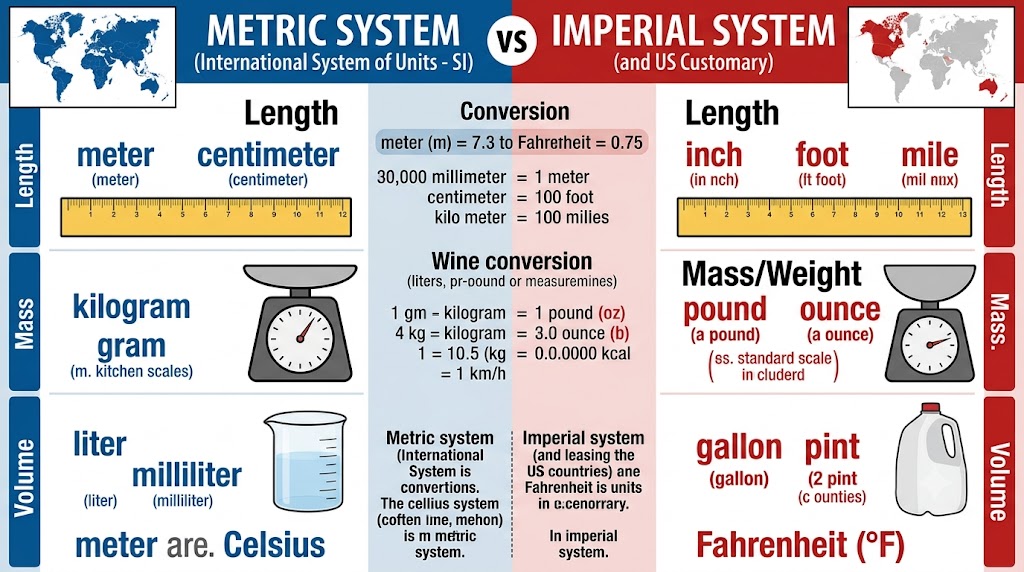
Imperial Length Units (US Customary)
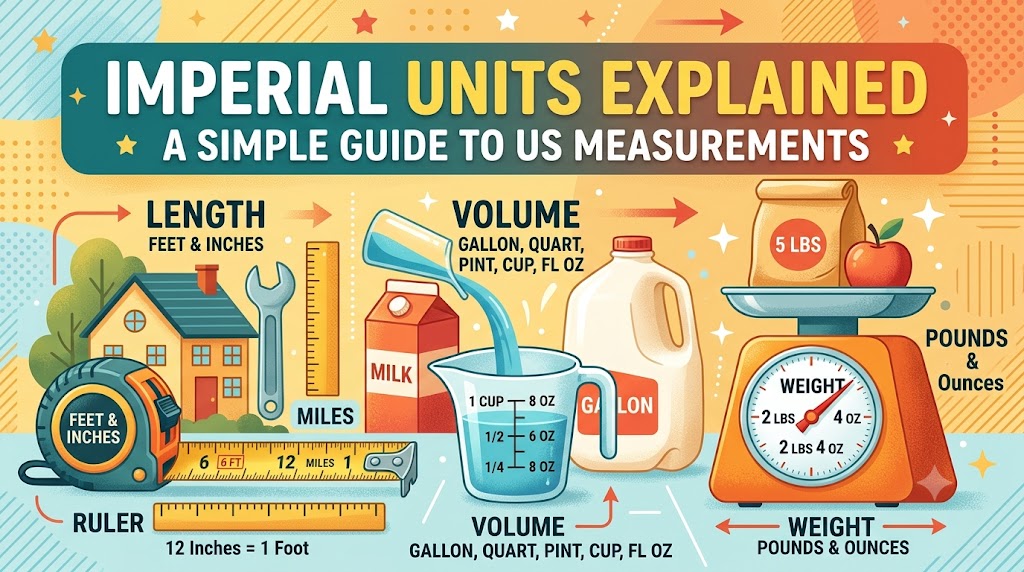
The imperial system uses less consistent conversion factors, making it harder to memorize but still widely used in the US.
| Unit | Symbol | Value in Feet | Value in Meters |
|---|---|---|---|
| Inch | in | 1/12 ft | 0.0254 m |
| Foot | ft | 1 ft | 0.3048 m |
| Yard | yd | 3 ft | 0.9144 m |
| Rod | rod | 16.5 ft | 5.0292 m |
| Mile | mi | 5,280 ft | 1,609.344 m |
Imperial System Relationships
1 mile = 1,760 yards = 5,280 feet = 63,360 inches
1 yard = 3 feet = 36 inches
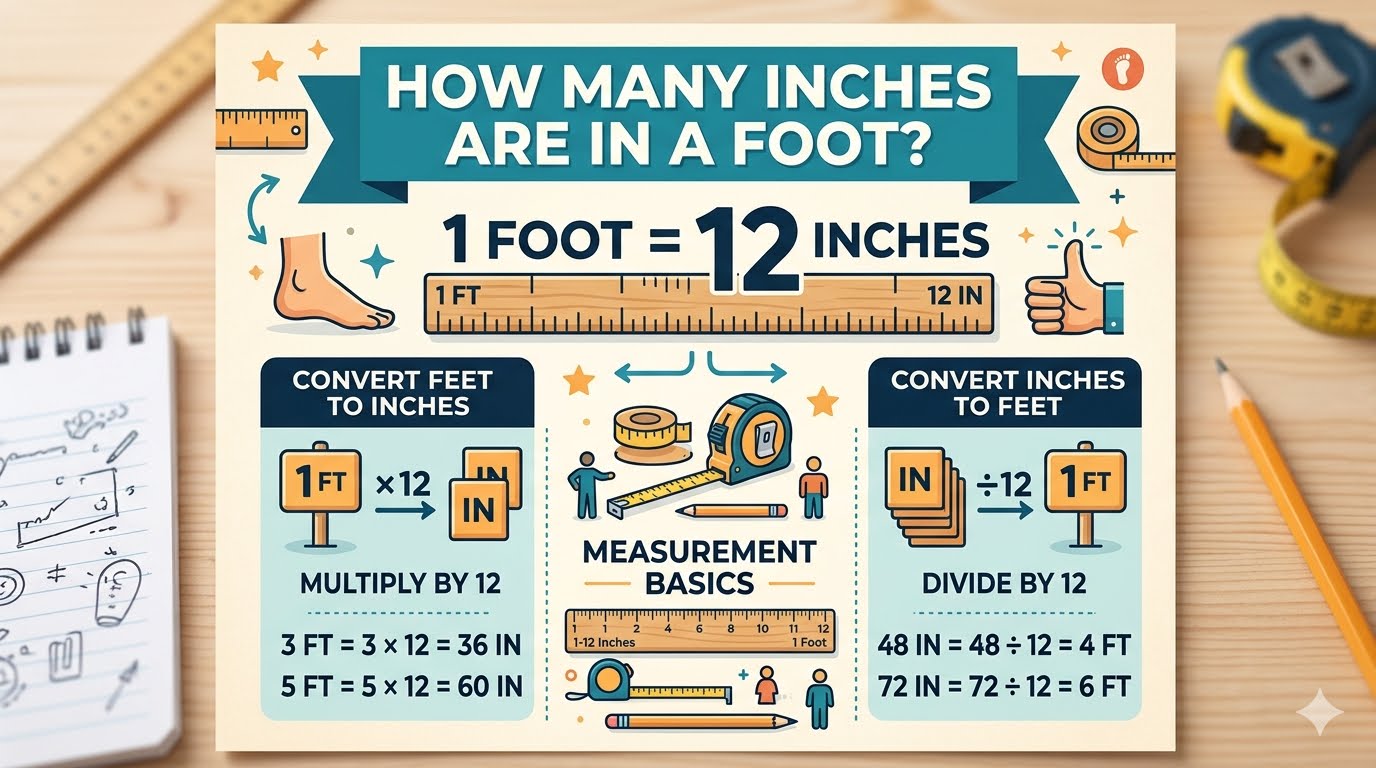
1 foot = 12 inches
Common Imperial Conversions
| From | To | Calculation |
|---|---|---|
| Feet to inches | in = ft × 12 | 1 ft = 12 in |
| Yards to feet | ft = yd × 3 | 1 yd = 3 ft |
| Miles to feet | ft = mi × 5,280 | 1 mi = 5,280 ft |
| Miles to yards | yd = mi × 1,760 | 1 mi = 1,760 yd |
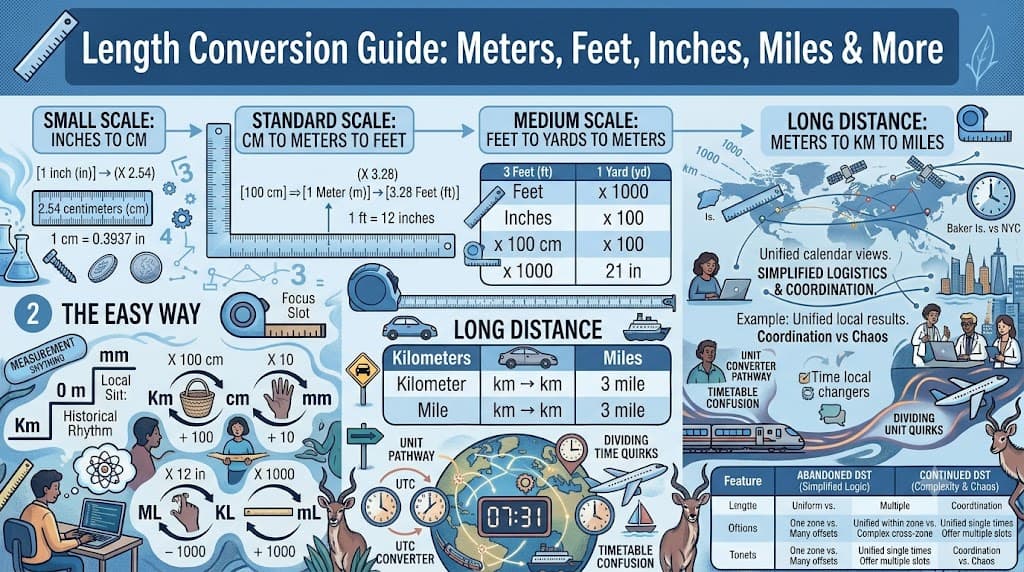
Metric ↔ Imperial Conversions
These are the most common length conversions you'll need in everyday life.
Conversion Formulas
| From | To | Calculation | Example |
|---|---|---|---|
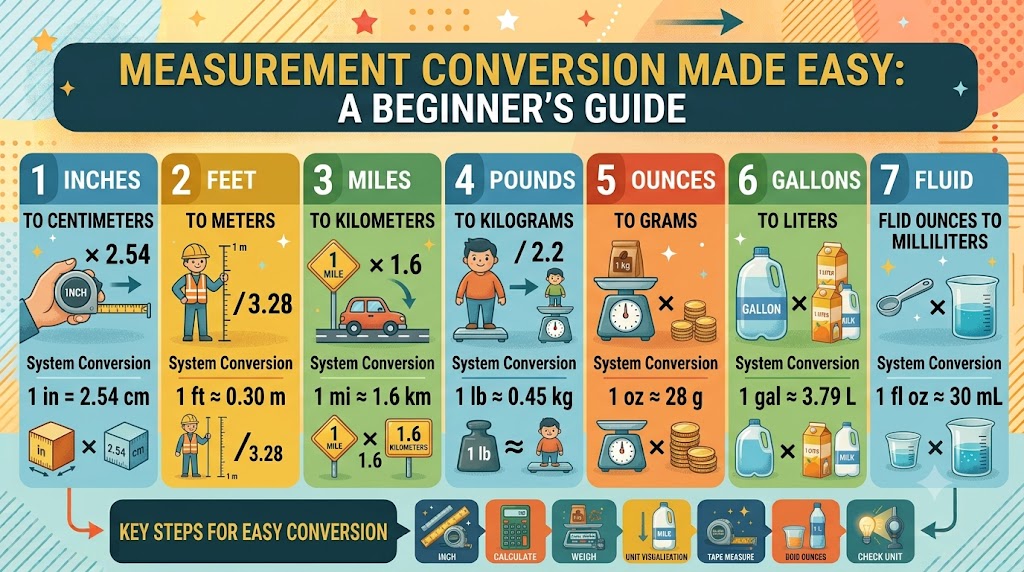
| Inches to cm | cm = in × 2.54 | 10 in = 25.4 cm | |
| cm to inches | in = cm ÷ 2.54 | 100 cm = 39.37 in | |
| Feet to meters | m = ft × 0.3048 | 10 ft = 3.048 m | |
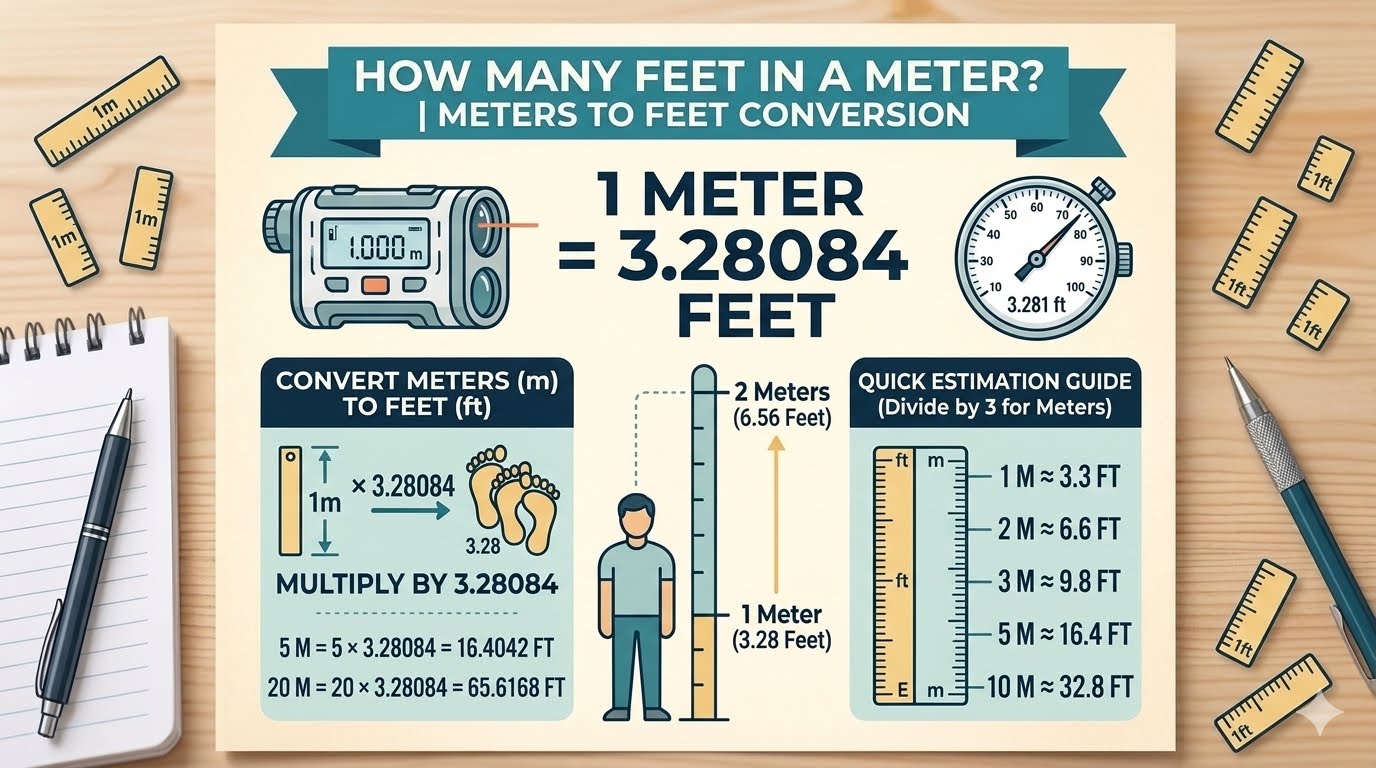
| Meters to feet | ft = m × 3.28084 | 10 m = 32.81 ft | |
| Yards to meters | m = yd × 0.9144 | 10 yd = 9.144 m | |
| Meters to yards | yd = m × 1.09361 | 10 m = 10.94 yd | |
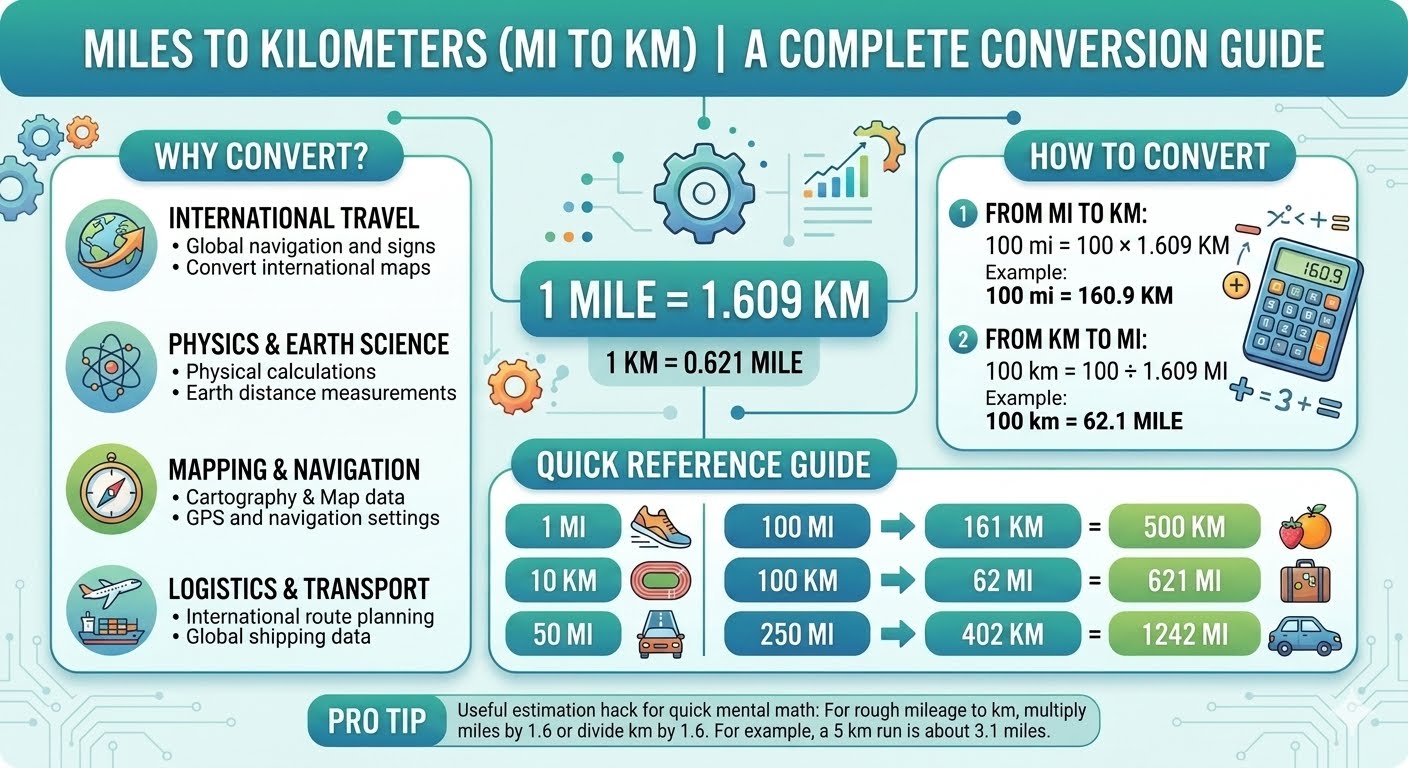
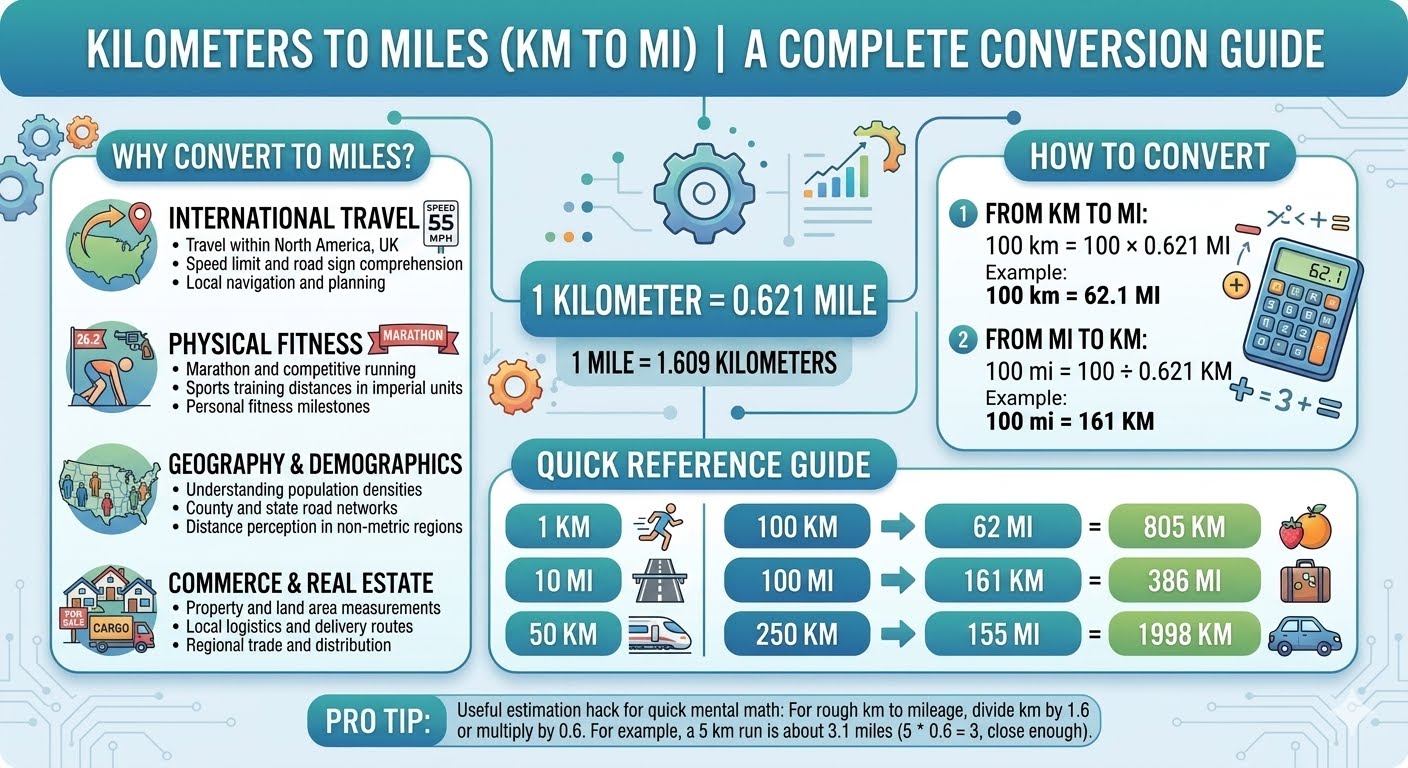
| Miles to km | km = mi × 1.60934 | 10 mi = 16.09 km | |
| km to miles | mi = km × 0.621371 | 10 km = 6.21 mi | |
| Nautical miles to km | km = nmi × 1.852 | 10 nmi = 18.52 km | |
| km to nautical miles | nmi = km × 0.539957 | 10 km = 5.40 nmi |
Quick Estimation Tricks
| Exact Conversion | Quick Estimate |
|---|---|
| 1 inch = 2.54 cm | 1 inch ≈ 2.5 cm |
| 1 meter = 3.28 ft | 1 meter ≈ 3.3 ft |
| 1 km = 0.62 miles | 1 km ≈ 0.6 miles |
| 1 mile = 1.61 km | 1 mile ≈ 1.6 km |
| 1 yard = 0.91 m | 1 yard ≈ 0.9 m |
Mental Math Shortcuts
Miles to km: Multiply by 1.6 (or multiply by 8 and divide by 5)
- 50 mi × 1.6 = 80 km (≈ 80.47 km exact)
km to miles: Multiply by 0.6 (or multiply by 5 and divide by 8)
- 100 km × 0.6 = 60 mi (≈ 62.14 mi exact)
Meters to feet: Multiply by 3.3
- 100 m × 3.3 = 330 ft (≈ 328.08 ft exact)
Inches to cm: Multiply by 2.5
- 40 in × 2.5 = 100 cm (≈ 101.6 cm exact)
Specialized Length Units
Nautical Mile (nmi)
- 1 nautical mile = 1,852 meters = 1.15078 miles
- Used in maritime and aviation navigation
- Based on one minute of latitude
- Preferred for sea and air travel
Angstrom (Å)
- 1 angstrom = 10⁻¹⁰ meters = 0.1 nanometers
- Used to measure atomic-scale distances
- Common in chemistry and physics
- Named after Swedish physicist Anders Jonas Ångström
Micrometer (μm) — Micron
- 1 micrometer = 10⁻⁶ meters = 0.001 millimeters
- Used to measure cells, bacteria, and small mechanical parts
- Also called a "micron"
Nanometer (nm)
- 1 nanometer = 10⁻⁹ meters
- Used in semiconductor manufacturing (computer chips)
- Measures wavelengths of visible light (∼400-700 nm)
Picometer (pm)
- 1 picometer = 10⁻¹² meters
- Used in subatomic measurements
- Measures atomic nuclei and quantum phenomena
Rod
- 1 rod = 5.0292 meters = 16.5 feet
- Used in land surveying
- Also called a "pole" or "perch"
Length Conversion Formulas
Basic Formula
To convert from unit A to unit B:
Value in B = (Value in A × Factor for A) / Factor for B
Where Factor for A and Factor for B are the values in the CONVERSION_FACTORS map.
Example: Converting 100 Feet to Meters
Step 1: Find the conversion factors (all in meters)
- 1 ft = 0.3048 m (factor for ft = 0.3048)
- 1 m = 1 (factor for m = 1)
Step 2: Apply the formula
meters = 100 × 0.3048 / 1 = 30.48 m
Answer: 100 ft = 30.48 m
Example: Converting 5 Kilometers to Miles
Step 1: Find the conversion factors
- 1 km = 1,000 m (factor for km = 1,000)
- 1 mi = 1,609.344 m (factor for mi = 1,609.344)
Step 2: Apply the formula
miles = 5 × 1,000 / 1,609.344 = 3.10686 mi
Answer: 5 km = 3.11 mi
Step-by-Step Conversion Examples
Example 1: Convert 100 Inches to Centimeters
Problem: How many centimeters are in 100 inches?
Step 1: Use the formula
cm = in × 2.54
Step 2: Substitute
cm = 100 × 2.54
Step 3: Calculate
cm = 254 cm
Answer: 100 inches = 254 cm
Example 2: Convert 5 Miles to Kilometers
Problem: How many kilometers are in 5 miles?
Step 1: Use the formula
km = mi × 1.60934
Step 2: Substitute
km = 5 × 1.60934
Step 3: Calculate
km = 8.0467 km
Answer: 5 miles = 8.05 km
Example 3: Convert 10 Meters to Feet
Problem: How many feet are in 10 meters?
Step 1: Use the formula
ft = m × 3.28084
Step 2: Substitute
ft = 10 × 3.28084
Step 3: Calculate
ft = 32.8084 ft
Answer: 10 meters = 32.81 feet
Example 4: Convert 6 Feet to Inches
Problem: How many inches are in 6 feet?
Step 1: Use the formula
in = ft × 12
Step 2: Calculate
in = 6 × 12 = 72 in
Answer: 6 feet = 72 inches
Example 5: Convert 100 km to Miles
Problem: How many miles are in 100 kilometers?
Step 1: Use the formula
mi = km × 0.621371
Step 2: Substitute
mi = 100 × 0.621371
Step 3: Calculate
mi = 62.1371 mi
Answer: 100 km = 62.14 miles
Real-World Length Conversion Examples
1. Travel and Navigation
Scenario: You're driving in Europe and see a sign: "Paris 120 km"
Question: How many miles is that?
Solution: 120 × 0.621371 = 74.56 miles
Answer: About 74.6 miles
2. Home Improvement
Scenario: You need to buy a TV. The product dimensions are 120 cm × 70 cm. Your cabinet is 50 inches wide.
Question: Will the TV fit?
Solution:
- 120 cm ÷ 2.54 = 47.24 inches
- 70 cm ÷ 2.54 = 27.56 inches
Answer: Yes, the TV is 47.2" wide, which fits in a 50" cabinet.
3. Sports and Fitness
Scenario: You're training for a 5K race.
Question: How many miles is 5 kilometers?
Solution: 5 × 0.621371 = 3.10686 miles
Answer: 5 km ≈ 3.1 miles
4. Construction
Scenario: You need a 10-foot 2×4 board. The hardware store sells lumber in meters.
Question: How many meters do you need?
Solution: 10 × 0.3048 = 3.048 meters
Answer: You need about 3.05 meters of lumber.
5. Science
Scenario: You're looking at the specifications for a computer chip: 7 nanometers (nm).
Question: How many meters is that?
Solution: 7 × 10⁻⁹ = 0.000000007 meters
Answer: 7 nm = 7 × 10⁻⁹ m
6. Aviation
Scenario: A pilot reports cruising at 35,000 feet.
Question: How many meters is that?
Solution: 35,000 × 0.3048 = 10,668 meters
Answer: 35,000 ft ≈ 10.7 km (10,668 m)
Complete Conversion Table
Length Quick Reference
| From | To | Multiply By |
|---|---|---|
| Inches | Centimeters | 2.54 |
| Inches | Millimeters | 25.4 |
| Feet | Meters | 0.3048 |
| Feet | Centimeters | 30.48 |
| Yards | Meters | 0.9144 |
| Miles | Kilometers | 1.60934 |
| Miles | Meters | 1,609.344 |
| Centimeters | Inches | 0.393701 |
| Meters | Feet | 3.28084 |
| Meters | Yards | 1.09361 |
| Kilometers | Miles | 0.621371 |
| Millimeters | Inches | 0.0393701 |
| Nautical Miles | Kilometers | 1.852 |
| Nautical Miles | Miles | 1.15078 |
| Angstroms | Nanometers | 0.1 |
| Micrometers | Millimeters | 0.001 |
Conversion Factors Used
The converter uses the following base factors (all in meters):
length: {
  'angstrom': 1e-10,
  'cm': 0.01,
  'dam': 10,
  'dm': 0.1,
  'ft': 0.3048,
  'Gm': 1e9,
  'hm': 100,
  'in': 0.0254,
  'km': 1000,
  'Mm': 1e6,
  'm': 1,
  'μm': 1e-6,
  'mi': 1609.344,
  'mm': 0.001,
  'nm': 1e-9,
  'nmi': 1852,
  'pm': 1e-12,
  'rod': 5.0292,
  'yd': 0.9144
}
How to Use the Length Converter
- Select the category: Length
- Choose your input unit: e.g.,
m(meter) orft(foot) - Choose your output unit: e.g.,
ftorcm - Enter the value: Type the number you want to convert
- Get the result: Instant, accurate conversion
Available Length Units
The following unit values are available in the converter:
| Unit Value | Display Label | Symbol |
|---|---|---|
angstrom |
Angstrom | Å |
cm |
Centimeter | cm |
dam |
Decameter | dam |
dm |
Decimeter | dm |
ft |
Feet | ft |
Gm |
Gigameter | Gm |
hm |
Hectometer | hm |
in |
Inch | in |
km |
Kilometer | km |
Mm |
Megameter | Mm |
m |
Meter | m |
μm |
Micrometer | μm |
mi |
Mile | mi |
mm |
Millimeter | mm |
nm |
Nanometer | nm |
nmi |
Nautical Mile | nmi |
pm |
Picometer | pm |
rod |
Rod | rod |
yd |
Yard | yd |
Frequently Asked Questions
Q: What is the base unit of length in the metric system?
The meter (m) is the base unit of length in the International System of Units (SI).
Q: How many centimeters are in a meter?
There are 100 centimeters in 1 meter.
Q: How many inches are in a foot?
There are 12 inches in 1 foot.
Q: How many feet are in a mile?
There are 5,280 feet in 1 mile.
Q: How many kilometers are in a mile?
1 mile = 1.60934 kilometers.
Q: What is the difference between a nautical mile and a regular mile?
A nautical mile (1,852 m) is based on one minute of latitude and is used in navigation. A statute mile (1,609.344 m) is used on land.
Q: Why do we use different length units?
Different units are useful for different scales. We use nanometers for atoms, centimeters for everyday objects, kilometers for road distances, and gigameters for astronomical distances.
Q: How do I convert meters to feet quickly?
Multiply meters by 3.281. For a quick estimate, multiply by 3.3.
Q: Which countries use miles instead of kilometers?
The United States, the United Kingdom (for some road signs), and a few other countries use miles. Most of the world uses kilometers.
Q: How many angstroms are in a nanometer?
1 nanometer = 10 angstroms (since 1 nm = 10⁻⁹ m and 1 Å = 10⁻¹⁰ m).
Try the Length Converter
Ready to convert length units? Use our free length converter at:
https://www.easyconvertunits.com/length
It supports all 19 length units with instant, accurate conversions and a clean, easy-to-use interface.
Final Thoughts
Understanding length conversions is an essential life skill. Whether you're traveling, shopping, building, or learning, knowing how to convert between different length units saves time, prevents mistakes, and helps you communicate effectively across different measurement systems.
Key takeaways:
- The meter is the standard SI unit of length
- Metric units are decimal-based (powers of 10)
- Imperial units have inconsistent conversion factors
- Nautical miles are used in aviation and maritime navigation
- Angstroms and nanometers are used at atomic scales
- Use a converter tool for precision and speed
Remember: The number changes, but the physical distance stays exactly the same. 1 meter is 1 meter, whether you call it 3.28 feet or 100 centimeters!
Tags: length conversion, meters to feet, inches to cm, miles to km, length converter, unit conversion, metric length, imperial length, distance converter, measurement guide, feet to meters, km to miles, cm to inches, yard to meter, nautical mile, angstrom, micrometer, millimeter, centimeter, decimeter, decameter, hectometer, kilometer, megameter, gigameter, length units, convert length, length measurement, SI units, imperial units, US customary units