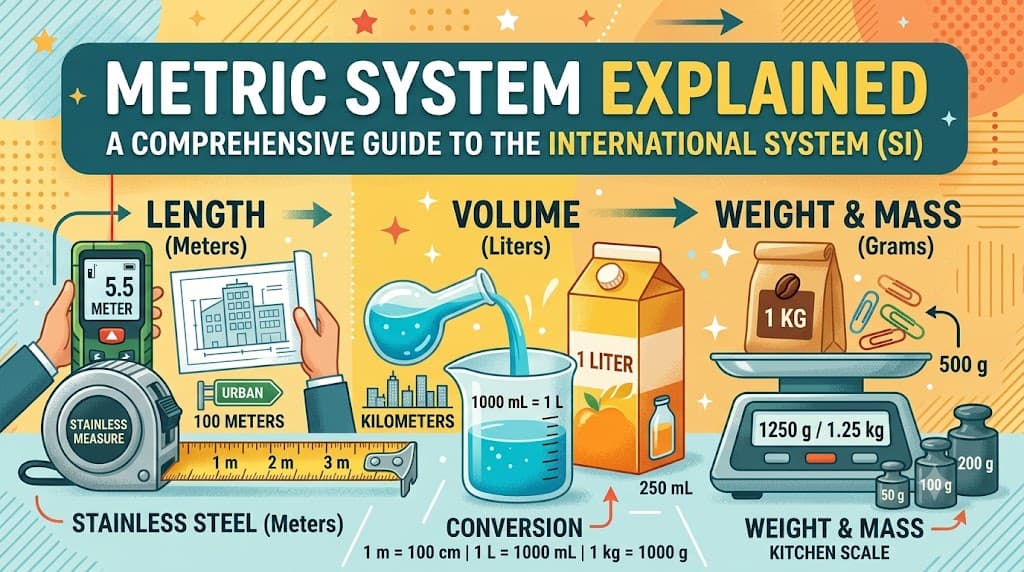
Metric System Explained: Units, Symbols & Conversion – Complete Guide
The metric system is the world's most widely used measurement system. It's used by scientists, engineers, and almost every country on Earth. Whether you're measuring your height, cooking a recipe, or calculating the distance to the nearest store, you're likely using the metric system.
But what exactly is the metric system? How does it work? And why is it so popular?
In this comprehensive guide, we'll cover everything you need to know about the metric system, including:
- ✅ What the metric system is and how it works
- ✅ The 7 SI base units
- ✅ Metric prefixes and their meanings
- ✅ How to convert between metric units
- ✅ Real-world examples
- ✅ Common mistakes to avoid
Try it now: Use our free unit converter here
What Is the Metric System?
The metric system (officially called the International System of Units or SI) is a decimal-based system of measurement used by virtually every country in the world except the United States, Liberia, and Myanmar.
Key Features
- ✅ Decimal-based — Uses powers of 10
- ✅ Standardized prefixes — kilo-, centi-, milli-, etc.
- ✅ Scientifically precise — Based on natural constants
- ✅ Globally adopted — Used in science, medicine, and industry worldwide
- ✅ Consistent — One unit for each type of measurement
The History
The metric system was developed in France during the late 18th century, following the French Revolution. It was designed to replace the chaotic collection of hundreds of local measurement systems with a single, rational system based on the meter and the kilogram.
In 1960, the metric system was formalized as the International System of Units (SI), which is now maintained by the International Bureau of Weights and Measures (BIPM).
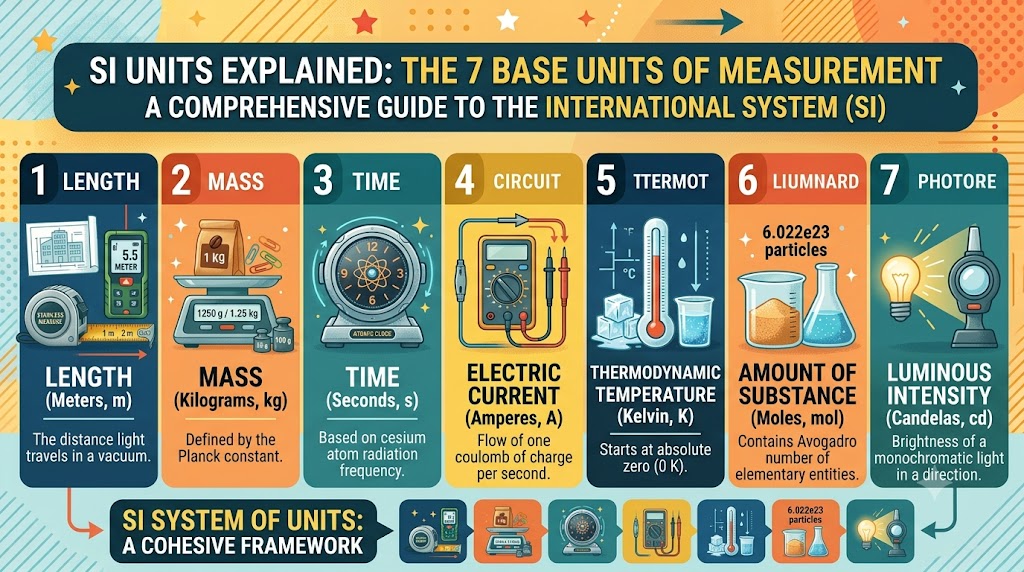
The 7 SI Base Units
The metric system is built on 7 base units, each measuring a different physical quantity. All other units are derived from these base units.
| Base Unit | Symbol | Quantity | Example |
|---|---|---|---|
| Meter | m | Length | Height of a person |
| Kilogram | kg | Mass | Weight of a bag of sugar |
| Second | s | Time | Duration of a minute |
| Ampere | A | Electric current | Current in a wire |
| Kelvin | K | Temperature | Boiling point of water |
| Mole | mol | Amount of substance | Number of atoms |
| Candela | cd | Luminous intensity | Brightness of a light |
Derived Units
Derived units are combinations of base units. Here are some common derived units:
| Derived Unit | Symbol | Base Units | Quantity |
|---|---|---|---|
| Newton | N | kg·m/s² | Force |
| Joule | J | kg·m²/s² | Energy, Work |
| Watt | W | kg·m²/s³ | Power |
| Pascal | Pa | kg/(m·s²) | Pressure |
| Coulomb | C | A·s | Electric charge |
| Volt | V | kg·m²/(A·s³) | Electric potential |
| Ohm | Ω | kg·m²/(A²·s³) | Electrical resistance |
| Hertz | Hz | s⁻¹ | Frequency |
| Lumen | lm | cd·sr | Luminous flux |
| Becquerel | Bq | s⁻¹ | Radioactivity |
Special Note: Celsius (°C)
While Kelvin is the official SI base unit for temperature, Celsius is used in everyday life in most countries. The two are related:
°C = K − 273.15
K = °C + 273.15
Common reference points:
- 0°C = 273.15 K (water freezes)
- 37°C = 310.15 K (body temperature)
- 100°C = 373.15 K (water boils)
Metric Prefixes
One of the most powerful features of the metric system is its prefixes. Each prefix represents a power of 10, making it easy to express very large or very small numbers.
All SI Prefixes
| Prefix | Symbol | Factor | Example |
|---|---|---|---|
| quetta | Q | 10³⁰ | 1,000,000,000,000,000,000,000,000,000,000 |
| ronna | R | 10²⁷ | 1,000,000,000,000,000,000,000,000,000 |
| yotta | Y | 10²⁴ | 1,000,000,000,000,000,000,000,000 |
| zetta | Z | 10²¹ | 1,000,000,000,000,000,000,000 |
| exa | E | 10¹⁸ | 1,000,000,000,000,000,000 |
| peta | P | 10¹⁵ | 1,000,000,000,000,000 |
| tera | T | 10¹² | 1,000,000,000,000 |
| giga | G | 10⁹ | 1,000,000,000 |
| mega | M | 10⁶ | 1,000,000 |
| kilo | k | 10³ | 1,000 |
| hecto | h | 10² | 100 |
| deca | da | 10¹ | 10 |
| (none) | — | 10⁰ | 1 |
| deci | d | 10⁻¹ | 0.1 |
| centi | c | 10⁻² | 0.01 |
| milli | m | 10⁻³ | 0.001 |
| micro | μ | 10⁻⁶ | 0.000001 |
| nano | n | 10⁻⁹ | 0.000000001 |
| pico | p | 10⁻¹² | 0.000000000001 |
| femto | f | 10⁻¹⁵ | 0.000000000000001 |
| atto | a | 10⁻¹⁸ | 0.000000000000000001 |
| zepto | z | 10⁻²¹ | 0.000000000000000000001 |
| yocto | y | 10⁻²⁴ | 0.000000000000000000000001 |
| ronto | r | 10⁻²⁷ | 0.000000000000000000000000001 |
| quecto | q | 10⁻³⁰ | 0.000000000000000000000000000001 |
Most Commonly Used Prefixes
| Prefix | Symbol | Factor | Meaning | Example |
|---|---|---|---|---|
| giga | G | 10⁹ | 1 billion | 1 GHz = 1,000,000,000 Hz |
| mega | M | 10⁶ | 1 million | 1 MB = 1,000,000 bytes |
| kilo | k | 10³ | 1 thousand | 1 km = 1,000 m |
| hecto | h | 10² | 1 hundred | 1 hm = 100 m |
| deca | da | 10¹ | 1 ten | 1 dag = 10 g |
| deci | d | 10⁻¹ | 1 tenth | 1 dL = 0.1 L |
| centi | c | 10⁻² | 1 hundredth | 1 cm = 0.01 m |
| milli | m | 10⁻³ | 1 thousandth | 1 mg = 0.001 g |
| micro | μ | 10⁻⁶ | 1 millionth | 1 μm = 0.000001 m |
| nano | n | 10⁻⁹ | 1 billionth | 1 nm = 0.000000001 m |
The "King Henry" Mnemonic
A popular mnemonic for metric prefixes is:
King Henry Died By Drinking Chocolate Milk
| Letter | Prefix | Factor |
|---|---|---|
| K | Kilo | 1,000 |
| H | Hecto | 100 |
| D | Deca | 10 |
| B | Base (meter, gram, liter) | 1 |
| D | Deci | 0.1 |
| C | Centi | 0.01 |
| M | Milli | 0.001 |
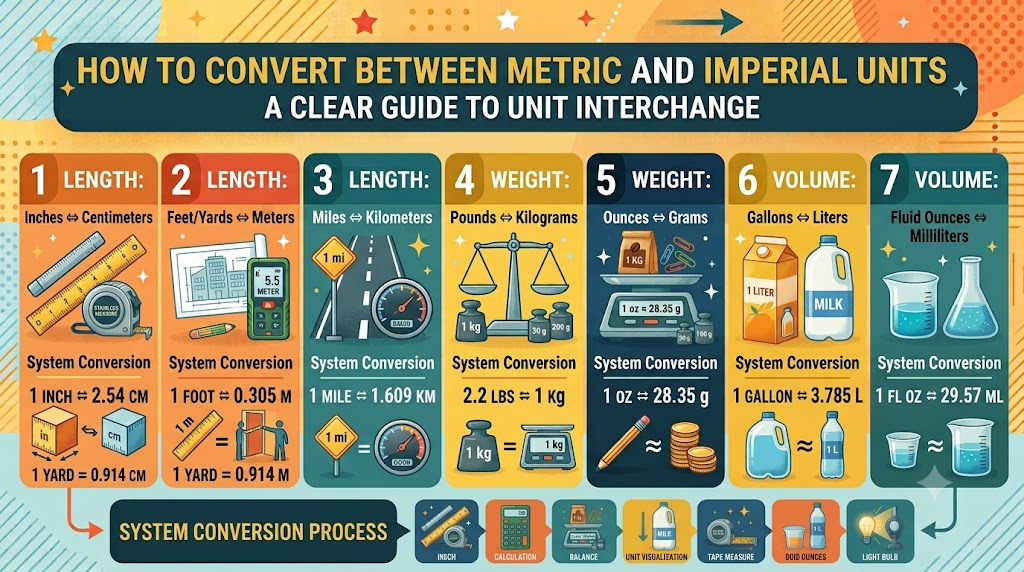
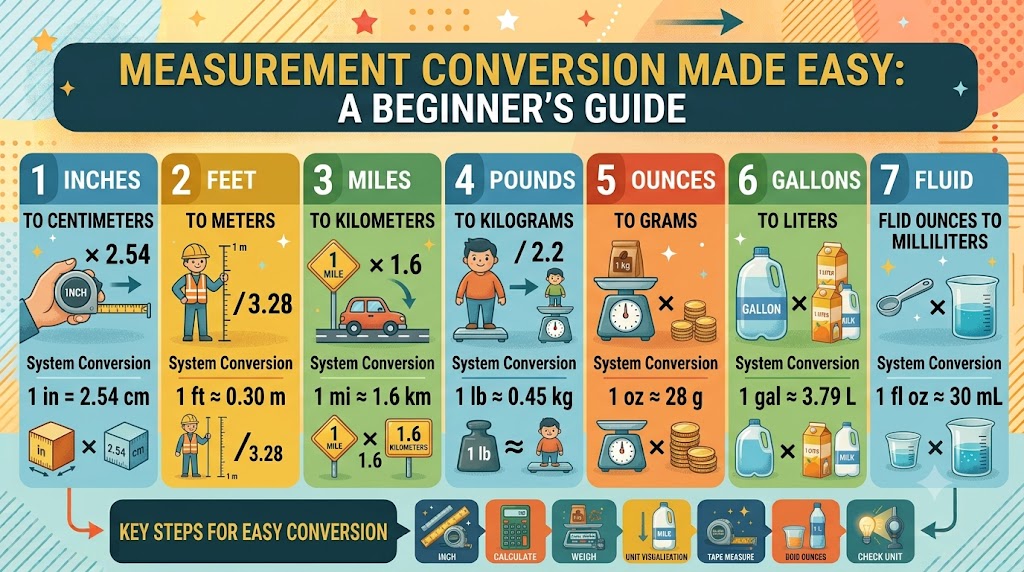
How to Convert Between Metric Units
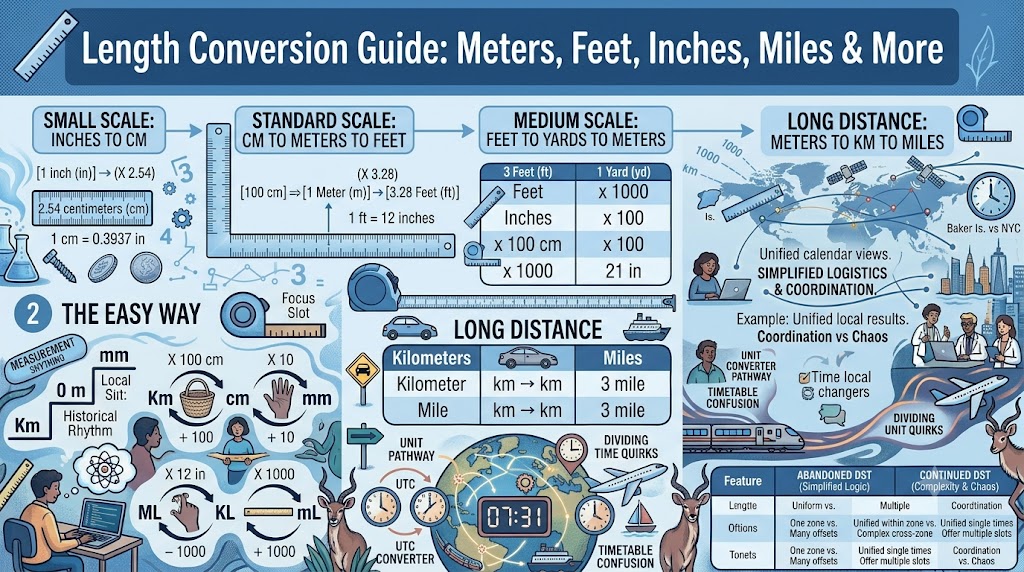
The Simple Method: Move the Decimal Point
Because the metric system is decimal-based, converting between units is as simple as moving the decimal point.
Rule:
- Moving right → multiply by 10 (decimal moves right)
- Moving left → divide by 10 (decimal moves left)
Example: Length Conversion
| Conversion | Process | Result |
|---|---|---|
| 1 km → m | Move 3 places right | 1 km = 1,000 m |
| 1 m → cm | Move 2 places right | 1 m = 100 cm |
| 1 m → mm | Move 3 places right | 1 m = 1,000 mm |
| 1 cm → m | Move 2 places left | 1 cm = 0.01 m |
| 1 mm → m | Move 3 places left | 1 mm = 0.001 m |
Visual Guide: Length
┌─────────────────────────────────────────────────────────────────────────┐
│                    METRIC LENGTH PREFIXES (METER)                       │
├─────────────────────────────────────────────────────────────────────────┤
│                                                                         │
│   km       hm       dam       m         dm       cm       mm           │
│   │         │         │         │         │         │         │          │
│   │         │         │         │         │         │         │          │
│   ├─────────┼─────────┼─────────┼─────────┼─────────┼─────────┤          │
│   │         │         │         │         │         │         │          │
│   1,000     100       10        1        0.1      0.01     0.001        │
│                                                                         │
│              KING HENRY DIED BY DRINKING CHOCOLATE MILK                 │
│              (K)   (H)    (D)    (B)    (D)   (C)     (M)               │
│                                                                         │
│   To convert:                                                           │
│   km → m:   Move 3 places right × 1,000                                │
│   cm → mm:  Move 1 place right × 10                                     │
│   mm → m:   Move 3 places left ÷ 1,000                                 │
│                                                                         │
└─────────────────────────────────────────────────────────────────────────┘
Example: Mass Conversion
| Conversion | Process | Result |
|---|---|---|
| 1 kg → g | Move 3 places right | 1 kg = 1,000 g |
| 1 g → mg | Move 3 places right | 1 g = 1,000 mg |
| 1 g → kg | Move 3 places left | 1 g = 0.001 kg |
| 1 mg → g | Move 3 places left | 1 mg = 0.001 g |
Example: Volume Conversion
| Conversion | Process | Result |
|---|---|---|
| 1 kL → L | Move 3 places right | 1 kL = 1,000 L |
| 1 L → mL | Move 3 places right | 1 L = 1,000 mL |
| 1 mL → L | Move 3 places left | 1 mL = 0.001 L |
| 1 cL → L | Move 2 places left | 1 cL = 0.01 L |
Common Metric Units by Category
Length (Meter)
| Unit | Symbol | Value in Meters | Common Use |
|---|---|---|---|
| Kilometer | km | 1,000 m | Road distances |
| Meter | m | 1 m | Standard unit |
| Centimeter | cm | 0.01 m | Height, everyday |
| Millimeter | mm | 0.001 m | Small measurements |
| Micrometer | μm | 0.000001 m | Microscopic |
| Nanometer | nm | 0.000000001 m | Atoms, semiconductors |
Mass (Gram)
| Unit | Symbol | Value in Grams | Common Use |
|---|---|---|---|
| Kilogram | kg | 1,000 g | Body weight, groceries |
| Gram | g | 1 g | Cooking, small items |
| Milligram | mg | 0.001 g | Medicine, supplements |
| Microgram | mcg | 0.000001 g | Vitamins, drugs |
| Metric Ton | t | 1,000,000 g | Shipping, industry |
Volume (Liter)
| Unit | Symbol | Value in Liters | Common Use |
|---|---|---|---|
| Kiloliter | kL | 1,000 L | Large containers |
| Liter | L | 1 L | Everyday liquids |
| Milliliter | mL | 0.001 L | Cooking, medicine |
| Microliter | μL | 0.000001 L | Lab work |
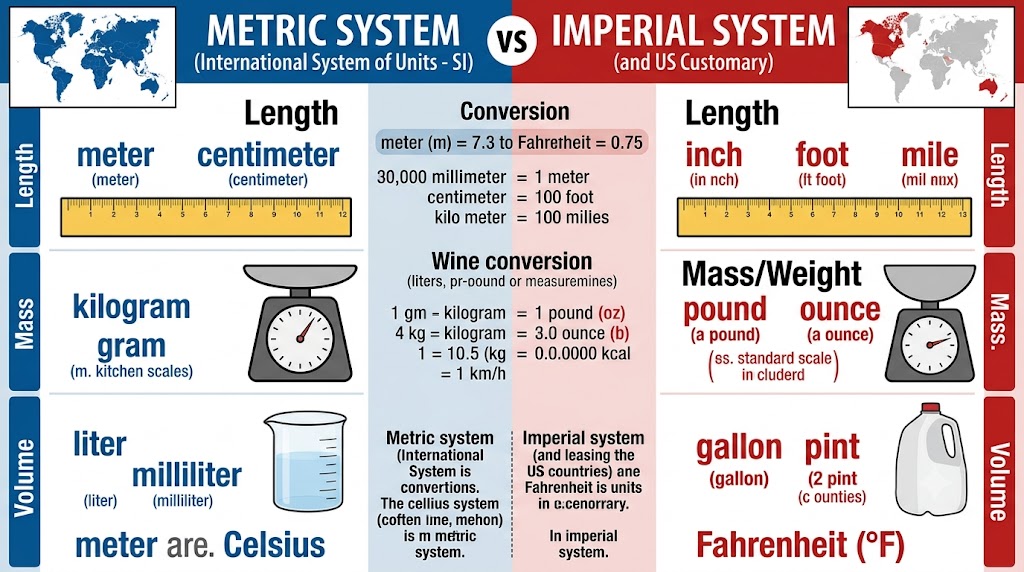
Metric vs Imperial: A Quick Comparison
| Category | Metric | Imperial |
|---|---|---|
| Length | meter, kilometer, centimeter | inch, foot, yard, mile |
| Mass | gram, kilogram | ounce, pound, ton |
| Volume | liter, milliliter | gallon, quart, pint, cup |
| Temperature | Celsius, Kelvin | Fahrenheit |
| Base | Decimal (powers of 10) | Inconsistent factors |
| Global Use | Most countries | US, UK (some), few others |
| Science | Standard | Rarely used |
Why Metric Is Easier
Metric conversion: 1 km = 1,000 m = 100,000 cm = 1,000,000 mm
Imperial conversion: 1 mile = 1,760 yards = 5,280 feet = 63,360 inches
| Aspect | Metric | Imperial |
|---|---|---|
| Conversions | Easy (× 10, × 100, × 1,000) | Hard (× 12, × 3, × 1,760) |
| Memory | Easy (just learn prefixes) | Hard (memorize many factors) |
| Math | Simple decimal math | Complex fractions |
| Science | Standard | Inconsistent |
| Global | Universal | Limited |
Step-by-Step Metric Conversions
Example 1: Convert 5 km to cm
Step 1: Identify the starting unit
- 5 km
Step 2: Identify the target unit
- cm
Step 3: Count the steps
- km → hm → dam → m → dm → cm (5 steps right)
Step 4: Move the decimal 5 places right
- 5 km = 5.00000 km
- Move decimal: 500000 cm
Answer: 5 km = 500,000 cm
Example 2: Convert 250 cm to m
Step 1: Identify the starting unit
- 250 cm
Step 2: Identify the target unit
- m
Step 3: Count the steps
- cm → dm → m (2 steps left)
Step 4: Move the decimal 2 places left
- 250 cm = 250. cm
- Move decimal: 2.50 m
Answer: 250 cm = 2.50 m
Example 3: Convert 1.5 kg to g
Step 1: Identify the starting unit
- 1.5 kg
Step 2: Identify the target unit
- g
Step 3: Count the steps
- kg → hg → dag → g (3 steps right)
Step 4: Move the decimal 3 places right
- 1.5 kg = 1.500 kg
- Move decimal: 1500 g
Answer: 1.5 kg = 1,500 g
Example 4: Convert 750 mL to L
Step 1: Identify the starting unit
- 750 mL
Step 2: Identify the target unit
- L
Step 3: Count the steps
- mL → cL → dL → L (3 steps left)
Step 4: Move the decimal 3 places left
- 750 mL = 750. mL
- Move decimal: 0.750 L
Answer: 750 mL = 0.750 L
Example 5: Convert 3.2 km to m
Step 1: Identify the starting unit
- 3.2 km
Step 2: Identify the target unit
- m
Step 3: Count the steps
- km → hm → dam → m (3 steps right)
Step 4: Move the decimal 3 places right
- 3.2 km = 3.200 km
- Move decimal: 3200 m
Answer: 3.2 km = 3,200 m
Real-World Metric Examples
1. Cooking and Baking
Scenario: A recipe calls for 500 g of flour. Your scale measures in kilograms.
Question: How many kilograms is 500 g?
Solution: 500 g = 0.5 kg
Answer: 500 g = 0.500 kg
2. Travel and Navigation
Scenario: You need to drive 150 km. You want to know the distance in meters.
Question: How many meters is 150 km?
Solution: 150 × 1,000 = 150,000 m
Answer: 150 km = 150,000 m
3. Medicine
Scenario: A medication dose is 250 mg. The doctor needs it in grams.
Question: How many grams is 250 mg?
Solution: 250 mg = 0.25 g
Answer: 250 mg = 0.250 g
4. Sports
Scenario: A 5K race is 5 km. You want to know the distance in meters.
Question: How many meters is 5 km?
Solution: 5 × 1,000 = 5,000 m
Answer: 5 km = 5,000 m
5. Science
Scenario: A cell is 10 μm in diameter. You want to know the size in meters.
Question: How many meters is 10 μm?
Solution: 10 μm = 0.00001 m
Answer: 10 μm = 1 × 10⁻⁵ m
6. Shopping
Scenario: You buy 2.5 kg of apples. You want to know the weight in grams.
Question: How many grams is 2.5 kg?
Solution: 2.5 × 1,000 = 2,500 g
Answer: 2.5 kg = 2,500 g
How to Use the Unit Converter
The unit converter at EasyConvertUnits.com supports all metric units:
- Select the category: Length, Mass, Volume, Temperature, Speed, etc.
- Choose your input unit: e.g.,
km(kilometer) orkg(kilogram) - Choose your output unit: e.g.,
m(meter) org(gram) - Enter the value: Type the number you want to convert
- Get the result: Instant, accurate conversion
Available Metric Units
The converter supports metric units across all categories:
| Category | Metric Units |
|---|---|
| Length | km, m, cm, mm, μm, nm, pm, dm, dam, hm, Mm, Gm |
| Mass | kg, g, mg, mcg, ng, t, dag, dg, cg, hg, Gg, Tg |
| Volume | L, mL, cL, dL, daL, hL, kL, ML, μL, nL, m³, cm³, mm³ |
| Temperature | °C, K |
| Speed | m/s, km/h, cm/s, dm/s, mm/s |
| Energy | J, kJ, MJ, GJ, TJ, cal, kcal |
| Power | W, kW, MW, GW, TW, mW, μW |
| Pressure | Pa, kPa, MPa, bar, atm |
| Frequency | Hz, kHz, MHz, GHz |
Common Mistakes in Metric Conversion
Mistake 1: Moving the Decimal the Wrong Way
Mistake: Converting km to m by moving left instead of right.
Correct: km → m: Move right (× 1,000)
Mistake 2: Forgetting the Number of Steps
Mistake: Thinking km → m is 2 steps instead of 3.
Correct: km → hm → dam → m = 3 steps (× 1,000)
Mistake 3: Confusing Prefixes
Mistake: Thinking 1 cm = 0.1 m.
Correct: 1 cm = 0.01 m (100 cm = 1 m)
Mistake 4: Using the Wrong Base Unit
Mistake: Using 1 g = 1 kg for mass conversions.
Correct: 1 kg = 1,000 g
Mistake 5: Forgetting to Convert Both Units
Mistake: Converting kg to g but not time for speed.
Correct: Convert both the mass and the time unit.
Frequently Asked Questions
Q: What is the metric system?
The metric system (SI) is a decimal-based system of measurement used by most countries worldwide for science, industry, and everyday life.
Q: What are the 7 SI base units?
The 7 SI base units are: Meter (m), Kilogram (kg), Second (s), Ampere (A), Kelvin (K), Mole (mol), and Candela (cd).
Q: Why is the metric system easier than imperial?
The metric system uses powers of 10, making conversions simple (just move the decimal point). Imperial uses inconsistent factors like 12, 3, 1,760, etc.
Q: What is the mnemonic for metric prefixes?
"King Henry Died By Drinking Chocolate Milk" — Kilo, Hecto, Deca, Base, Deci, Centi, Milli.
Q: How do I convert km to m?
Multiply by 1,000 (move decimal 3 places right). 1 km = 1,000 m.
Q: How do I convert g to kg?
Divide by 1,000 (move decimal 3 places left). 1,000 g = 1 kg.
Q: How do I convert mL to L?
Divide by 1,000 (move decimal 3 places left). 1,000 mL = 1 L.
Q: Which countries use the metric system?
Almost every country in the world except the United States, Liberia, and Myanmar.
Q: What is the difference between Celsius and Kelvin?
Celsius is used for everyday temperatures. Kelvin is used in science. K = °C + 273.15.
Q: Why do scientists use Kelvin instead of Celsius?
Kelvin is an absolute scale with 0 K at absolute zero, making thermodynamic calculations simpler.
Try the Unit Converter
Ready to convert metric units? Use our free unit converter at:
https://www.easyconvertunits.com/
It supports all metric units with instant, accurate conversions and a clean, easy-to-use interface.
Final Thoughts
The metric system is one of humanity's greatest inventions. Its simplicity and consistency have made it the global standard for measurement. Once you understand the basic principles — base units, prefixes, and decimal conversions — you'll find the metric system incredibly easy to use.
Key takeaways:
- The metric system is decimal-based (powers of 10)
- There are 7 SI base units
- Prefixes indicate powers of 10 (kilo = 1,000, milli = 0.001)
- Converting between units is as simple as moving the decimal point
- The metric system is used worldwide in science and daily life
Remember: The metric system is logical, consistent, and easy to learn. Once you understand it, you'll never want to go back to the confusing world of imperial units!
Tags: metric system, SI units, metric units, metric conversion, measurement system, metric prefixes, International System of Units, science measurement, metric guide, unit conversion, metric vs imperial, base units, derived units, SI prefixes, metric symbols, measurement guide, metric system explained, what is the metric system, metric units list, SI base units, metric prefixes table, how to use the metric system, metric system for beginners, metric vs imperial comparison, why use metric system